
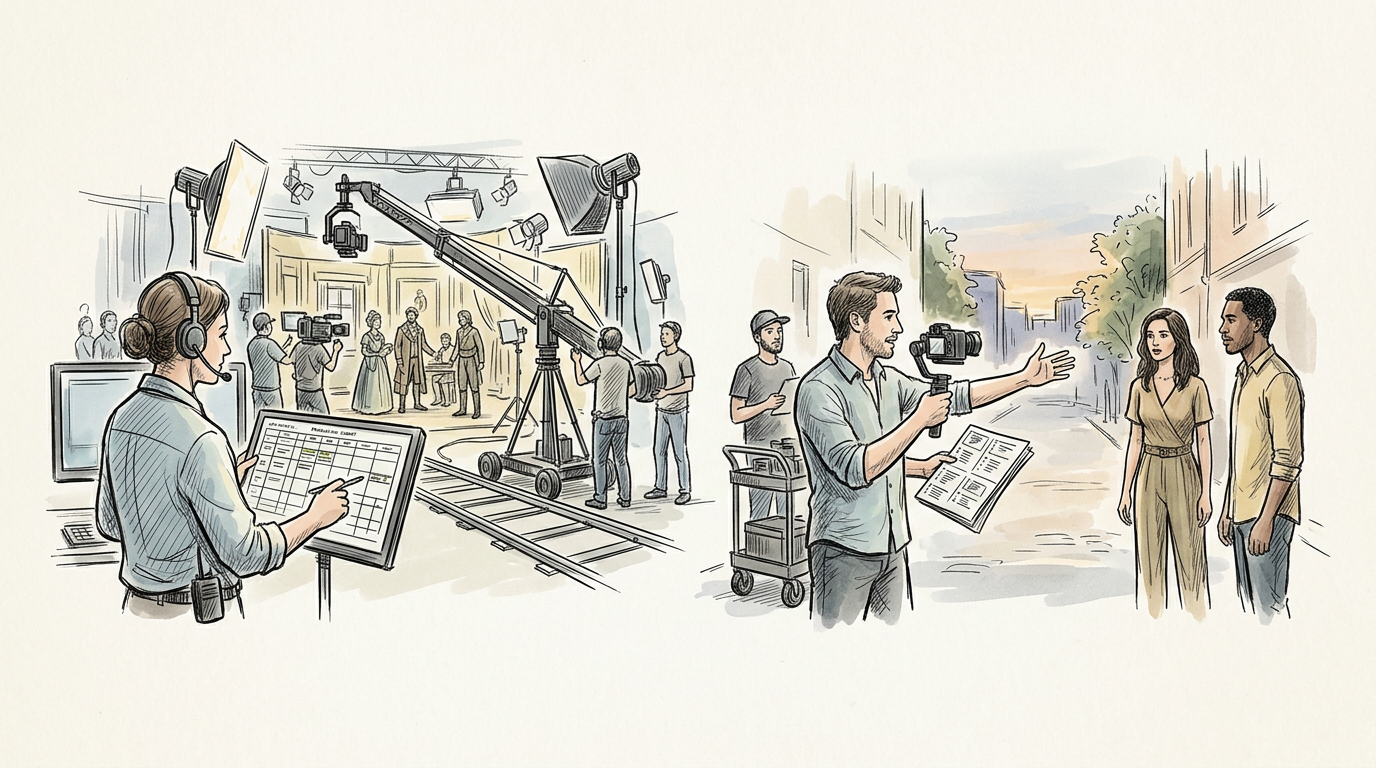
Production budgets influence creative work long before a crew is booked or a location is secured. They shape what kind of idea gets approved, how a script is written, what can be shown on screen, how many versions can be produced, and whether the final execution feels precise, generic, intimate, cinematic, or unfinished. Yet budget is often discussed as if it enters the process only after the “real” creative decisions have been made. In practice, money is part of the creative system from the start.
That reality matters because advertising and marketing teams still fall into two predictable mistakes. One is assuming that more money naturally produces better creative. The other is treating budget as a late-stage constraint that ruins otherwise strong ideas. Both views are simplistic. Higher spend can expand options, improve craft, and increase flexibility, but it can also finance complexity that weakens clarity. A limited budget can narrow execution choices, but it can also force sharper thinking, stronger prioritization, and more disciplined brand communication.
Strong creative work does not ignore budget. It uses budget as a design condition.
Budget is not just a production issue
When teams say a project has a “production budget,” they are usually referring to visible line items such as director, crew, cast, location fees, equipment, wardrobe, set construction, music licensing, editing, color, sound mix, VFX, photography, animation, or versioning. Those costs matter, but the budget question begins earlier. The strategic issue is not simply what the team can afford to make. It is what form of idea can be expressed persuasively within the available resources and in the right media.
A campaign concept that depends on celebrity recognition, large-scale stunts, heavy visual effects, or multiple international locations is not merely expensive in execution. It is expensive in concept. By contrast, an idea built around a product truth, a distinctive visual system, strong writing, or a repeatable demonstration mechanism may be far more scalable across media and markets.
This is where creative strategy and execution need to stay distinct. Strategy defines what the communication must achieve and what audience understanding or response matters. Execution determines how to realize that strategy through copy, image, sound, sequence, and format. Budget affects execution directly, but it also affects whether a concept is viable enough to carry the strategy at all.
A useful creative team asks several budget-aware questions early:
- Does the idea require expensive elements, or is it flexible about how it is expressed?
- Which executional choices are essential to the strategic proposition, and which are merely desirable?
- Can the concept survive in more than one production scenario?
- Will lower-cost adaptations preserve the idea, or will they expose that the idea was mostly spectacle?
- Does the media plan require many assets and versions, making breadth more valuable than a single hero execution?
Those questions do not lower creative ambition. They protect it.
The most expensive choice is often complexity
Budget pressure is commonly framed in terms of unit costs: a well-known actor versus a nonprofessional cast, one location versus three, custom music versus stock, practical build versus green screen. But many costs are driven less by prestige than by complexity. Every additional setup, script beat, prop, costume change, effect, location move, aspect ratio, language adaptation, and stakeholder approval path adds time and cost. Complexity also raises the risk that the work loses coherence.
For creative teams, this has direct implications for concept development. A script with six scenes may not be stronger than one scene if the central idea is understood in the first five seconds. An art-directed still-life campaign can outperform a sprawling lifestyle shoot if the objective is to make a product attribute legible and memorable. A sharp line of copy can carry a social post more effectively than custom animation if the audience is already familiar with the brand and only needs a timely reason to care.
Production value is useful when it adds meaning, credibility, mood, or attention appropriate to the brief. It is wasteful when it decorates a weak proposition or obscures the message under technique.
Locations are strategic, not just scenic
Location decisions offer a clear example of how money and meaning interact. A real location can add texture, specificity, and social credibility. It can also introduce permits, travel, sound issues, weather risk, limited control, and schedule delays. A studio build or controlled interior may feel less spontaneous, but it can give the team tighter command over lighting, timing, continuity, and layout.
The creative question is not whether real-world environments are inherently better. It is whether the location choice helps communicate the intended idea to the intended audience.
If the strategy depends on authenticity, community recognition, or documentary-style observation, an actual location may matter. If the work depends on graphic precision, repeatable product demonstration, or heavy versioning across product lines, a controlled set may be the wiser creative choice. If a campaign is meant to depict scale, aspiration, or physical challenge, travel may be justified. If the point is convenience, affordability, or everyday utility, a highly produced destination setting can actively undermine the message.
Budget disciplines this decision. It forces teams to ask what the environment contributes beyond visual appeal. That often leads to stronger work, because scenic attractiveness is not the same as strategic relevance.
Talent choices affect tone, memory, and cost structure
Talent decisions are often reduced to a false binary between celebrity and non-celebrity. The real range is broader: trained actors, improvisers, creators, customers, employees, voice actors, domain experts, athletes, musicians, and ordinary people cast for look, skill, or credibility. Each option changes not only cost but also tone, audience expectation, production pace, legal complexity, and brand linkage.
A celebrity can deliver instant attention and cultural relevance, but only if the person strengthens the message rather than absorbing it. The cost is not just the fee. It includes availability, approvals, insurance, scheduling pressure, usage restrictions, and often the need to build the execution around the individual. This can make versioning and adaptation harder. It can also shift evaluation criteria internally, with stakeholders focusing on the talent relationship rather than the communication problem.
At the other end, unknown or real people can bring a level of specificity or believability that fits categories such as healthcare, financial services, retail, B2B, or local marketing. Lower cost does not automatically mean lower quality. It may mean the team can afford more shooting time, more variants, or more postproduction polish where it matters.
Voice talent follows similar logic. Distinctive voice work can elevate audio, video, and social formats, but the right voice is not always the most famous one. For many brands, consistency of tone across assets matters more than recognizability on a single spot.
The creative standard should be fit, not status. Who or what does the audience need to believe, notice, or remember?
Effects, animation, and motion craft should solve communication problems
Visual effects and animation often get treated as luxury upgrades. Sometimes they are. Sometimes they are the clearest and most efficient way to communicate.
Animation can explain invisible systems, product features, software workflows, scientific processes, and data relationships that would be costly or confusing to capture live. It can also create a repeatable visual language for campaigns requiring many versions across channels. In those cases, animation may be a strategically efficient choice, not a compromise.
The tradeoff is that different forms of animation communicate differently. Simple motion graphics can deliver clarity and speed but may offer limited emotional range. Character animation can create warmth and storytelling flexibility but requires more development. High-end 3D may help demonstrate product form or technical detail, but it can quickly consume budget without improving understanding if the audience only needs a straightforward message.
VFX decisions work the same way. If the effect is central to the proposition, such as visualizing a product benefit, transforming scale, or making a comparison legible, it may be worth the investment. If the effect merely adds visual novelty, it can distract from brand linkage and compress the budget available for more important needs such as edit time, sound design, or cutdowns.
This is where creative leadership matters. Teams need someone willing to ask whether a technique is carrying meaning or only carrying cost.
Music is a creative choice with budget consequences
Music shapes pace, emotion, memory, and brand character. It also has one of the widest possible price ranges in production. A global hit can consume a substantial portion of a campaign budget. A custom score can be tailored precisely but requires time, talent, and rounds of revision. Production music libraries offer speed and affordability but may reduce distinctiveness if used generically.
The strategic issue is what role music plays in the work. If the execution depends on cultural recognition or lyrical resonance, a known track may materially change how the audience receives it. If music is there primarily to support mood and rhythm, original composition or well-selected library music may do the job better and more flexibly.
Licensing also affects media and geography. A music choice that works for a domestic campaign may become prohibitively complicated for international use, social extensions, or long-tail content needs. Creative teams that ignore these realities can end up presenting work whose emotional engine disappears when the licensed track cannot be cleared broadly enough.
Budget-smart creative teams therefore discuss music earlier than many do. They ask whether the concept survives without the exact song everyone is imagining. If not, the music is not an accessory. It is part of the idea and should be budgeted and defended as such.
Photography budgets shape visual systems, not just image quality
Still photography often suffers from budget discussions that focus narrowly on shoot-day quality. In reality, the bigger question is how photography supports the broader communication system.
A campaign may need hero imagery, e-commerce assets, retailer crops, paid social variants, out-of-home extensions, web banners, PR stills, and internal brand library images. In that context, the creative value of a photography budget lies not only in lighting, set styling, and retouching, but in planning for reuse, consistency, and adaptability.
A smaller budget may lead a team toward a simpler visual system with controlled framing, repeatable compositions, limited props, and modular backgrounds. That can be a strength. A larger budget may allow more elaborate lifestyle scenes or bespoke set builds, but if those images cannot be efficiently repurposed across channels, the campaign may become visually rich yet operationally weak.
Art direction is central here. The best photography budgets are not spent only on making individual images attractive. They are spent on establishing a visual hierarchy that aligns with audience attention and platform needs: where the product sits, how text overlays will work, whether hands or faces are necessary, how brand colors enter the frame, and how much negative space future versions require.
That is creative discipline, not thrift.
Set design and props can sharpen the idea or dilute it
Set design is one of the easiest places for teams to confuse elaboration with effectiveness. Rich environments can communicate category cues, social context, aspiration, craft, and period detail. They can also crowd a message, add approval friction, and absorb money that would be better spent on performance, demonstration, or edit flexibility.
The right question is whether the set is doing communicative work. In a food campaign, surfaces, utensils, steam, garnish, and background treatment may materially affect appetite appeal and brand positioning. In a home-services spot, the set may need to signal realism and problem recognition more than style. In B2B or technology advertising, a highly designed environment can either clarify innovation or make the product feel abstract and detached from actual use.
Budget often improves creative judgment by forcing prioritization. Teams decide which environmental details carry the message and which are decorative. When that discipline is absent, campaigns sometimes look expensive without becoming clearer.
Crew size affects options, speed, and confidence
Not every budget discussion is visible in the final frame. Crew size can profoundly affect what is possible on set and how confidently a team can pursue performance, precision, and adaptation.
A larger crew can mean stronger specialization: more lighting control, art support, camera movement, sound quality, script supervision, digital asset management, and on-set problem solving. That can be essential for complex productions, especially when many deliverables must be captured in limited time. A smaller crew can reduce cost, move faster, and feel less intrusive, which may help documentary-style shooting or social-first content.
Neither model is inherently superior. The fit depends on the idea. If the concept relies on nuanced acting, difficult product handling, or multiple lighting conditions, under-crewing can damage creative quality more than viewers ever notice explicitly. If the concept depends on spontaneity or access in real environments, over-crewing can damage authenticity.
From a creative management standpoint, crew decisions also affect morale and review quality. If the team is stretched too thin, they may accept weaker takes, compromise composition, or skip useful alternates. What looks like a production saving can become an expensive creative loss in post.
Postproduction is where many budget assumptions fail
Creative teams often fight hardest over shoot budgets because the costs are tangible and visible. Postproduction, by contrast, is where many ideas are actually completed. Editing, color correction, sound design, mix, graphics, retouching, conform, localization, accessibility work, and versioning all shape the communication outcome.
A beautifully shot campaign can underperform if the edit buries the selling point, the supers are unreadable, the pacing is wrong for platform behavior, the sound mix reduces intelligibility, or the brand appears too late. Conversely, modest footage can become significantly stronger through disciplined editing and clear graphic structure.
Budget decisions in post are especially consequential in multi-channel work. If a campaign requires six-second, fifteen-second, vertical, square, silent autoplay, language-specific, and retailer-specific versions, the team needs enough editorial and design resources to preserve coherence across all of them. Otherwise, the hero asset gets attention while the actual working media deteriorates into rushed adaptations.
This is one reason “spend it all on the shoot” is poor creative management. Many campaigns live or die in the adaptation layer.
Higher budgets can improve craft, but they can also hide weak ideas
It is worth saying plainly: more money can produce better work. It can buy time for concept development, stronger casting, more exacting production design, better cinematography, more editorial options, cleaner sound, and more durable assets. Budget should not be romanticized as irrelevant.
The problem comes when teams treat scale as proof of quality. Production craft can create a persuasive first impression inside review rooms. It can make work feel resolved before the underlying idea has been tested against the brief. It can also protect weak strategic choices because objections become harder to voice once substantial resources have been committed.
This is especially common when a concept depends heavily on mood. Beautiful imagery, licensed music, and polished motion can create emotional confidence among decision-makers even when the proposition is vague, the product role is thin, or the audience takeaway is uncertain. The opposite can also happen: a rough but strategically sharp idea may be undervalued because stakeholders cannot see past the lack of finish in early stages.
Strong creative review processes help correct this. Teams should evaluate concepts before expensive execution makes them harder to question, while also allowing enough context that strong low-fidelity ideas are not dismissed unfairly.
Lower budgets can produce stronger creative discipline
Budget constraints can improve the work when they force creative choices that align more closely with strategy. A limited production scenario often leads teams to simplify narrative structure, focus on one message, sharpen product demonstration, write more precisely, and develop modular visual systems that travel across media.
That does not mean scarcity is inherently beneficial. Chronic underfunding can lead to repetitive templates, exhausted teams, weaker testing, limited experimentation, and quality problems that hurt brands over time. But within a given project, reasonable constraints can expose what the idea really is.
Many enduring ad formats are budget-efficient not because they are cheap, but because they are structurally strong. A product demonstration. A testimonial with clear proof. A visual comparison. A repeatable art-directed template. A distinctive voice-led audio concept. A typographic system that turns a message into recognizable branded communication. These approaches can scale because the idea is doing the work, not because the production is carrying it.
Creative briefs should acknowledge budget reality without narrowing the thinking too early
A good brief clarifies the communication problem, audience, objective, proposition, support, and constraints. Budget belongs in that conversation, but how it is introduced matters.
If budget is used too early as a veto on all but the safest ideas, teams may never explore stronger approaches that could be produced intelligently. If budget is omitted entirely, creative development may drift toward executions the organization cannot support, leading to late-stage compromise that weakens the work.
The brief should therefore indicate the approximate scale, asset needs, and operational realities that affect concept viability. For example, the team may need a campaign that can work in stills and short video, support multiple product variants, avoid music licensing complexity, or be produced without travel. Those constraints are useful when they are framed as design conditions rather than prohibitions.
That kind of briefing helps creatives develop ideas with production logic built in.
Presentation matters when budget affects concept evaluation
Creative teams presenting work at different budget levels need to explain what decision-makers are actually choosing. If one route depends on a premium location, custom score, and extensive postproduction while another depends on a simpler performance-led execution, the distinction should not be framed as “bigger” versus “smaller.” It should be framed in terms of strategic effect, audience experience, production implications, and media utility.
Decision-makers need to understand the tradeoffs clearly:
- What does the added spend buy creatively?
- Does it increase comprehension, emotional impact, distinctiveness, or flexibility?
- What risks come with the more complex route?
- What does the lower-cost route preserve or improve?
- How will each option perform across required channels and versions?
This approach improves approval quality because it shifts the conversation away from taste and toward consequence.
Some of the most important budget choices happen in versioning
Modern campaigns rarely end with a single asset. They require adaptations for platform, duration, audience segment, retail partner, language, geography, and format. Yet versioning is often treated as a mechanical afterthought rather than a creative planning issue.
This is where budgets quietly shape effectiveness. If the money is spent entirely on one flagship video, the campaign may have little left to create strong cutdowns, statics, vertical edits, or localizations. The result is common across the industry: a polished hero piece supported by compromised working assets that carry the real media weight.
Smarter budgeting treats versioning as part of the concept architecture. Can the idea be broken into short units? Can the shoot capture modular components? Can the copy platform flex by audience or offer? Can the design system hold together without the full-length film? Can stills and motion be captured simultaneously with enough planning to protect both?
Creative teams that understand these questions are more likely to produce work that survives contact with actual media plans.
Measuring creative quality requires more than noticing production value
When teams assess whether work succeeded, production craft should be evaluated in relation to the objective. Did the execution earn attention? Clarify the proposition? Increase brand linkage? Improve emotional fit? Support response? Enable efficient adaptation? Strengthen long-term memory structures?
Sometimes higher spend helps achieve those outcomes. Sometimes it does not. A costly film that viewers enjoy but misattribute is not stronger because it looks premium. A simple social video that clearly demonstrates a product benefit and drives qualified response is not weaker because it was produced leanly.
Research on creative effectiveness consistently points back to fundamentals such as attention, memory, distinctiveness, clarity, emotional resonance, and brand linkage rather than cost alone. The World Advertising Research Center’s discussions of creative effectiveness, for example, regularly emphasize that effective work depends on how well the creative idea is expressed and connected to brand and audience, not on production expense by itself (warc.com). Industry analysis from the IPA’s work on effectiveness has similarly reinforced that creative quality and strategic coherence are central drivers of results, while executional scale is only valuable when it serves those ends (ipa.co.uk).
For practitioners, the practical lesson is straightforward. Production value should be judged as a means, not an outcome.
What creative leaders need to manage
Budget-aware creativity is not only a skill for producers. It is a leadership responsibility across creative, strategy, account, and client teams.
Creative leaders need to protect ideas from avoidable production mismatch. That means encouraging ambition while insisting on executional realism. It means helping writers and art directors understand cost drivers without making them timid. It means involving producers early enough that feasibility informs concept shaping instead of destroying it late. It means resisting both vanity spend and false economy. And it means teaching teams to articulate why a given line item matters creatively.
Client leaders have parallel responsibilities. If they want adaptable, high-performing campaigns, they need to fund not only hero moments but also the less glamorous craft of postproduction, accessibility, versioning, and asset management. They also need to avoid late strategic changes that waste budget and force salvage operations in execution.
The healthiest teams do not separate “creative ambition” from “budget discipline.” They combine them.
Better work comes from intelligent fit
The most useful way to think about production budgets is not as a ladder from low quality to high quality. It is as a set of tradeoffs among clarity, flexibility, craft, speed, scale, and distinctiveness. Every budget level creates both opportunities and constraints. The creative job is to make those conditions legible and then build work that uses them well.
That may mean spending heavily because the strategy genuinely requires cinematic immersion, difficult demonstration, or a durable multi-market asset library. It may mean choosing a more contained execution because the message benefits from precision and repeatability. It may mean reducing locations to protect postproduction. It may mean skipping celebrity to preserve versioning flexibility. It may mean writing a sharper script because no amount of visual finish will rescue a confused proposition.
Strong advertising and marketing creative does not prove its value by how much it cost to make. It proves its value by how intelligently the idea, the craft, and the spending align.
Leave a Reply