
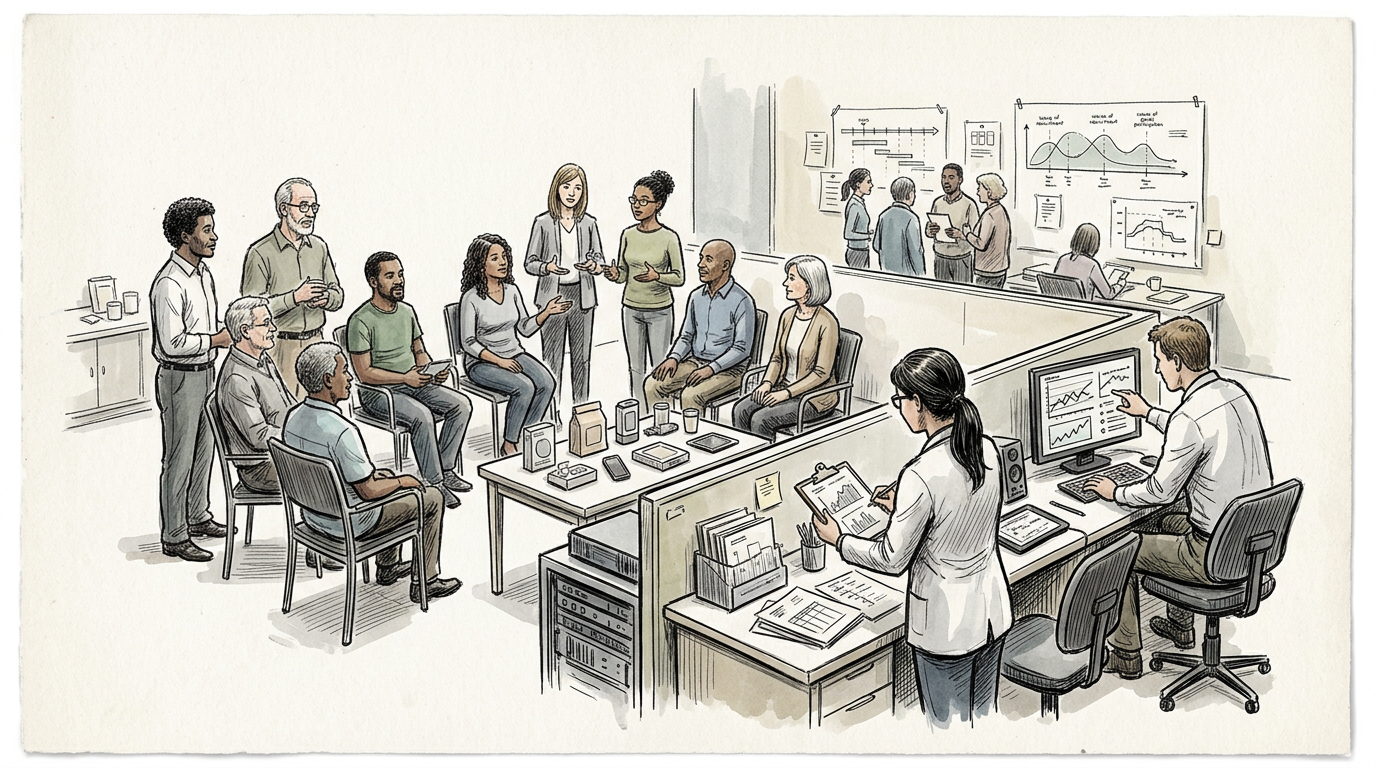
Brand leaders rely on research panels constantly, even when the term itself stays in the background. Brand trackers, concept tests, message diagnostics, packaging studies, customer experience monitoring, ad pretesting, reputation research, and longitudinal equity studies often depend on some form of panel-based sample. For branding professionals, that matters because panels shape how organizations interpret awareness, familiarity, trust, consideration, distinctiveness, and change over time. If the panel is poorly recruited, overused, unrepresentative, or insufficiently controlled, the resulting data can distort strategic decisions about positioning, identity, naming, portfolio structure, or rebranding.
Panels are useful precisely because they make repeated measurement possible. They allow researchers to return to a known pool of respondents, often quickly and at relatively low cost, to observe shifts in recognition, associations, attitudes, and behaviors. But that strength can create confusion. A panel is not automatically a miniature version of the population. It is a managed pool of people who have agreed to participate in research, and its usefulness depends on how that pool was built, maintained, screened, weighted, and interpreted.
For branding teams, understanding how panels work is less a technical side issue than a strategic necessity. Brands are managed over time. Panels are one of the main instruments used to detect whether a brand is becoming more salient, more trusted, more differentiated, more confusing, or less culturally resonant. Knowing what the instrument can and cannot tell you is part of responsible brand management.
What a research panel actually is
A research panel is a group of pre-recruited participants who have agreed to take part in future studies. Panels can be broad consumer panels, business-to-business panels, customer panels, patient panels, household panels, media panels, or highly specialized panels built around particular traits or behaviors. Some are owned and operated by research companies, while others are assembled for a specific client or study.
That definition sounds straightforward, but it is worth separating panels from one-off sampling. In a one-time survey, respondents may be freshly recruited for that specific project. In panel research, respondents have an ongoing relationship with the panel operator. They have already supplied profile data, have agreed to be contacted again, and may complete multiple surveys over time. This enables faster fielding and repeated observation, which is especially valuable when brand managers need trend data rather than a single snapshot.
Repeated measurement is central to branding because brands are cumulative systems of meaning. Awareness builds gradually. Distinctive assets gain strength through repeated exposure and memory encoding. Trust and reputation are influenced by accumulated experience, not one isolated interaction. Rebrands rarely reveal their full effects immediately. Panels help researchers examine that gradual movement, which is why they are deeply embedded in brand tracking and equity measurement.
Why branding teams use panels
Panels are particularly useful when the branding question concerns change, consistency, or comparison. A company may want to know whether a new verbal identity improves recognition, whether a packaging redesign weakens shelf identification, whether a brand purpose campaign affects trust, or whether a masterbrand endorsement helps transfer equity to a newly launched offer. Those are not purely creative questions. They are questions about perception, memory, meaning, and long-term brand management.
Panels support this work in several ways:
- They allow repeated tracking of the same metrics over time, including awareness, familiarity, consideration, preference, trust, and usage.
- They can help isolate directional changes after a repositioning, product issue, sponsorship, identity update, or reputation event.
- They can provide access to low-incidence groups, such as luxury buyers, business decision-makers, category rejecters, or recent switchers.
- They often field quickly, which matters when brands need timely diagnostics after a launch or controversy.
- They can support longitudinal designs in which the same respondents are recontacted, making it possible to observe individual-level change as well as aggregate movement.
Those advantages are real. They are also why panels are sometimes overtrusted. Speed and convenience can make panel data appear more definitive than it is. A trend line with monthly numbers looks objective, but brand interpretation still depends on who was recruited, how many dropped out, how the sample was balanced, what incentives were offered, and whether repeated respondents are becoming atypical because they have learned how surveys work.
Recruitment determines what the panel can represent
Any panel begins with recruitment. This is the first and most important source of both value and bias.
Panelists may be recruited through website intercepts, social media ads, email invitations, loyalty programs, affiliate networks, telephone recruitment, address-based sampling, probability-based sampling, app signups, or other channels. Each route reaches somewhat different people. A panel recruited heavily through digital promotions may overrepresent people who are highly online, promotion-responsive, survey-tolerant, or motivated by small rewards. A customer panel may be highly relevant for understanding current users while being useless for estimating category-wide brand awareness among noncustomers.
This distinction matters because brand decisions often require different universes of inference. If a company is refining onboarding communications for existing subscribers, a customer panel may be appropriate. If it is evaluating whether a corporate rebrand has changed reputation among the wider market, relying only on current customers would be too narrow. If it is assessing whether a new naming system travels across regions or generations, recruitment method and coverage become even more important.
The American Association for Public Opinion Research has long distinguished probability-based approaches from nonprobability online panels, noting that recruitment method has major implications for inference and error. Probability-based panels attempt to give members of the target population a known chance of selection, often using address-based sampling or other structured frames. Nonprobability access panels, common in commercial research, rely on volunteers or convenience recruitment. Both can be useful, but they should not be treated as interchangeable.
For branding work, the key question is not whether one method is morally superior. It is whether the recruitment design matches the decision at hand. A nonprobability panel can be entirely suitable for fast concept screening or directional diagnostics. It is less suitable for making unqualified claims that a result represents the general population.
Repeated participation is a feature, but also a source of distortion
The defining advantage of a panel is repeated participation. The same people may complete many studies over weeks, months, or years. This supports longitudinal analysis, especially when brand teams want to know whether movement is durable rather than momentary.
However, repeated participation can also change respondents. In research terminology, this is often discussed as panel conditioning. The idea is simple: people who take many surveys may become more practiced, more attentive to question intent, more sensitized to categories, or more likely to remember previous answers. In some cases, participation itself can affect attitudes or behavior.
This is not merely a statistical footnote. It can affect branding conclusions in important ways. A heavily surveyed participant may notice category attributes that typical consumers barely process. They may become unusually aware of packaging variants, slogans, or architecture cues. They may learn to articulate brand differences more sharply than ordinary buyers do in real-world conditions. If a brand team interprets those refined responses as a faithful measure of marketplace perception, it may overestimate how much consumers actually notice or care about the distinctions the company is making.
Academic research has documented conditioning effects in panel studies, although the size and practical consequence vary by topic and design. The broader implication is that repeated measurement can improve trend visibility while also making respondents less like untouched members of the market. That is not a reason to avoid panels. It is a reason to use them with discipline.
Weighting can improve balance, but it cannot fix everything
Because panel samples rarely mirror a target population perfectly, researchers often weight the data. Weighting adjusts the contribution of respondents so the final sample better aligns with known benchmarks such as age, gender, region, race and ethnicity, education, household income, or other relevant variables. Industry groups such as ESOMAR and insights organizations such as Pew Research Center have published detailed explanations of weighting and the limits of adjustment.
For brand professionals, weighting is often misunderstood. It can improve sample balance. It cannot retroactively erase every problem created by recruitment bias, poor incidence coverage, careless screening, or low-quality responses. If a panel underrepresents light category users, nonbuyers, older consumers with lower digital participation, or culturally distinct subgroups that interpret the brand differently, weighting may reduce some imbalance while leaving deeper distortions intact.
This matters because branding often depends on nonobvious differences in interpretation. A brand refresh may be read as modern and clear by current enthusiasts but as generic and less recognizable by occasional buyers. A naming decision may feel intuitive to insiders and perplexing to newcomers. A premium repositioning may attract high-income segments while alienating mainstream category users who once understood the brand’s role more clearly. Weighting demographic variables does not necessarily solve those perceptual differences if the underlying sample did not adequately capture the relevant groups or behaviors.
In other words, weighted data can be more useful than unweighted data, but weighting should not be treated as a certification stamp that makes panel findings universally representative.
Incentives affect who joins and how they respond
Most panelists receive some form of incentive. That may include cash, points, gift cards, sweepstakes entries, loyalty rewards, or charitable donations. Incentives are not inherently problematic. They are often necessary to recruit and retain participants, particularly for time-consuming studies or hard-to-reach populations.
But incentives shape panel composition. People who are willing to complete repeated surveys for modest rewards may differ from those who are not. If incentives are too weak, the panel may attract only highly motivated enthusiasts or individuals with unusual free time. If incentives are structured poorly, they can encourage speeders, duplicate accounts, or professional respondents who focus more on maximizing survey volume than providing thoughtful answers.
For brand research, incentive structure can influence not only who joins but also how carefully people engage with questions about recognition, associations, or experience. Consider a study evaluating whether a new package design preserves brand identification. If respondents rush through image exposure tasks to reach the reward, apparent recognition levels may not reflect how actual shoppers process the package in store conditions. Similarly, if a panel member has answered many concept surveys, they may learn to infer what kind of answer is expected in a naming or positioning test.
That is why panel quality management involves not just paying people, but paying in a way that supports attentiveness without attracting excessive fraud or straight-line participation.
Attrition changes the panel over time
Panels do not stay stable. People leave. Email addresses go inactive. interest declines. category usage changes. life circumstances shift. Some panelists stop responding altogether, while others become very frequent participants. This process, usually called attrition, has strategic consequences.
A panel that looked balanced at recruitment can become less balanced later if certain groups drop out at higher rates. Younger participants may churn more quickly than older ones. Heavy category users may remain active because the research feels relevant, while light users disappear. Dissatisfied customers may ignore future invitations from a brand-owned panel, making service recovery look better than it really is. In a longitudinal brand study, those changes can subtly distort the trend.
From a branding perspective, attrition matters because change in a panel can be mistaken for change in the brand. If the composition of respondents drifts, then movement in trust, relevance, or awareness scores may partly reflect who is still answering rather than what the market now thinks. Responsible researchers monitor this carefully, refresh samples when needed, compare new entrants with longer-tenured panelists, and document whether apparent gains or losses may be compositional.
This is especially important in long-term equity tracking. A brand’s meaning can evolve over years, but so can the panel used to measure it. Without ongoing panel maintenance, the instrument itself can drift.
Quality controls are essential, not optional
Commercial panels are attractive because they promise speed at scale. That same scale creates risk. Poor-quality responding, duplicate identities, bots, inattentive panelists, and fraudulent signups can all damage data quality. Research organizations therefore use layered quality controls, though the rigor varies significantly by provider.
Common controls include identity verification, digital fingerprinting, duplicate detection, geolocation checks, CAPTCHA and bot screening, attention checks, trap questions, red-herring items, open-end review, response-time analysis, straight-lining detection, inconsistent profile matching, and limits on survey frequency. Industry guidance from organizations such as ESOMAR, the Insights Association, and sample-quality specialists has emphasized the need for transparent fraud prevention and respondent validation in online research.
For branding work, low-quality responses are especially dangerous when the research involves nuance rather than obvious factual recall. Brand associations, trust judgments, naming interpretations, architecture comprehension, and perceived fit for brand extensions all require engaged cognition. A respondent who is multitasking or random-clicking can create noise that looks like weak positioning or unclear identity. Conversely, if poor respondents are systematically removed only after fieldwork without careful review, the final sample may become skewed in less visible ways.
Quality controls therefore need to be understood as part of brand measurement validity. They are not just fieldwork hygiene. If a study is being used to decide whether to retire a heritage brand name, collapse sub-brands into a masterbrand, or revise distinctive assets, then the integrity of the panel matters directly to strategy.
Panels are valuable for repeated measurement because brands are managed over time
Despite these limitations, panels remain indispensable because branding is rarely a one-survey discipline. Brands accumulate meaning through repetition, memory, experience, and social circulation. Measuring that process requires repeated observation.
A panel-based tracker can help answer questions such as whether spontaneous awareness is growing, whether a refreshed verbal identity is easier to understand, whether a sonic asset is becoming more recognizable, whether a reputation event has damaged trust among current customers only or the wider category, and whether a rebrand has improved comprehension of a complex portfolio. Those are longitudinal questions. They benefit from consistent instruments, stable benchmarks, and ongoing sample access.
This is where panels can be especially powerful for long-term brand management. They help distinguish temporary communications effects from deeper brand movement. An advertising campaign may produce short-lived recall, while the underlying brand position remains unchanged. A visual identity refresh may trigger intense launch-week commentary, yet panel-based tracking over months may show little change in recognition, trust, or consideration. Conversely, an architecture simplification that receives little public attention may materially improve brand clarity over time.
Panels are well suited to detecting those slower developments, provided teams remember that consistency of measurement does not by itself guarantee representativeness of inference.
Representative of what, exactly?
One of the most common missteps in brand research is the loose use of the word representative. A panel sample may be balanced to resemble a target group on selected variables. That does not automatically mean it represents every relevant dimension of the market.
Branding decisions often require precision about the relevant population. Is the study meant to reflect all U.S. adults, category buyers, lapsed users, premium buyers, decision-making parents, small business owners, current customers, former customers, or people aware of at least one competitive brand? Different branding questions require different frames.
A study of package recognition among frequent in-category buyers does not need to represent the whole country. A study of corporate reputation after a name change may need much broader coverage. A customer panel may be highly representative of active users if maintained carefully, while being entirely unrepresentative of prospects who have never encountered the brand. An online access panel may provide a reasonable directional read among digitally connected adults but miss populations that engage differently with the category.
This matters strategically because brands are interpreted differently by different audiences. Employees, investors, channel partners, loyal customers, occasional buyers, nonusers, and skeptics do not read the brand in the same way. Treating one panel as if it speaks for all audiences can flatten those distinctions and encourage overconfident decisions.
What branding professionals should ask before trusting panel findings
Brand teams do not need to become sample-methodology specialists, but they should ask more of panel-based research before using it to support consequential brand decisions.
Useful questions include:
- How was the panel recruited, and through which channels?
- Is it probability-based, nonprobability, customer-owned, or blended?
- What population is the sample intended to represent?
- How often do respondents participate, and how is over-surveying managed?
- What incentives are used, and how might they affect participation quality?
- What weighting variables were applied, and what limitations remain after weighting?
- How are attrition and panel refresh handled over time?
- What quality controls were used to exclude bots, duplicates, speeders, and inattentive respondents?
- Are trend shifts plausibly due to brand movement, or could they reflect sample composition changes?
- Does the panel fit the branding decision being made, or is it merely the fastest available sample source?
These questions are not bureaucratic hurdles. They help determine whether research is suitable for evaluating a brand’s meaning in the market.
Using panels well in branding practice
The most effective use of panels in branding comes from matching method to decision. If the objective is to monitor movement in brand equity metrics over time, a stable panel design with disciplined weighting and quality control may be ideal. If the objective is to understand the texture of audience interpretation during a rebrand, panel surveys may need to be supplemented with qualitative work, social listening, customer interviews, search analysis, or behavioral data. If the objective is to estimate broad population incidence with high confidence, a convenience panel alone may not be sufficient.
That mixed-method reality is worth emphasizing because branding is interpretive as well as numerical. Panels can show that recognition declined after a packaging change. They may not fully explain why. They can indicate that a new masterbrand architecture scores as clearer. They may not reveal whether the improvement came from simpler naming, more familiar endorsement, or reduced internal complexity. Panels are powerful tools for structured measurement, but they work best when brand teams understand what they illuminate and what they leave partially unresolved.
In practice, good panel-based brand research often depends on restraint. Not every statistically detectable fluctuation in a tracker warrants a strategic response. Not every subgroup break should drive a redesign. Not every dip in stated differentiation indicates a positioning crisis. Panels make it easy to generate data continuously. Brand stewardship requires deciding which movements are meaningful, persistent, and tied to real marketplace behavior.
The strategic lesson for brand management
Research panels are central to modern brand measurement because they make repeated observation practical. They help organizations track awareness, recognition, trust, reputation, and other dimensions of brand equity across time, which is essential for managing brands as long-term assets rather than as isolated campaigns or design exercises.
Their utility, however, should not be confused with automatic representativeness. Recruitment methods shape who enters the panel. Repeated participation can condition responses. Incentives influence behavior. Attrition alters composition. Weighting improves balance without solving every bias. Quality controls protect validity but vary in rigor. A panel can be highly useful, strategically relevant, and still limited in what it represents.
For branding professionals, that is the real takeaway. Panel data is not just a stream of numbers to plug into dashboards. It is evidence produced by a specific research system. Understanding that system is part of understanding the brand. When organizations use panels carefully, they gain a disciplined way to observe how brand meaning, recognition, and equity develop over time. When they use panels casually, they risk mistaking the habits of a managed respondent pool for the perceptions of the market they are trying to serve.
Leave a Reply