
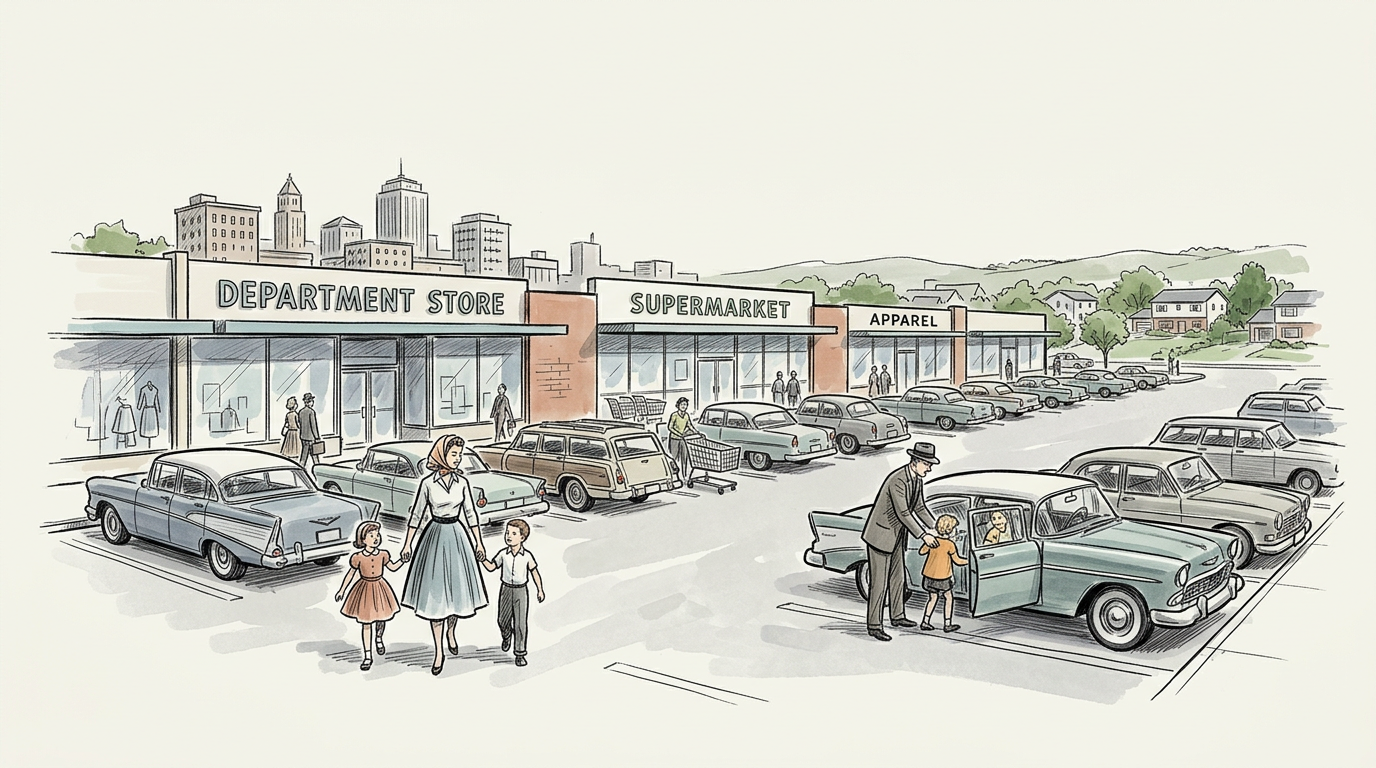
The rise of the shopping center changed more than where Americans bought goods. It reorganized marketing around a new commercial geography. As households, highways, and disposable income moved outward from central cities after World War II, retail strategy had to follow. Location planning, tenant selection, traffic analysis, merchandising calendars, promotional tactics, and consumer research all changed as business districts lost some of their historic monopoly over shopping and suburban centers became major sites of everyday consumption.
This was not a simple story of downtown decline and suburban convenience. Shopping centers emerged from a larger set of structural changes: mass automobile ownership, mortgage finance, highway construction, postwar homebuilding, zoning, rising household formation, and the growing ability of national retailers and manufacturers to serve dispersed markets. Marketers did not merely advertise to suburban consumers. They had to learn how to reach them physically, understand how they moved through space, and build retail systems around those patterns.
For modern marketers, the importance of shopping centers lies in how they made geography a more explicit part of market strategy. They helped turn trade-area analysis, co-tenancy planning, parking capacity, convenience, and destination retailing into routine business concerns. They also helped shift marketing from a primarily street-based urban logic to a system organized around automobile access, managed retail environments, and planned concentrations of stores.
Before the shopping center: downtown retail and the older geography of demand
Before suburban shopping centers reshaped retailing, most large-scale American shopping was organized around downtown business districts, neighborhood shopping streets, department stores, and smaller local commercial nodes. In the late nineteenth and early twentieth centuries, department stores in cities such as New York, Chicago, Philadelphia, and Boston combined merchandising, display, credit, delivery, and customer services in ways that made them important institutions in the history of marketing. They concentrated assortment and spectacle in central locations tied to streetcar lines, commuter rail, and dense pedestrian traffic.
That geography shaped retail practice. Store operators depended heavily on walk-in traffic, public transit access, display windows, seasonal merchandising, newspaper promotion, and reputation within a city or district. Manufacturers seeking broad markets worked through wholesalers, department stores, specialty retailers, variety chains, and mail-order firms such as Sears, Roebuck and Montgomery Ward. Even as chain stores expanded between the 1910s and 1930s, much retail strategy still assumed that commercial life was clustered in established urban corridors or main streets.
There were earlier precedents for planned retail groupings. The Country Club Plaza in Kansas City, developed by J.C. Nichols and opened in 1922, is often cited as an important early automobile-oriented retail district. It integrated shops, parking, and architectural control in ways that anticipated later suburban centers. But it was not yet the dominant national model. The larger transformation came when suburbanization reached a scale that made planned retail decentralization a mass-market necessity rather than a local experiment.
Suburbanization created a new retail problem
The postwar period altered the physical distribution of demand. Millions of families moved to suburbs, especially in metropolitan regions where developers could build tract housing at scale and automobile ownership made commuting feasible. Federal Housing Administration and Veterans Administration mortgage programs supported home purchase, though not equally across populations, and highway investment improved suburban accessibility. The 1956 Federal-Aid Highway Act accelerated metropolitan decentralization, but the shift had begun earlier as developers, lenders, builders, and local governments created new suburban landscapes.
For marketers and retailers, the challenge was practical. If customers no longer lived near downtown department stores or traditional neighborhood business streets, where should stores be placed? How large should they be? What other merchants should be nearby? How much parking was needed? How could stores serve households making weekly automobile trips rather than frequent pedestrian visits?
Retail geography had always mattered, but suburbanization made it a strategic science. Marketers increasingly had to study not just who customers were, but where they lived, how far they would drive, when they traveled, and what combinations of stores would motivate a trip. This was a shift from city-center catchment based on transit and foot traffic toward trade areas defined by driving time, road networks, and parking convenience.
The planned shopping center as a retail system
The shopping center answered this problem by making retail location a deliberately managed system rather than the accidental aggregation of independently chosen storefronts. The Urban Land Institute, which became a major source of industry guidance on shopping-center development, helped formalize definitions and planning principles in the postwar era. Its 1945 publication Shopping Centers: Planning for Shopping Centers, associated with development consultant Richard L. Nelson, is one of the field’s early influential texts, and later ULI publications further codified center types, site planning, and tenant relationships.
Victor Gruen, an Austrian-born architect and planner, became one of the most visible interpreters of the regional shopping center in the 1950s. His work on centers such as Northland Center near Detroit, which opened in 1954, helped define the shopping center as a coordinated environment rather than simply a retail subdivision. Southdale Center in Edina, Minnesota, which opened in 1956 and is widely recognized as the first fully enclosed, climate-controlled regional shopping mall, further demonstrated how planned retail could reshape consumer movement, leisure, and merchandising.
These developments mattered to marketing because the center itself became a medium of market organization. A shopping center assembled merchants whose proximity increased each tenant’s effectiveness. Grocery stores, drugstores, apparel chains, department stores, shoe stores, beauty services, and restaurants were no longer merely neighbors. They were components in a planned demand ecosystem. Co-location created cross-traffic. Parking reduced friction. Standardized leases gave developers and landlords unusual influence over tenant mix, operating rules, signage, promotions, and hours.
This was a major change from downtown retail districts, where city governments, property owners, and merchants had influence but rarely controlled the whole commercial environment. In the shopping center, management could shape retail experience at the level of the entire site.
Anchor stores and the economics of traffic
One of the most important marketing innovations associated with shopping centers was the systematic use of anchor tenants. Department stores had long drawn shoppers, but suburban centers turned that drawing power into a formal planning principle. Anchors justified customer trips from longer distances, supported smaller specialty tenants, and helped define a center’s market position.
This arrangement changed retail decision-making in several ways. First, location strategy became interdependent. A smaller tenant was not choosing a site in isolation but buying access to a flow of customers generated by neighboring stores. Second, the composition of a center became a marketing instrument. Developers and leasing managers had to think in terms of complementary uses, frequency of visit, household needs, and price positioning. Third, traffic itself became measurable and marketable. Footfall, parking counts, car counts, and trade-area estimates gained greater strategic importance because they affected rents, promotion, and merchandising.
In later decades, this logic became familiar in discussions of category killers, food courts, multiplex theaters, big-box clusters, and mixed-use centers. But the underlying idea took shape in the shopping-center era: customers often choose destinations because a planned concentration of retail options reduces search costs and increases convenience. Marketing geography became less about a single storefront’s address and more about the cumulative pull of a retail cluster.
Trade areas, drive time, and the rise of location analysis
Shopping centers also helped institutionalize techniques that are now central to retail marketing: trade-area analysis, site selection modeling, and traffic-based segmentation. Some of these practices existed earlier in chain-store management, real estate appraisal, and urban land economics. What changed after the war was their scale and routine use in suburban retail planning.
Developers, department stores, supermarket chains, and chain retailers increasingly studied population growth, household income, car ownership, road access, and projected residential construction. The goal was not merely to identify dense populations but to estimate purchasing potential within a drivable radius. Retail success now depended on understanding circulation patterns as much as census totals.
This geographic turn in marketing coincided with broader developments in market research and business education. Mid-century marketing scholarship and retail management increasingly treated distribution, place, and location as measurable variables rather than static background conditions. Shopping centers made these issues more visible because the financial stakes were high. A center built in the wrong corridor or with the wrong tenant mix could struggle for years. A center placed along expanding residential and highway networks could become a durable regional draw.
The practical methods were often simpler than modern geospatial analytics. Developers relied on census data, local building permits, highway counts, engineering studies, aerial observation, and field surveys. But the business mindset was significant. Marketing was becoming more spatially analytical. Today’s GIS-based site selection, mobile-location analytics, and catchment modeling have deeper roots in this postwar effort to measure suburban demand geographically.
Convenience became a marketing proposition
Downtown merchants had long competed on assortment, service, and prestige. Shopping centers elevated convenience into a central organizing principle of retail marketing. The convenience at issue was not merely speed. It combined parking, adjacency, weather protection, one-stop shopping, easier package handling, and proximity to suburban homes.
This changed the rhythms of consumption. Consumers making car-based trips could carry larger loads, combine errands, and visit multiple stores in one outing. That favored supermarkets, drug chains, discount formats, and soft-goods merchants operating in clustered settings. It also encouraged a more planned household shopping pattern, especially for weekly stock-up purchases.
Convenience had implications for product strategy and merchandising. Packaging sizes, basket composition, and promotional timing all responded to the car-centered shopping trip. Supermarkets and discount stores benefited from larger average purchases facilitated by parking and trunk capacity. Specialty retailers benefited from nearby anchors and routine family traffic. Restaurants and service businesses benefited from dwell time generated by multipurpose visits.
The language of convenience also became a market-positioning tool. Suburban centers promised relief from downtown congestion, parking scarcity, and travel time. That promise was not available equally to all consumers, and it depended heavily on automobile access. But for the suburban middle-class households that many developers targeted, convenience was one of the most persuasive value propositions of the shopping-center model.
Promotion moved from the citywide district to the managed center
Shopping centers changed not only retail location but promotional organization. In downtown districts, merchants often promoted individually, through department store advertising, newspapers, and civic or merchant associations. In the shopping center, promotion increasingly took place at multiple levels: the individual store, the center as a whole, and sometimes a coordinated seasonal or community program designed by management.
This was historically important because center management became an active marketing institution. Developers and managers sponsored events, holiday programs, fashion shows, sidewalk-style promotions adapted to center layouts, and community activities intended to increase repeat traffic. Santa installations, back-to-school promotions, and themed events became regular traffic-building devices. Center-wide branding, directories, signage systems, and promotional calendars helped make the shopping center itself legible as a destination.
These practices linked retail promotion more tightly to place management. A center’s operator had incentives to increase overall traffic, strengthen tenant sales, reduce vacancy risk, and define the center’s position against other suburban centers. That encouraged coordinated promotional planning and tenant participation rules that were different from the looser arrangements typical of traditional commercial streets.
This also affected manufacturers. As chain retailers and shopping-center merchants gained power, trade promotion, merchandising support, in-store displays, and cooperative promotion took on greater importance. Marketing activity moved closer to the point of purchase in a built environment designed to shape shopper movement.
Tenant mix became a form of market segmentation
Shopping centers gave physical form to segmentation long before many later textbook frameworks became commonplace in everyday business language. Different centers were planned for different kinds of trade areas and purchasing power. Neighborhood centers often emphasized grocery and convenience services. Community centers assembled a broader range of soft goods and household needs. Regional malls used department store anchors and larger assortments to draw from wider areas.
This hierarchy was not merely architectural. It reflected assumptions about frequency of visit, household composition, discretionary income, and trip purpose. Developers and retailers had to decide whether a location should serve routine provisioning, comparison shopping, youth-oriented fashion, family leisure, or some combination of these functions.
Tenant selection thus became an applied form of market segmentation. Instead of segmenting only audiences for media or product messaging, shopping-center operators segmented local demand and translated it into physical retail combinations. An apparel tenant in a center anchored by an upscale department store expected a different customer than a variety store in a neighborhood strip center. Rents, store formats, merchandising, and promotional tactics followed.
This remains central to modern retail marketing. Lifestyle centers, outlet centers, warehouse clubs, neighborhood power centers, and mixed-use developments still rely on versions of the same principle: define the market geographically, estimate traffic patterns, align tenants with anticipated trip behavior, and shape the environment to reinforce that positioning.
Shopping centers changed consumer behavior as well as retail strategy
Consumers were not passive recipients of this new geography. They adapted to it, incorporated it into household routines, and sometimes used it in ways developers had not fully anticipated. For many suburban families, the shopping center became both a provisioning site and a social space. It concentrated errands, offered informal leisure, and in enclosed-mall form later provided climate-controlled public gathering space that was privately managed.
This altered expectations. Shoppers increasingly came to expect easy parking, broad assortments in one location, predictable store hours, and standardized retail environments. Retailers benefited from those expectations when centers performed well, but they were also constrained by them. Once suburban consumers became accustomed to convenience, downtown formats and isolated stores often had to compete harder on destination value, service, or specialty.
Consumer behavior research followed these changes. Retailers, developers, and academic researchers studied trip length, store adjacency, impulse purchase behavior, time of day, family shopping patterns, and center loyalty. Methods remained uneven by modern standards, but the questions were revealing. Marketers increasingly wanted to know not only what consumers preferred, but how they moved through retail space and how one shopping task led to another.
This was an important bridge toward later shopper marketing, in-store analytics, and customer journey thinking. The vocabulary was different, and the tools were much less precise, but the underlying problem was already visible in the shopping-center era: understanding consumer behavior required studying the interaction among place, route, purpose, and purchase.
Downtown retail did not simply disappear, but its marketing logic changed
The growth of suburban shopping centers did not eliminate downtown commerce overnight. Many central business districts remained important office, specialty, entertainment, and flagship retail locations for decades. Some department stores tried suburban branches while maintaining downtown flagships. Others learned that the branch store could no longer be a minor adjunct. It had to become a serious local market operation with merchandising and services adapted to suburban households.
This branching strategy was especially important in the department store sector. Established retailers such as Marshall Field, Hudson’s, Dayton’s, and others expanded into suburban centers because their customer base had dispersed geographically. The suburban branch changed merchandising, staffing, parking assumptions, and promotional planning. A retailer that once relied on downtown prestige and urban accessibility now needed regional coverage and a network strategy.
At the same time, some downtown districts experimented with parking ramps, skyways, pedestrian improvements, and coordinated promotions in response to suburban competition. In later decades, business improvement districts and festival marketplaces would represent further attempts to market central-city retail environments as destinations. The shopping center did not simply replace downtown retail. It forced downtown merchants and city planners to become more self-conscious about access, environment, and district-level promotion.
The mall era extended the shopping center’s marketing logic
By the 1960s and 1970s, the regional mall extended many of these patterns. Enclosed malls intensified environmental control, lengthened dwell time, and broadened the mix of shopping and leisure. Department store anchors remained important, but mall operators also learned the value of specialty chains, food service, seasonal programming, youth traffic, and demographic positioning.
Mall management became a more sophisticated marketing function. Operators tracked sales per square foot, foot traffic, occupancy cost, shopper demographics, and event performance. Leasing strategies evolved around category balance and customer draw. Center promotions became more professionalized, and mall directories, wayfinding, decor, and amenities were treated as parts of a unified customer experience.
This period also coincided with the growth of national specialty chains that depended on malls as distribution and branding platforms. For many apparel, footwear, and gift retailers, the mall was not just a place to rent stores. It was the operating system through which brands entered suburban markets at national scale. That made shopping-center geography a crucial part of brand growth, field merchandising, and chain-store expansion.
Yet the mall model also revealed limitations. It favored populations with automobile access and often reflected patterns of racial and class exclusion embedded in suburban development. It could homogenize retail environments and weaken traditional commercial streets. In later decades, overbuilding, e-commerce, changing demographics, and new formats would expose the vulnerability of retail systems too dependent on one kind of managed space. Those later developments should not obscure the mall’s historical significance, but they do complicate any simple narrative of inevitable progress.
Why shopping centers mattered to the development of marketing
Shopping centers are sometimes treated mainly as architectural forms or cultural symbols. In marketing history, their deeper importance is organizational and analytical. They changed the profession by making several now-familiar practices more central to everyday business decision-making.
They elevated location from a real estate concern to a core element of market strategy. They encouraged systematic trade-area analysis. They formalized tenant mix as a way to shape demand. They made traffic generation and circulation measurable business objectives. They tied promotion to place management. They pushed retailers to think in networks rather than single flagship locations. They strengthened the role of convenience in positioning. And they encouraged marketers to treat consumer behavior as something that unfolded across planned physical environments.
The shopping center also redistributed influence among marketers, retailers, developers, and landlords. In older downtown systems, department stores and merchant districts often dominated local retail identity. In suburban centers, the developer and center manager gained unusual power over the commercial setting itself. This created new marketing intermediaries whose decisions about leasing, layout, parking, signage, and events affected how brands reached consumers.
Modern marketers still work within structures shaped by that history. Big-box clusters, airport retail, lifestyle centers, warehouse clubs, open-air mixed-use developments, and digitally optimized store networks all continue to rely on principles refined during the rise of suburban shopping centers. Even e-commerce has not erased them. Omnichannel retail still depends on fulfillment geography, convenience, catchment areas, traffic flows, and network design. The underlying question remains recognizably mid-century: where should commerce be placed so that it fits how consumers live and move?
Shopping centers changed marketing geography by forcing business to recognize that markets are spatial systems as well as demographic ones. As commercial life moved away from downtown districts, marketers had to learn a new map of consumption. That lesson remains highly relevant. However advanced contemporary analytics become, marketing still depends on understanding how place organizes demand, shapes behavior, and determines what forms of convenience consumers will value enough to act on.
Leave a Reply