
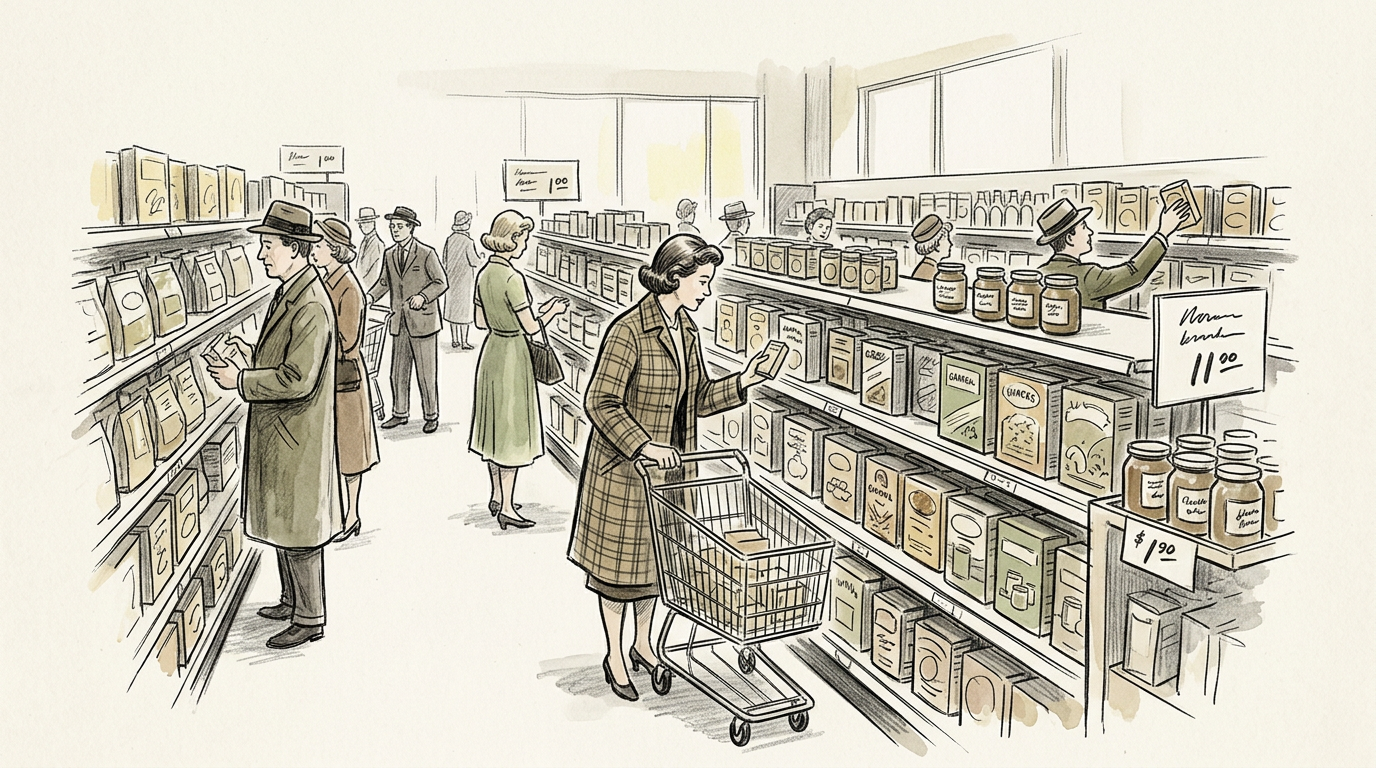
Long before the supermarket became an ordinary part of daily life, most food retailing in the United States worked through service counters. Customers presented a list to a clerk, who gathered goods from shelves and bins behind the counter. That system shaped marketing in one way; the retailer and the clerk stood between the manufacturer and the shopper. When self-service food stores and, later, supermarkets spread in the first half of the twentieth century, they changed that relationship. The selling environment moved onto the sales floor. Packages had to identify themselves quickly. Brands had to compete side by side. Prices became more visible and comparable. Merchandising, store layout, displays, and promotions became central parts of the marketing system rather than secondary matters of retail operations.
The modern supermarket did not simply create a new kind of store. It helped create a new marketing environment, one in which the shelf itself became a medium of competition and persuasion. That shift had lasting consequences for manufacturers, retailers, market researchers, and marketers trying to understand how consumers actually make choices in stores.
Before the supermarket: clerk service, loose goods, and retailer mediation
Nineteenth-century and early twentieth-century grocery retailing was fragmented and local. General stores, independent grocers, and specialty food merchants sold many staple goods in bulk. Flour, sugar, coffee, beans, crackers, and other staples were often scooped, weighed, wrapped, or measured by the merchant. Brand identity existed, but it was uneven. Some branded packaged goods had already gained traction by the late nineteenth century, especially in categories such as soap, canned goods, tobacco, and baking products. Trademarks, printed labels, and national advertising helped manufacturers distinguish products in a growing mass market. Still, in many food categories, the retailer’s recommendation, local trust, and store reputation carried great weight.
That arrangement limited what later marketers would call point-of-purchase influence. A consumer often did not browse among dozens of visually competing items. The clerk interpreted the assortment, proposed alternatives, and sometimes substituted goods. For manufacturers, national demand depended not only on advertising and distribution, but also on winning cooperation from wholesalers and retailers who controlled access to the consumer.
Several developments began to weaken that older structure. Industrial food processing expanded the supply of standardized packaged goods. Printing and packaging technologies improved the appearance and consistency of labels and cartons. Railroad distribution and, later, motor trucking widened geographic markets. Urbanization increased demand for dependable, quickly handled food retailing. Chain store organizations developed more systematic procurement and store operations. Together these changes made self-service more practical and made manufacturers more interested in putting recognizable packages directly in front of consumers.
Self-service arrives
The immediate prehistory of the supermarket lies in self-service grocery retailing. The most frequently cited early milestone is Clarence Saunders’s Piggly Wiggly, opened in Memphis in 1916. Saunders secured patents related to self-service store organization and promoted a system in which customers entered through turnstiles, moved through aisles, selected packaged goods themselves, and paid at the front. Other retailers also developed self-service formats in the 1910s and 1920s, and historians caution against treating any single founder as the sole inventor of modern grocery retailing. Even so, Piggly Wiggly became a widely visible demonstration that a grocery store could shift labor away from clerk service and let the customer do more of the selection work.
Self-service solved several business problems at once. It reduced labor requirements per transaction. It increased customer throughput. It made larger assortments easier to present. It also transferred part of the selling function from the clerk to the package and the display. That mattered enormously for marketing. If consumers were now expected to identify, compare, and choose products on their own, manufacturers needed packaging, trademarks, and visual consistency that could do work once performed by store employees.
Self-service did not spread because of marketing logic alone. It spread because it fit broader changes in retail economics. Labor costs mattered. Consumer habits were changing in cities and towns with busier purchasing patterns. Packaged goods manufacturers were producing more items suited to shelf display. Chain organizations could standardize store layouts and replenish packaged inventory more efficiently than many older stores built around clerk service and loose goods.
The supermarket emerges in the 1930s
The supermarket as a distinct retail institution took shape during the Depression. Historians commonly point to Michael J. Cullen’s King Kullen, opened in Jamaica, Queens, in 1930, as an important early example. Cullen had argued for a high-volume, low-margin grocery operation in a large store with extensive self-service, broad assortment, and aggressive pricing. Other operators were developing related formats at about the same time, but the supermarket model gained momentum in the 1930s because it aligned with economic pressure on households and retailers alike.
The Depression made low prices a powerful draw. Large stores could emphasize rapid inventory turnover, heavy buying, and fewer service frills. They often used converted garages, warehouses, or other low-rent spaces. Parking became increasingly important as automobile ownership changed shopping patterns, especially outside the densest urban cores. The supermarket brought together grocery staples, branded packaged goods, and eventually more perishables in one shopping trip. This one-stop logic changed consumer expectations as well as retail operations.
Trade coverage from the 1930s and 1940s shows that the supermarket was understood not merely as a bigger grocery store but as a different merchandising system. The store depended on traffic flow, category placement, end-aisle displays, visible price signage, and planned use of floor space. Selling shifted into store design. Retailers, wholesalers, and manufacturers all had to think more carefully about how products were encountered in sequence.
Industry organizations helped formalize the new format. The Food Marketing Institute traces its roots to the Super Market Institute, founded in 1935. The emergence of such organizations reflected the growing scale and complexity of food retailing. Supermarkets required specialized attention to operations, buying, merchandising, refrigeration, consumer behavior, and manufacturer-retailer relations.
Why the shelf became a marketing environment
In a clerk-service store, the consumer often asked for a product before seeing the full set of alternatives. In a supermarket, the alternatives sat beside one another. That altered competition in practical ways.
First, brands had to be recognized at a glance. Packaging could no longer function only as a container or a shipping unit. It had to serve as identification, reassurance, and silent salesmanship. Shape, color, typography, and trademark consistency became essential because consumers were making faster decisions in aisles rather than consulting clerks.
Second, shelf adjacency changed substitution patterns. A shopper intending to buy one item might see a lower-priced alternative, a larger size, a private label, a promotional display, or a newer national brand. The manufacturer was no longer competing only for consumer memory generated by advertising or habit. It was competing in the moment of purchase, in full view of rivals.
Third, the shelf made price comparison easier. Posted prices, standardized package sizes, and visual display encouraged direct comparison across brands and package formats. This pushed manufacturers and retailers to think more systematically about price points, promotional price reductions, and pack architecture.
Fourth, the shelf turned store space into a scarce asset. Placement mattered. Eye-level shelves, end caps, checkout areas, and feature displays all offered different selling potential. Over time, this produced increasingly formal negotiations over display allowances, cooperative promotions, and what later became known as slotting and space management practices.
The shelf, in other words, became a structured decision environment. Modern marketers would later analyze it with shopper research, scanner data, and category management software, but the underlying problem emerged much earlier: how do consumers choose among physically adjacent alternatives in a self-service setting?
Packaging moved from transport to communication
The rise of self-service supermarkets accelerated one of the central changes in marketing history: the transformation of packaging into a core branding and merchandising instrument.
Manufacturers had already been investing in packaging for protection, standardization, and trademark use. What changed under self-service was the amount of commercial meaning the package had to carry. It had to attract attention on a crowded shelf. It had to communicate product type, brand, quantity, quality, and often preparation or usage cues. It had to maintain consistency across repeated shopping trips so consumers could relocate a preferred item quickly.
Packaging technology helped make this possible. Advances in paperboard cartons, metal cans, cellophane, glass containers, and later plastics supported a wider array of package forms and window displays. Better color printing improved shelf visibility. Standardized labels and prepackaged units reduced handling and shrinkage for retailers. For manufacturers, packaging became tied more closely to marketing budgets and strategy rather than being treated mainly as a production necessity.
This was not simply a matter of prettier boxes. Self-service created a functional demand for legibility, distinction, and reproducibility. The package became a substitute for some of the explanatory work previously done by a clerk. In many categories, it also became a defense against retailer substitution. A consumer who could identify a national brand package directly was less dependent on the merchant’s recommendation.
The National Biscuit Company’s earlier use of branded packaging for Uneeda Biscuit is often cited in branding history because it showed how a manufacturer could standardize and protect a mass-market product. The supermarket era extended that logic across much of grocery retailing. By mid-century, package design, naming, sizing, and shelf impact were inseparable from brand strategy.
Merchandising became more systematic
Supermarkets expanded the importance of merchandising from a local retail craft into a more formal marketing discipline. Product assortment, shelf arrangement, traffic flow, signage, in-store displays, and promotional timing all became measurable commercial variables.
Retailers learned that physical layout influenced what sold. Staple goods could anchor trips. High-margin or impulse items could be placed in more visible or high-traffic zones. End-of-aisle displays could interrupt routine shopping behavior and stimulate unplanned purchases. Checkout areas could support candy, magazines, gum, and other small items that benefited from waiting time.
Manufacturers also adapted. They developed display materials, shelf talkers, case cards, coupon attachments, and temporary promotional packaging designed specifically for store environments. Trade marketing, though not always labeled that way historically, became more sophisticated as manufacturers worked to secure favorable treatment from retailers. Cooperative advertising and promotional allowances linked manufacturer funds to retail execution.
By the postwar period, supermarkets had become laboratories for in-store selling techniques. Refrigerated cases, frozen foods, standardized gondola shelving, fluorescent lighting, and shopping carts increased the scope of what could be sold and how consumers encountered it. The shopping cart itself, introduced by Sylvan Goldman in 1937 at Humpty Dumpty stores in Oklahoma City, changed basket size and made large-format, high-volume retailing more effective. More carrying capacity meant more opportunity for merchandising strategies to influence total purchase volume.
Price visibility changed competition
Supermarkets helped normalize a more explicit and continuous form of price competition. In small clerk-service stores, shoppers might know general price levels, but direct side-by-side comparison was harder and often mediated by the merchant. In self-service stores, posted prices and displayed packages increased transparency.
This mattered during the Depression, when retailers used low prices and specials to attract traffic. It mattered again after World War II, when expanding consumer markets and suburban growth intensified competition among chains, independents, and later discount-oriented food retailers. Price became not just a financial condition of sale but a visible retail message.
The growth of chain supermarkets also supported more systematic promotional pricing. Retailers could use weekly circulars, newspaper inserts, and in-store specials to drive store traffic. Manufacturers had to account for temporary price reductions, feature advertising, and trade deals as regular parts of market planning. In many packaged goods categories, list price told only part of the story; promotional frequency, display support, and retailer pass-through influenced actual market performance.
This visibility also strengthened private-label competition. If a retailer’s own product sat next to a higher-priced national brand, the comparison became immediate. That forced national brands to justify premiums through familiarity, perceived quality, packaging, innovation, or promotion. The shelf was therefore a site where price, brand equity, and retailer power met directly.
Promotions and impulse buying became central to food marketing
Supermarkets did not invent sales promotion, but they made in-store promotion much more influential. Feature displays, loss leaders, couponing, premiums, sampling, and themed merchandising all gained power in a self-service environment built around shopper circulation and visible assortment.
Manufacturers and retailers learned that not all purchases were preplanned. By the mid-twentieth century, researchers and trade publications increasingly discussed impulse buying and in-store decision making as practical retail concerns. The supermarket provided the physical conditions for such behavior: open access to goods, repeated visual prompts, and a large volume of low-risk, frequently purchased items.
This environment encouraged marketers to think in terms of consumer attention at the point of purchase rather than relying entirely on demand generated before the store visit. Packaging, shelf position, deal signage, and display volume could all alter outcomes. The older distinction between advertising and retail selling became less tidy in practice. A national campaign might build awareness, but the sale could still be won or lost in the aisle.
Couponing provides a good example of how supermarket retailing changed promotional mechanics. Coupons had earlier precedents, but their integration into packaged goods marketing expanded significantly in the mass-retail era because they could be redeemed through standardized checkout systems and linked to store traffic and brand switching. Retailers and manufacturers developed more coordinated promotional calendars as supermarkets became the dominant food retail format.
Brand recognition had to work in motion
The supermarket made brands more visible, but it also made attention scarcer. A shopper moving down an aisle encountered many products in a short period of time. Brand recognition had to function quickly, often at a distance and amid clutter. That favored simple visual systems, repeated colors, legible logos, and packaging that could be recognized from partial views on shelves.
This had consequences for brand management. It encouraged greater consistency across package sizes and line extensions. It increased the importance of what would later be called visual identity systems. It also strengthened the role of the brand as a shortcut in routine purchasing. In many grocery categories, shoppers did not conduct extended evaluations in the aisle. They relied on habit, recognition, perceived reliability, and price cues.
Supermarkets therefore reinforced two different tendencies at once. They made consumers more independent from clerks, but they also increased dependence on brand cues and store cues as decision aids. The shelf favored the familiar, yet it also created openings for challengers using visible discounts, novel packaging, or superior placement.
Private labels illustrate this especially well. As supermarkets and chains gained scale, they could develop their own brands and place them strategically. National brands could no longer assume that broad advertising alone guaranteed dominance. Retail control over assortment and placement gave stores greater leverage. Modern discussions of retailer power, category captaincy, and own-brand strategy have roots in this earlier restructuring of the food marketplace.
Research followed the store
As supermarkets grew, marketers needed better ways to understand what happened inside them. Traditional sales reports and wholesaler feedback were no longer enough. The complexity of shelf competition, promotions, and store-level variation encouraged more systematic retail and consumer research.
Early market research in packaged goods had already expanded in the interwar and postwar years through surveys, panels, audits, and statistical analysis. Firms such as A.C. Nielsen, founded in 1923, became important by measuring retail movement and market share. Nielsen’s store audit methods helped manufacturers and retailers compare performance across markets and brands. This kind of evidence mattered more in a supermarket environment where shelf turnover, distribution breadth, and merchandising support could vary substantially by store and chain.
Consumer panels also helped marketers understand repeat purchase, brand switching, and household buying patterns. While early research methods had limitations by modern standards, they represented an important shift in marketing practice: moving from anecdotal beliefs about shoppers to more structured observation and measurement.
Later developments deepened this trend. Universal Product Codes, introduced in the 1970s, and scanner systems transformed retail measurement by allowing product-level tracking at checkout. The first UPC-scanned item at a supermarket, a pack of Wrigley’s Juicy Fruit gum in Troy, Ohio, in 1974, is often noted for its symbolic significance. More important historically, scanning made it possible to connect pricing, promotion, distribution, and shelf performance with much greater precision than earlier audit methods allowed.
Scanner data did not create the supermarket shelf as a marketing problem; it made that problem more measurable. Category management, space management, planograms, and modern trade promotion analysis all grew from the basic reality that the shelf is a finite, competitive environment in which placement and presentation affect results.
Postwar expansion and the normalization of supermarket marketing
After World War II, rising incomes, suburban growth, automobile use, home refrigeration, and improvements in food processing accelerated supermarket expansion. Stores became larger and carried broader assortments, including frozen foods, dairy, meat, produce, household products, and health and beauty items. The supermarket increasingly functioned as a weekly household provisioning center.
As the format matured, many practices that now seem standard became more deliberate and formalized. Manufacturers created dedicated packaging, merchandising, and trade promotion functions. Retailers invested in store planning, promotional circulars, traffic analysis, and category-level performance measurement. Food marketing education and trade literature increasingly treated merchandising and distribution as strategic concerns rather than mere operational details.
The National Association of Food Chains and the Super Market Institute, among other industry bodies, circulated practices and data that helped standardize the field. Universities and business schools also expanded the study of marketing channels, consumer behavior, retailing, and packaged goods distribution in the postwar decades. The supermarket’s growth was one reason academic marketing moved further into questions of buyer behavior, channel power, retail competition, and point-of-purchase influence.
In this period, the shelf became so central that marketing could no longer be understood only as mass communication plus sales. It also required coordination among product policy, packaging, distribution, trade relations, pricing, promotion, and in-store execution.
Limits, tensions, and unintended consequences
The supermarket did not give all power to consumers, nor did it create a neutral marketplace of perfect choice. Shelf competition reflected retailer decisions about assortment, placement, and display access. Large manufacturers with trade budgets often enjoyed advantages in securing visibility. Standardized self-service also encouraged product proliferation, packaging waste, and promotional clutter.
There were social and geographic limits as well. Supermarket development tracked suburbanization, automobile access, and patterns of investment that did not serve all communities equally. Independent grocers and smaller neighborhood stores often faced severe pressure as chains and large-format retail expanded. Later debates over food deserts, retail concentration, and slotting fees emerged from structural changes that had been building for decades.
For marketers, these tensions are historically important because they show that the supermarket shelf was never simply a site of consumer sovereignty. It was a negotiated commercial space shaped by retailer strategy, manufacturer resources, logistics, regulation, and household constraints such as time, transportation, and income.
What the supermarket changed in marketing practice
The supermarket helped consolidate several ideas that remain central to marketing today.
It made packaging a primary communications tool. It elevated merchandising from storekeeping to strategy. It tied brand management more closely to in-store visibility and retail execution. It increased the importance of promotional pricing and feature support. It strengthened the need for research on actual purchase behavior rather than stated preference alone. It also gave retailers greater influence over what brands could do, creating an enduring tension between manufacturer brand-building and retailer control of the shopping environment.
Most of all, the supermarket made the point of purchase impossible to ignore. The shelf became a place where product design, brand identity, pricing, consumer habit, and retail economics met in real time. That was true in mid-century grocery aisles, and it remains true in updated forms today, whether the environment is a big-box store, a convenience chain, a club warehouse, an ecommerce category page, or a mobile grocery app. The technologies differ, but the underlying marketing problem is familiar: how to win recognition, trust, and choice within a structured retail environment where competing offers are presented side by side.
Understanding how supermarkets reshaped consumer marketing therefore helps explain more than the history of food retailing. It shows how marketing became more deeply integrated with packaging, distribution, store design, consumer research, and channel strategy. The shelf was not just a place where products sat. It became one of the most consequential marketing institutions of the modern consumer economy.
For readers interested in the documentary record behind this history, useful starting points include the Food Industry Association’s historical material on the Super Market Institute at fmi.org, the Smithsonian’s collections and essays on grocery retailing and packaging at americanhistory.si.edu, the history resources of The Kroger Co. at thekrogerco.com/about-kroger/history-and-timeline/, and the George B. Delaplaine Jr. McGraw Center for Business Journalism and related archival resources on early supermarket development. For retail measurement history, A.C. Nielsen’s early role is discussed in business histories and archival material from Nielsen and contemporary trade sources, while UPC history is documented by GS1 at gs1.org and by established reporting on the 1974 Troy, Ohio scan.
Leave a Reply