
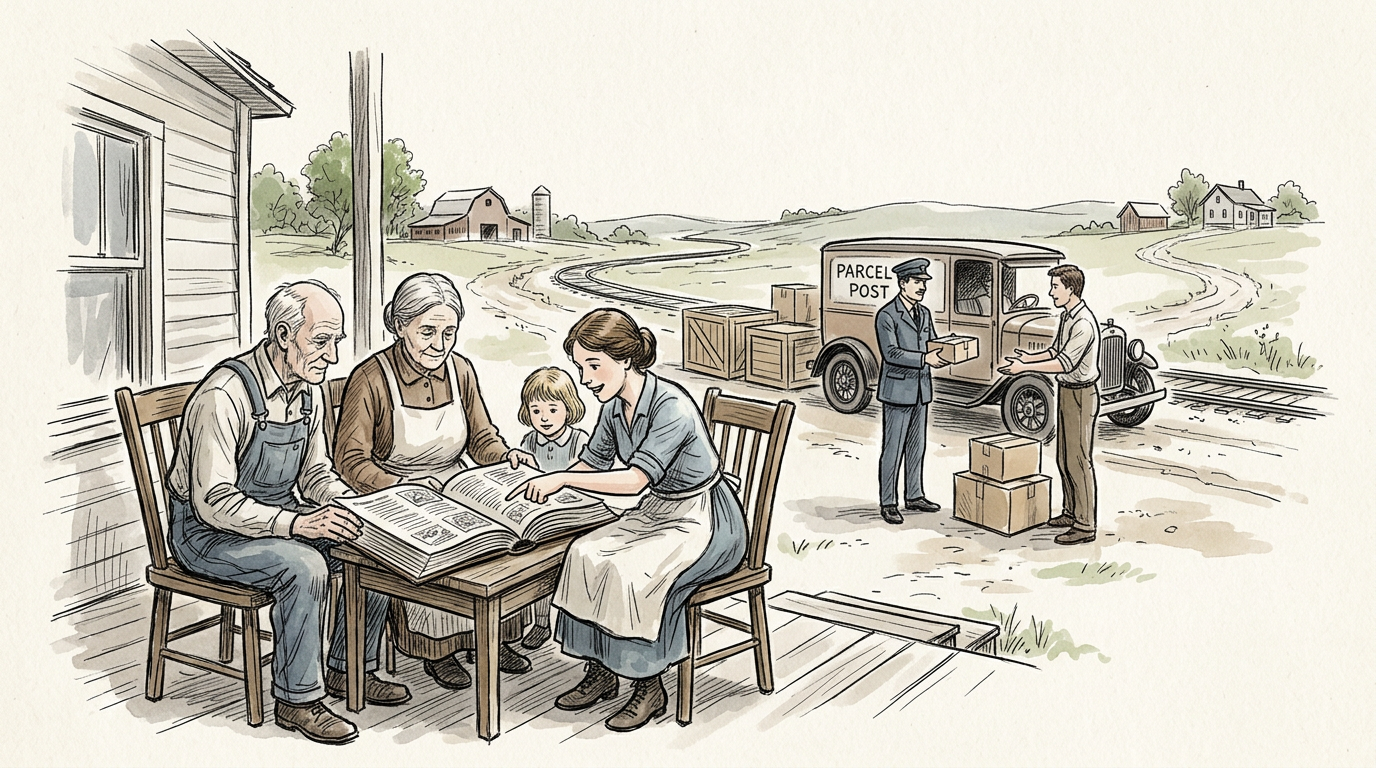
Long before ecommerce made national assortment seem routine, the Sears catalog helped reorganize how Americans shopped, how manufacturers reached households, and how retail marketing could operate at scale. Its importance was not simply that it sold goods by mail. Mail-order selling existed before Sears, and other merchants, most notably Montgomery Ward, had already shown that catalogs could connect distant customers to urban supply networks. What Sears, Roebuck and Company did with unusual force in the late nineteenth and early twentieth centuries was integrate merchandising, pricing, distribution, brand presentation, and customer acquisition into a system that served mass rural demand with remarkable breadth and regularity.
That system mattered because much of the United States was still poorly served by local retail. In the decades after the Civil War, industrial production expanded, railroads linked regional markets, printing became cheaper, and the postal system became more capable. Yet many rural consumers still faced limited assortment, inconsistent quality, and prices shaped by small local markets and long chains of intermediaries. Sears did not solve every one of those problems, and it did not create the conditions that made national retail possible. But it became one of the clearest demonstrations that modern marketing was not just promotion. It was the organized coordination of demand, information, logistics, merchandising, and trust.
## Before Sears: the retail problem of distance
To understand what changed, it helps to begin with the retail system Sears entered. In much of nineteenth-century America, especially in small towns and farming regions, households relied on general stores, itinerant peddlers, local agents, and nearby merchants for a wide range of goods. Distribution was uneven. Product information traveled slowly. Prices were often opaque. Consumers had limited ability to compare alternatives across distance, and local merchants often stocked a narrower assortment than urban department stores.
This was not a simple story of rural ignorance meeting urban efficiency. Local retailers also extended credit, carried goods suited to local needs, and offered immediate access. But the system imposed real constraints. For many households, branded national goods were difficult to obtain consistently. Choice was restricted not only by income but by market access.
Mail-order merchants emerged in response to those constraints. Montgomery Ward, founded in 1872 in Chicago, is usually credited as the first major general mail-order house aimed at rural consumers. Its catalog model showed that a centrally organized merchant could buy in larger volume, publish standardized offers, and sell directly to customers who lived far from major retail centers. Sears followed in a market that had already been partially prepared by postal expansion, rail networks, and the growth of mass manufacturing.
## Richard Sears, Alvah Roebuck, and a fast-growing mail-order business
Richard W. Sears began in the 1880s selling watches after an unclaimed shipment came into his hands while he was working as a railroad station agent in North Redwood, Minnesota. He soon moved into mail-order watch sales, first in Minneapolis and later in Chicago, a city that had become a crucial node for rail distribution, wholesaling, printing, and commercial coordination. In 1887 he partnered with watch repairman Alvah C. Roebuck, and the business took the name Sears, Roebuck & Co.
The early watch trade mattered because it taught lessons that would shape the later catalog enterprise. Watches were standardized goods that could be described in print, shipped at distance, and compared on price. Selling them successfully required persuasive copy, reliable fulfillment, and an ability to reassure customers who could not inspect merchandise in person. In effect, the early business operated as a laboratory for direct retailing.
In 1893 Sears, Roebuck and Company was incorporated in Chicago. During the 1890s, it expanded rapidly from watches into a broad general merchandise business. Its catalogs grew thicker and more ambitious, and its customer base widened. In 1895 Richard Sears recruited Julius Rosenwald, then a vice president at the clothing firm Rosenwald & Weil, who became a key managerial and financial force in the company. Rosenwald’s role was central in imposing more disciplined operations on a fast-growing enterprise. If Richard Sears represented aggressive merchandising and promotional instinct, Rosenwald represented administrative structure, supplier discipline, and large-scale organizational management.
That combination became one of the company’s great contributions to retail history. The Sears catalog was not merely a publication. It was the visible interface of a back-end system that had to align buying, vendor management, inventory control, order handling, packaging, rail shipment, payment processing, returns, and customer correspondence.
## The catalog as a marketing system
Later generations often remembered the Sears catalog as a cultural object, sometimes called the “consumer’s bible,” though that phrase has been repeated more often in retrospective commentary than as a precise contemporaneous descriptor. Historically, its greater significance lies in how it functioned as a marketing platform before the term existed in modern form.
The catalog combined several functions now distributed across multiple channels and departments:
– Product discovery
– Merchandising and assortment planning
– Price communication
– Comparative selling
– Brand presentation
– Direct response ordering
– Customer data capture through orders and inquiries
– Post-sale relationship management through fulfillment and correspondence
Each issue represented a structured market offer. Customers were not simply buying isolated goods. They were being invited into a standardized retail environment governed by printed description, numbered items, fixed terms, and a nationally distributed promise of value.
This was especially important in a period when many goods still lacked the standardized packaging, quality signaling, and mass-media support that later characterized twentieth-century consumer marketing. The catalog itself often had to carry the burden of comparison and explanation. It translated urban wholesale abundance into a legible system for household decision-making.
## National assortment and the idea of choice at scale
One of Sears’s most important retail innovations was not invention in a technical sense, but organization. The company assembled an enormous assortment and made it available through a single ordering instrument to customers scattered across the country. Clothing, tools, musical instruments, furniture, stoves, farm equipment, guns, medicines, household goods, and later automobiles, kit homes, and many other categories appeared in the same commercial system.
For marketing history, that breadth matters because assortment is one of the core ways retailers shape demand. Sears did not only respond to existing wants. By presenting categories side by side, standardizing descriptions, and making alternatives comparable, it taught consumers to think in terms of expanded choice. The catalog familiarized households with a wider universe of purchasable goods than local stores could usually carry.
This did not create consumer desire out of nothing. Rural households already wanted better access to clothing, household goods, tools, and status-bearing items associated with urban markets. But Sears changed the terms on which those wants could be evaluated and acted upon. Assortment itself became a marketing promise.
In that sense, the catalog anticipated later retail logics visible in department stores, category killers, online marketplaces, and ecommerce superstores. Modern marketers often discuss “selection” as if it were a digital-era advantage. Sears demonstrates that the strategic use of wide assortment as a market proposition has a much longer history.
## Fixed pricing, comparison, and the politics of value
Sears also helped normalize a different relationship between retailer and customer around price. Rural storekeeping often involved bargaining, credit relationships, freight uncertainty, and local markups shaped by low-volume purchasing. By contrast, mail-order catalog retail relied on published prices. Those prices were visible, comparable, and national in scope, even if shipping conditions and product availability could vary.
That transparency had marketing consequences. It altered the customer’s role from one of localized dependence to one of comparison shopper at a distance. Sears’s copy regularly emphasized low prices, savings, and value against local merchants or middlemen. Such appeals were not unique to Sears, and they could be exaggerated. But they resonated because they spoke to a real structural issue in American distribution: many rural consumers believed, often with reason, that they were paying more for less choice.
Price communication became part of trust building. A printed price was not only an economic signal. It was a statement that the merchant was willing to make a public, replicable offer. That principle remains fundamental to direct and digital commerce. Consumers are more willing to transact remotely when terms are standardized, inspectable, and comparable before purchase.
Sears also relied on refunds, guarantees, and descriptive selling to reduce perceived risk. These practices were not always frictionless in execution, and historians should resist treating them as perfect consumer protections. But they formed part of a broader remote-retailing solution: if shoppers could not touch the goods, the merchant needed other mechanisms to overcome uncertainty.
## Distribution infrastructure made the model possible
The Sears catalog could not have transformed retail without parallel changes in infrastructure. Railroads were foundational. Chicago’s role as a rail and wholesale hub gave Sears access to national transport networks and to suppliers serving expanding consumer markets. Equally important were developments in federal postal policy.
A major turning point came with Rural Free Delivery, introduced experimentally in the 1890s and made permanent in 1902 by the U.S. Post Office Department. RFD did not deliver every catalog package directly in all circumstances, and large items often traveled by freight or express rather than ordinary mail. But it dramatically improved communication and ordering convenience for rural households by bringing mail service directly to many farm families who had previously needed to travel to post offices.
Parcel Post, launched by the Post Office in 1913, further expanded the practical range of goods that could be distributed through the postal system. These government systems did not exist for Sears alone, but companies like Sears were among their major commercial beneficiaries. Public communications infrastructure and private retail strategy reinforced one another.
Sears invested heavily in operational scale to use these systems effectively. Its massive mail-order plant on Chicago’s West Side, completed in stages beginning in 1906, became one of the best-known fulfillment centers of its era. Contemporary accounts emphasized the building’s size, mechanized handling systems, and capacity to process large volumes of orders. The modern language would be fulfillment optimization. In its own time, it represented the industrialization of retail back-office work.
That distinction is important. The catalog’s success depended less on romantic notions of old-fashioned service than on process engineering. Retail marketing at scale required operational precision.
## Customer acquisition, data, and direct response logic
Sears was also part of the historical development of direct marketing. Every mail-order transaction produced records: names, addresses, product choices, payments, complaints, and repeat orders. These were not “customer databases” in the digital sense, but they were organized commercial information assets. Mail-order merchants learned where demand was strongest, which categories attracted response, and how often customers reordered.
The catalog itself was a measurable medium. Circulation could be expanded or reduced by territory. Edition formats could change. Product mix could be adjusted based on sales experience. While early twentieth-century merchants lacked later statistical techniques and modern attribution models, they did not operate blindly. They used response as evidence.
This direct-response structure distinguished mail-order retail from many forms of general advertising. A catalog had to do more than create awareness. It had to generate an order under specified terms and sustain enough customer confidence to make repeat purchasing possible. That requirement encouraged disciplined merchandising and clearer offers.
It also gave Sears a more immediate relationship with the end customer than many manufacturers had. In local-store systems, producers often depended on wholesalers and retailers for market feedback. Sears, by contrast, could observe demand through orders and correspondence coming directly from households. In this respect, the catalog business foreshadowed later forms of database marketing, ecommerce analytics, and customer relationship management, even though its information systems were manual and administrative rather than digital.
## Private brands and the growth of trust at a distance
Mail-order retail placed unusual pressure on product identification. If consumers could not inspect a store shelf, the merchant needed other ways to signal quality and consistency. Sears responded in part through private brands and exclusive labels. Over time it marketed goods under names such as Kenmore, Craftsman, and Silvertone, though those brands belong more fully to Sears’s twentieth-century evolution across both catalog and store retailing than to its earliest mail-order decades.
The rise of such brands illustrates a broader point in marketing history. Branding in retail was not solely a manufacturer-led process. Retailers also developed branded assurances that connected assortment strategy with margin management and customer trust. A private label could promise dependable value, distinguish the merchant’s offer from rivals, and create a repeat-purchase relationship that did not depend entirely on national manufacturer brands.
In the Sears system, branding worked alongside detailed product descriptions, comparison claims, guarantees, and price positioning. Trust came from the total retail proposition, not from logos alone. This is one reason the catalog belongs in marketing history rather than in a narrower history of advertising art or copy. Its significance lies in the coordinated design of a market-facing system.
## Rural consumption and changing household expectations
The Sears catalog also reshaped rural consumption by changing what many households considered realistically obtainable. Historians have long noted that mail-order retail reduced the cultural and material distance between rural and urban consumers. That claim should be handled carefully. Rural America remained economically diverse, regionally varied, and unequal. Not every household could afford what the catalog displayed, and many continued to rely heavily on local merchants.
Still, the catalog widened the horizon of consumption. It made urban styles, manufactured household goods, ready-made clothing, and specialized tools visible and orderable on a new scale. It also offered practical products that fit farm and small-town life, not just aspirational novelties. This combination mattered. Sears did not simply impose city tastes on the countryside. It served a mixed demand composed of utility, economy, self-improvement, comfort, and status.
Consumers were not passive in this process. They compared offers, shared catalogs, delayed purchases, ignored categories irrelevant to their needs, and used the book selectively. Some local merchants fought back with service, credit, immediacy, or criticism of mail-order competitors. Others adapted by improving assortment or sharpening prices. The catalog changed market behavior partly because consumers used it as leverage in local retail negotiations, not only because they ordered directly from Chicago.
In that sense, Sears changed retail competition even where it did not make the final sale.
## Tensions with local retail and the debate over “middlemen”
Sears’s rise was accompanied by conflict. Local merchants often regarded mail-order houses as unfair intruders draining business from communities whose infrastructure they did not support in the same way local stores did. Trade publications and local newspapers periodically reflected such tensions. Campaigns urging residents to “buy at home” appeared in many places during the early twentieth century.
From a marketing-systems perspective, this conflict was about more than sentiment. It involved competing models of intermediation. Sears argued, explicitly and implicitly, that many existing intermediaries added cost without equivalent customer value. Local merchants countered that they provided credit, local knowledge, service, and immediate availability that remote retailers could not match.
Both claims had truth in different contexts. Modern marketing history is better served by recognizing that the issue was structural, not moral. Sears prospered where centralized buying, printed selling, and long-distance distribution solved customer problems more effectively than local channels. Local retail persisted where in-person service, community presence, urgency, or credit remained decisive.
This tension remains visible in contemporary debates over platform commerce, direct-to-consumer distribution, and marketplace concentration. Questions about which intermediary creates value, captures margin, and controls customer data did not begin with the internet.
## From catalog company to broader retail institution
Sears is often remembered as if the catalog and the department store belonged to different historical stories. In fact, they were related phases in an evolving retail strategy. By the 1920s, demographic change and automobile ownership were shifting American consumption. Urban and suburban populations were growing, and many customers now lived within easier reach of stores. Rural markets remained important, but the geography of demand was changing.
Under leaders including Julius Rosenwald and, later, General Robert E. Wood, Sears moved decisively into brick-and-mortar retail. The first Sears retail store under the new strategy opened in 1925 in Chicago. In 1926 the company created an operating subsidiary for its retail stores, and store expansion accelerated. This was not a rejection of the catalog model so much as an adaptation of its underlying principles. Sears took its strengths in assortment, centralized buying, price communication, and brand development into physical retail formats suited to a motorized consumer economy.
That transition is important for marketing history because it shows that the company’s core capability was not a single channel. It was the management of distribution and merchandising at scale. The catalog had been one powerful interface. The store became another.
## Why the Sears catalog mattered to the development of modern marketing
The Sears catalog changed American retail because it showed how a merchant could build a national market-facing system around five interlocking capabilities.
First, it treated assortment as strategy. By making a vast range of goods visible and purchasable through one source, Sears demonstrated the power of organized selection as a competitive proposition.
Second, it used published pricing and standardized offers to reduce information asymmetry. Transparent terms helped customers compare alternatives across distance and made remote purchasing more plausible.
Third, it relied on fulfillment and infrastructure, not only persuasive selling. The catalog was effective because it was connected to transportation networks, postal reforms, warehousing, and order-processing systems that could execute the promise.
Fourth, it generated and used customer information through direct response. Even before computerized databases, mail-order retail taught marketers the value of measurable transactions, customer files, repeat purchasing, and market feedback from end users.
Fifth, it linked branding to trust in remote commerce. Product descriptions, guarantees, private labels, and merchant reputation all helped close the credibility gap created by distance.
These are not obsolete principles. They are visible today in ecommerce marketplaces, omnichannel retail, subscription commerce, private-label strategy, digital merchandising, and customer lifecycle marketing. The technologies have changed. The underlying business problem has not. Marketers still have to connect demand with assortment, price, information, fulfillment, and trust.
The Sears catalog therefore belongs in the history of marketing not as a quaint paper precursor to online shopping, but as a major episode in the formation of modern retail systems. It demonstrated that marketing power could come from reorganizing access to goods, standardizing market information, and building direct relationships with dispersed customers. In doing so, it helped redefine what a retailer was: not merely a local point of sale, but a manager of national demand.
Leave a Reply