
Long before marketers spoke of brand equity, manufacturers and merchants faced a practical problem: how to make a product recognizable and trusted when buyer and seller no longer knew each other personally. Trademarks became one of the most important solutions to that problem. They linked goods to a consistent source, gave producers a way to defend reputations in expanding markets, and helped consumers navigate growing shelves of similar products. As production scaled, distribution widened, and packaged goods moved farther from the factory and the storekeeper who once vouched for them, trademarks helped build the commercial system that modern branding still depends on.
This history is larger than logos or legal formalities. Trademarks mattered because they connected law, packaging, retailing, transportation, and consumer trust. They became more valuable as markets became more anonymous. In that sense, the rise of the trademark was part of the rise of modern marketing itself.
Before national brands, reputation traveled through people and place
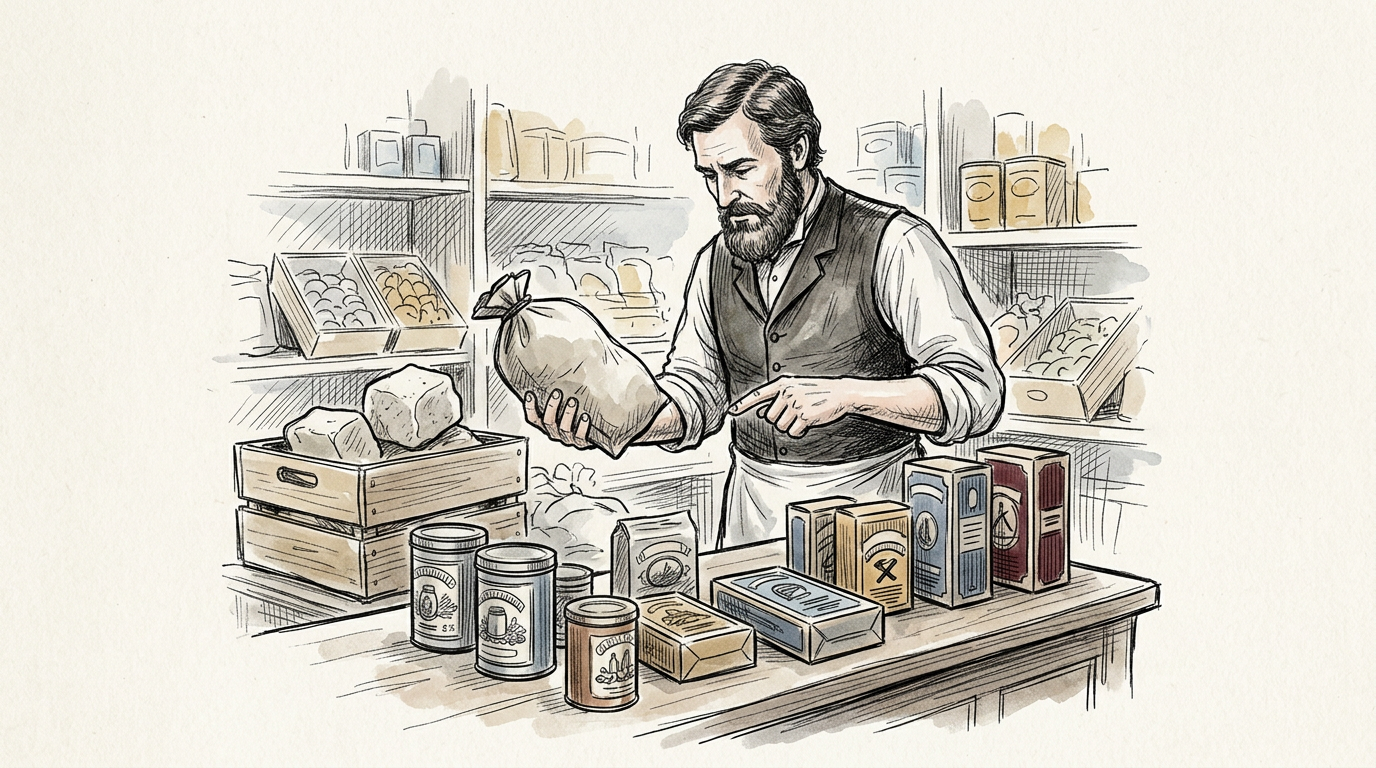
In local and regional markets, reputation was often carried by face-to-face relationships. Buyers knew the merchant, the miller, the distiller, the apothecary, or the local producer. Many goods were sold in bulk rather than in manufacturer-sealed packages. Flour, coffee, sugar, soap, and spices were commonly scooped, weighed, and wrapped by the retailer. Assurance of quality came less from a distant producer’s identity than from the standing of the local seller and the consumer’s own experience.
Marks identifying source were not new in the nineteenth century. Craftsmen, guilds, potters, printers, and merchants had long used identifying signs. English trademark history reaches back centuries, and legal historians often point to early examples such as the Bakers’ Marking Law of 1266. But these earlier marks belonged to a different commercial world. Their significance expanded dramatically only when industrial production, rail transportation, mechanized printing, and national wholesaling created a much larger separation between producer and purchaser.
By the mid-nineteenth century, especially in the United States and Britain, manufacturers increasingly sold into markets where consumers never met them and retailers stocked competing goods from many distant suppliers. In that environment, a mark no longer served merely as an identifier among traders. It became a market signal to consumers.
Industrialization made source identification a marketing necessity
The growth of trademarks cannot be understood apart from the conditions of industrialization. Mass production increased output. Railroads and steamships moved goods much farther and more reliably. Urban populations grew. Wholesale networks connected manufacturers to far-flung retailers. Advances in lithography, label printing, paperboard cartons, glass containers, and tin packaging made it easier to standardize and display products. Department stores, chain retailing, and later self-service formats changed how consumers encountered goods.
These changes created both opportunity and risk. A manufacturer could now reach a national market, but competitors could imitate appearance, use confusing names, or allow retailers to substitute one product for another. For consumers, wider choice also meant greater uncertainty. A shopper could no longer rely only on local familiarity. Products needed visible signs of origin and consistency.
Trademarking therefore addressed a market problem as much as a legal one. It gave the producer a durable way to connect repeated purchases to a recognizable source. It also gave retailers a way to stock goods consumers could request by name. That mattered in an era when branded packaged goods were beginning to compete with bulk goods, private formulations, and locally made substitutes.
Trademark law developed unevenly, but business demand for protection was clear
Formal trademark law developed gradually and not always smoothly. In the United States, Congress passed the first federal trademark act in 1870, but the Supreme Court struck it down in the Trade-Mark Cases (1879), holding that the law exceeded Congress’s constitutional authority as written. Congress then enacted a narrower federal trademark statute in 1881 focused on marks used in commerce with foreign nations or Indian tribes. A broader federal law followed in 1905, and modern U.S. trademark law took fuller shape under the Lanham Act of 1946, still the basic framework today.
The legal story matters because manufacturers were already telling lawmakers and courts that marks had become economically important. They were investing in product names, labels, packaging, and distribution relationships that could be undermined by imitation or substitution. Legal protection did not create branding by itself, but it made long-term brand-building less precarious.
Britain moved earlier in statutory form. The Trade Marks Registration Act 1875 established a formal registration system, building on earlier common-law protections against passing off. Other industrializing countries developed their own systems, and cross-border trade increased pressure for international coordination. The Paris Convention for the Protection of Industrial Property, first signed in 1883, was one of the foundational agreements in international intellectual property. For businesses trying to extend branded goods into multiple markets, this mattered. The ability to protect names and marks beyond a single local jurisdiction supported the wider circulation of branded products.
Still, registration should not be mistaken for instant clarity or universal fairness. Courts often had to decide whether a term was distinctive, descriptive, generic, deceptive, or confusingly similar to an existing mark. Those distinctions became central to marketing because not every commercially useful name could be protected equally well. A strong trademark was not just memorable. It had to function legally as a source identifier.
Packaged goods turned trademarks into everyday consumer signals
The modern importance of trademarks grew most visibly with the rise of packaged goods. When manufacturers sealed flour, soap, baking powder, canned foods, cigarettes, medicines, and other products in containers bearing consistent names and marks, they reduced some of the uncertainty that accompanied distance. Standard packaging made a promise legible: this product came from the same source as the one bought before.
That promise could be imperfect, and quality was not always what advertising or labels implied. But the underlying shift was substantial. Instead of relying mainly on the storekeeper’s recommendation, consumers could look for a printed name, a distinctive device, a wrapper color, or a package shape. Over time, these elements worked together as practical tools of recognition.
Several nineteenth-century brands illustrate this transition. Procter & Gamble’s Ivory soap, introduced in 1879, was sold as a nationally distributed packaged soap identified by name and trade dress. Quaker Oats registered the Quaker mark in the United States in the 1870s and used it to distinguish packaged oats in a market where grain products had often been sold more generically. The Coca-Cola name, first used in the 1880s and federally registered in 1893, became valuable not only because consumers could ask for it, but because the company spent decades fighting imitation and substitution in soda fountains and retail outlets.
The point is not that these marks succeeded because of naming alone. Their growth depended on manufacturing scale, distribution, sales effort, and in many cases advertising. But trademarks made those investments accumulative. They allowed reputation built in one place or medium to attach to repeatable commercial identity.
From trade acceptance to consumer pull
In earlier wholesale systems, much marketing effort was directed toward intermediaries. Manufacturers needed jobbers, wholesalers, and retailers to carry and recommend their goods. Trademarks helped in those channels because they simplified ordering and reduced confusion among competing items. A retailer could more easily stock and reorder a product identified by a distinct name or emblem than one known only by generic description.
As national brands expanded, however, trademarks also supported consumer pull. If consumers learned to request a product by name, the retailer’s ability to substitute a competing product declined. This was one reason many retailers and wholesalers were ambivalent about national brands. Branded goods could bring traffic and standardization, but they could also shift power toward manufacturers and reduce the merchant’s control over recommendation and margin.
Trade publications from the late nineteenth and early twentieth centuries show these tensions repeatedly. Manufacturers promoted the idea that branded, trademarked goods delivered dependable quality and easier selling. Some merchants agreed. Others worried about price rigidity, customer expectations, or the erosion of local store identity. These conflicts were not incidental. They were part of the larger restructuring of marketing channels.
Trademarks thus contributed to one of modern marketing’s enduring dynamics: the struggle and negotiation among manufacturers, intermediaries, and consumers over who defines value, controls choice, and owns the customer relationship.
Why source mattered when adulteration and substitution were common
Trust in branded goods developed in part because many nineteenth-century markets were full of inconsistency. Food adulteration, counterfeit patent medicines, variable ingredients, and retailer substitution were common enough to create real concern. Consumers had reasons to seek reliable signals, and manufacturers had reasons to distinguish themselves from lower-quality imitators.
Trademarked packaged goods offered one response. They did not eliminate fraud or guarantee safety, and some trademarked goods themselves were misleadingly marketed. But in categories where quality was difficult to inspect before purchase, a recognizable mark could reduce uncertainty. That was especially important for products bought repeatedly, used in the household, or consumed by children.
Government regulation later reinforced this logic. In the United States, the Pure Food and Drugs Act of 1906 and related reforms did not create brands, but they strengthened a marketplace in which claims about source, content, and consistency mattered more. Regulation and trademarks were not substitutes. They worked in parallel. Regulation established baseline rules; trademarks enabled firms to compete on reputational claims above that baseline.
This interaction remains central to marketing history. Branding succeeds most durably when recognizable identity is paired with product experience, institutional trust, and enforceable standards.
Distinctiveness became a strategic business asset
As trademark law matured, businesses learned that not all names were equally useful. A generic product term could describe what was being sold, but it could not easily serve as proprietary brand property. Courts and trademark offices increasingly distinguished among arbitrary, fanciful, suggestive, descriptive, and generic terms. Marketers would later teach these distinctions more formally, but the business implications were visible much earlier.
A distinctive mark was easier to defend and easier to attach to a particular source. That encouraged firms to create names and symbols that were unusual enough to stand apart in crowded markets. It also shaped package design and naming strategy. The commercial value of invented or highly distinctive brand names was not simply creative preference. It was tied to legal enforceability and channel clarity.
At the same time, success could produce a paradox. Some famous marks became so strongly associated with a product category that they risked becoming generic in public usage. Historical examples include Aspirin in the United States, which Bayer lost as a U.S. trademark after World War I, and Cellophane, Escalator, and Thermos in later legal disputes over genericization. These cases taught marketers a lasting lesson: a brand can become culturally dominant yet legally vulnerable if it ceases to signify a single commercial source.
That problem remains familiar today whenever brand managers insist that a mark should be used as an adjective rather than a noun or verb. Such usage guidance is not mere pedantry. It has deep roots in trademark history.
Department stores, mail order, and chain retail changed how trademarks functioned
Retail transformation altered the practical role of trademarks. Department stores in the late nineteenth century assembled large assortments under one roof, exposing consumers to many competing goods and making visual identification more important. Mail-order merchants such as Montgomery Ward and Sears, Roebuck & Co. depended on printed descriptions, catalog illustrations, and the credibility of names. Their catalogs sold both branded and unbranded goods, but the circulation of product names at scale helped standardize consumer recognition across geography.
Chain stores added another layer. As chains expanded in the early twentieth century, they changed the balance between manufacturer brands and retailer-controlled assortments. Some chains embraced famous national brands to reassure shoppers. Others emphasized private labels, using their own trademarks to create trust in store-controlled goods. This is an important part of trademark history because it shows that trademarks were not only tools for manufacturers. Retailers also used marks to build loyalty, differentiate assortments, and capture margin.
Later retail changes, including self-service grocery formats and supermarkets, made trademarks even more visible. In a clerk-served environment, conversation and recommendation still mediated many purchases. In self-service aisles, packaging had to do more work on its own. Marks, colors, shapes, and brand names became navigational devices. By the mid-twentieth century, trademarked packaged goods were embedded in the visual logic of mass retail.
Trademark protection supported the rise of brand management
As branded consumer goods firms grew in the early twentieth century, trademarks became part of broader systems of brand stewardship. Protecting a mark required monitoring imitators, managing packaging consistency, standardizing usage, coordinating sales materials, and aligning claims with product performance. These activities were not yet always organized under a modern marketing department, but they increasingly required specialized managerial attention.
The development of brand management inside major packaged goods companies illustrates this shift. Procter & Gamble is frequently cited for formalizing aspects of brand management with Neil H. McElroy’s 1931 memorandum on the management of Camay soap, a document often treated as a landmark in brand organization. While that memo belongs to a later stage of marketing history, it rested on foundations built earlier: products already had protected names, established package identities, and recognizable positions in the market. Trademarked identity made sustained brand administration possible.
This is one of the clearest ways trademarks connect to the professionalization of marketing. A mark that carries accumulated commercial meaning must be managed across distribution, pricing, packaging, promotion, legal protection, and product change. As firms recognized that need, branding became less an occasional sales aid and more a continuing business function.
Research, recognition, and the measurement of brand value
Trademarked goods also shaped the development of market research. Once products were sold under stable names and symbols, firms could ask consumers what they recognized, preferred, trusted, and repurchased. Early twentieth-century commercial research did not yet have the methodological sophistication of later brand tracking, but the existence of identifiable brands made comparative measurement far more practical.
Recognition studies, dealer reports, coupon returns, repeat-order records, and consumer surveys all became more useful when responses could be tied to clearly differentiated branded goods. In that sense, trademarks did not merely protect brands after the fact. They helped create the measurable units of competition on which much modern marketing analysis depends.
Later concepts such as brand awareness, brand loyalty, and brand equity were built in part on this condition of stable market identity. A product sold only as a generic commodity can be measured by volume and price. A trademarked brand can also be measured by recognition, associations, substitution patterns, and loyalty behavior.
International trade expanded the strategic importance of trademarks
As companies crossed borders, trademarks became even more consequential. A brand entering a new country had to secure rights, avoid conflicts with existing marks, navigate translation issues, and ensure that packaging and names functioned in local retail environments. International trademark registration systems evolved gradually to reduce friction, but they never eliminated complexity.
For marketers, the historical significance is clear. The globalization of brands was not only a matter of exporting products or buying media abroad. It also required legal and linguistic management of brand identity. Distinctiveness in one country might be descriptive or problematic in another. A family-owned or regionally strong mark might have little protection outside its home market. Trademark strategy therefore became part of international marketing planning long before digital commerce made cross-border visibility instantaneous.
Counterfeiting, copying, and the limits of trademarks
Trademark history is also a history of limits. Marks could be infringed, diluted, evaded, or copied in ways difficult to police. Packaging look-alikes, suggestive imitation, and deceptive similarity have persisted across eras. Some firms deliberately hovered near another brand’s identity without making identical claims. Others used trademarks to assert market control aggressively. Legal protection never resolved every competitive dispute cleanly.
Nor should the history of trademarks be mistaken for a simple history of consumer empowerment. Trademarks helped consumers identify and repurchase goods, but they also helped firms lock in preference, discourage substitution, and command premiums. The same mark that reduced uncertainty could also be used to sustain status hierarchies, obscure manufacturing changes, or extend reputations into adjacent categories with mixed results.
These tensions are part of modern marketing, not deviations from it. Trademarks support trust, but they also support strategy.
What this history explains about modern branding
Modern marketers often use the word “brand” to cover a wide range of meanings: visual identity, reputation, positioning, customer experience, cultural symbolism, and financial value. Trademark history does not encompass all of that, but it explains an essential foundation. A brand became commercially scalable when it could be identified consistently across distance, protected legally, reproduced on packaging, recognized in stores, ordered through distribution channels, and remembered by consumers.
That is why trademarks mattered so much in the development of modern marketing. They made reputations portable. They allowed manufacturers to invest in names and packages that would survive beyond a single transaction. They gave retailers and consumers shorthand for source. They supported standardization in an increasingly complex market. They encouraged the growth of branded packaged goods, helped shift demand toward consumer recognition, and created assets that required ongoing managerial care.
Today’s digital platforms, search results, marketplaces, loyalty systems, and omnichannel retail environments may seem far removed from the era of lithographed labels and rail-shipped cartons. Yet the core problem is familiar. In crowded markets, buyers still need signals that connect offers to accountable sources. Firms still need ways to distinguish themselves, defend reputation, and make repeated choice easier. Trademarks remain one of the oldest and most durable tools for doing that, not because they are relics of legal history, but because they helped create the conditions under which brands became central to marketing at all.
Leave a Reply