
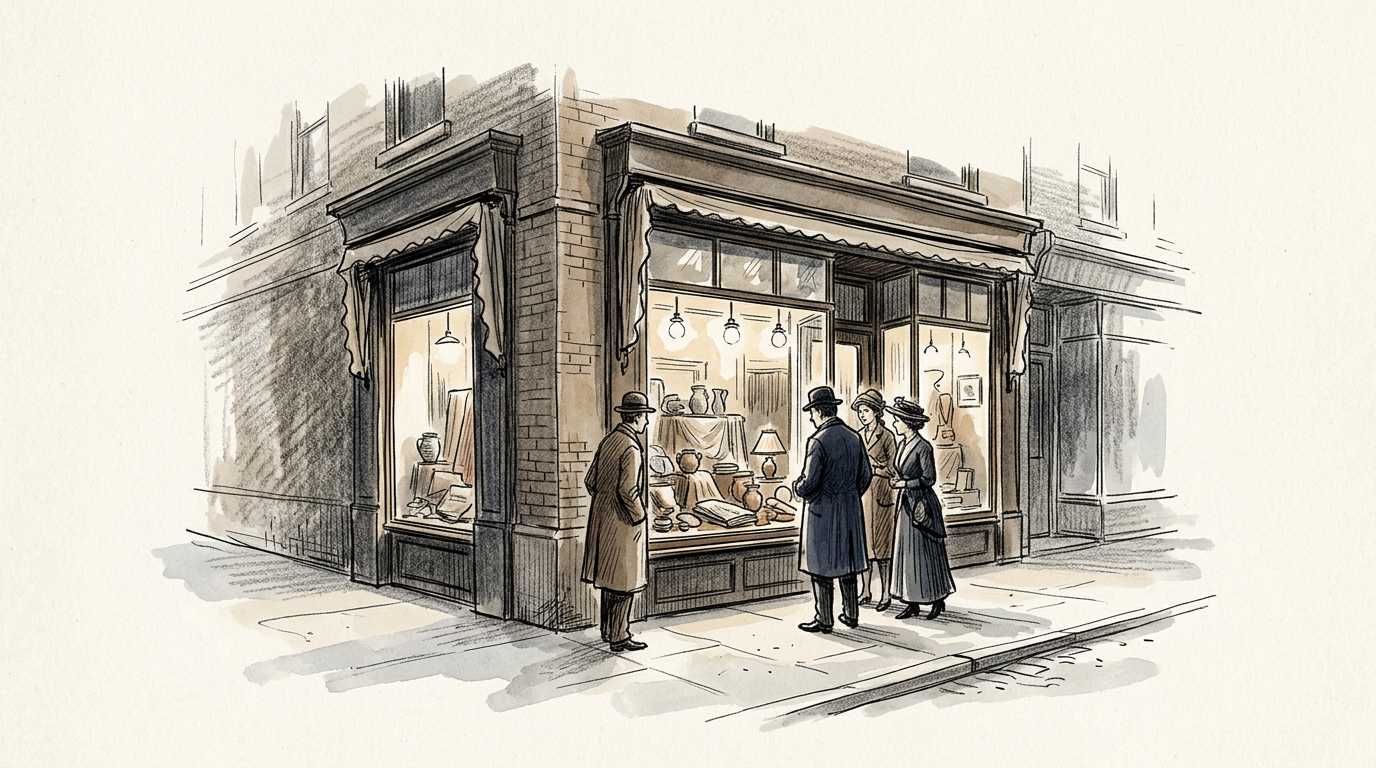
Long before retailers spoke of customer journeys, storefront windows were already shaping one of the most important moments in marketing: the transition from public street life to private commercial space. A shop window could identify a business, signal quality, introduce novelty, teach consumers how to use a product, stage desire, and convert passersby into store traffic. By the late 19th and early 20th centuries, the window had become more than an architectural feature. It had become a marketing medium.
That development did not happen simply because merchants wanted prettier storefronts. It depended on changes in glass manufacturing, urban retail geography, transportation, lighting, department store competition, and merchandising practice. It also depended on a broader shift in how merchants understood the market. As retailing moved from local trade and clerk-mediated selling toward large-scale, branded, visually organized consumer markets, the window became a place where retailers could present goods before any conversation with a salesperson began.
Seen in that context, the history of window display belongs squarely to marketing history. It is part of the development of merchandising, product presentation, seasonal promotion, store image, and the management of pedestrian attention in increasingly crowded commercial environments.
Before the modern display window
For much of the early modern period, many shops did not operate with the large transparent frontages now associated with retail. Goods were often sold through open stall-like fronts, over counters, or in relatively dim interiors where merchandise was shown selectively by the shopkeeper. In many trades, particularly in the 18th century, exterior signs and symbolic trade emblems did more to identify a store than any large visual presentation of its inventory.
Glass existed, of course, but large panes were expensive, technically limited, and fragile. Window openings were often divided into many small panes by muntins, which restricted visibility. In practical terms, the street-facing shopfront was not yet an expansive visual merchandising surface.
The gradual enlargement of display windows in the 19th century reflected industrial improvements in plate glass production and distribution. In Britain, repeal of the glass tax in 1845 helped lower costs and encourage wider use of larger panes. In the United States and Europe, advances in manufacturing and transport made broad sheets of clearer glass more available to urban builders and merchants over the course of the century. These technical changes mattered because they altered what retailers could do. A larger pane did not merely improve aesthetics. It created a new interface between store and street.
At the same time, urbanization and the growth of shopping districts created heavier pedestrian traffic. Retailers in cities such as Paris, London, New York, Philadelphia, and Chicago increasingly competed not only on assortment and price but also on visibility. In denser commercial streets, where consumers could compare stores within a short walk, attention itself became a retail resource.
Department stores and the public theater of merchandise
The rise of the department store gave window display a new commercial importance. Stores such as Aristide Boucicaut’s Le Bon Marché in Paris, A. T. Stewart’s establishments in New York, Marshall Field & Company in Chicago, John Wanamaker’s stores in Philadelphia and New York, and Selfridges in London developed retail environments built around volume, assortment, spectacle, and foot traffic. Their success depended in part on attracting large numbers of shoppers who might browse as well as buy.
This was a meaningful change from earlier retail formats. In smaller shops, goods were often stored behind counters, and selling remained highly mediated by clerks. Department stores, by contrast, increasingly treated merchandise presentation as a strategic function. Interior departments, fixed prices, browsing, seasonal stock turnover, and large-scale promotions all required new methods of showing goods. The window became one of the first points in that system.
By the late 19th century, trade writing and retailer commentary were already treating the window as a sales instrument. Dry goods merchants, department store managers, and trade journals discussed how displays could increase traffic, support promotions, and establish the store’s reputation for taste or fashion leadership. The logic was recognizably modern: the storefront should not merely reveal inventory; it should present a curated proposition to a specific public at a specific moment.
John Wanamaker is often cited in retail histories for elevating display and merchandising practice, though care is needed with broad claims about any single founder “inventing” modern retail methods. What can be documented is that major department stores in the late 19th century invested heavily in display, decoration, and event-based merchandising, and that Wanamaker’s stores were among the best-known examples. Storefronts and interiors worked together to create what would later be called store image, long before that term was formalized in marketing literature.
The department store window also reflected a larger change in the relationship between producers, retailers, and consumers. As manufacturers developed national brands and fashion cycles accelerated, retailers needed a way to present novelty quickly. Windows offered a high-visibility, rapidly changeable surface for this purpose. They could feature imported goods, seasonal fabrics, ready-made garments, holiday merchandise, or branded packaged products without redesigning the store itself.
From architectural opening to planned merchandising space
Once retailers recognized the window as commercially important, display became more systematic. Storefront design evolved to support it. Architects and retailers increasingly used large plate-glass windows, recessed entrances, and deeper display spaces. The recessed doorway, common in late 19th- and early 20th-century urban retail, created room for window composition while also easing pedestrian flow.
Display itself became a specialized retail function. Rather than simply piling goods near the glass, stores began to arrange items by theme, use risers and props, manage color harmony, and control sightlines from the sidewalk. These were merchandising decisions, not just decorative ones. They reflected a growing awareness that product context affected perceived value.
This development paralleled changes in retail labor. As stores expanded, responsibilities that had once belonged loosely to owners or floor clerks became specialized roles. Window trimmers, display managers, decorators, and visual merchandisers emerged as recognized retail specialists. Their work sat at the intersection of sales promotion, store operations, fashion knowledge, and consumer psychology.
Trade publications helped professionalize the field. In the United States, titles such as The Dry Goods Economist and other retail journals published advice on arrangement, color, seasonality, and window effectiveness. By the early 20th century, display had become teachable, discussable, and measurable enough to sustain a body of professional knowledge.
This is one reason window display matters in marketing history. It illustrates how merchandising moved from tacit shop practice to a more formalized business discipline. The window was not only a space for goods. It was a site where retailers developed practical theories about attention, segmentation, aspiration, and conversion.
Electric lighting extended the marketing day
If plate glass made display visible, electric lighting made it continuous.
In the gaslight era, evening visibility was limited and often uneven. Electric lighting, which expanded in urban commercial districts in the late 19th century, transformed the selling potential of windows after dark. A well-lit display could continue working long after store closing, reaching office workers, theatergoers, commuters, and other nighttime pedestrians. The window became a persistent advertisement for the store’s assortment and identity, but one integrated with the retail premises rather than purchased through external media.
This changed both retail scheduling and display strategy. Merchants could justify more elaborate scenes because the audience lasted longer. Lighting also enabled greater dramatic control through spot effects, contrast, and emphasis on specific products. White goods, jewelry, glassware, and fashion all benefited from illumination that suggested refinement or novelty.
Urban nightlife mattered here. As downtown entertainment districts, department stores, restaurants, and transit hubs fed pedestrian circulation, windows became part of the illuminated commercial streetscape. They did not function in isolation. They formed a visual competition system in which each retailer had to win seconds of attention from people already surrounded by stimuli.
By the early 20th century, display lighting was sufficiently important that it appeared regularly in trade discussions about sales effectiveness. Illumination had become part of retail marketing strategy, not merely an operational utility.
Window display and the rise of seasonal promotion
One of the window’s most durable contributions to marketing was its role in organizing retail time. Windows helped retailers teach consumers that merchandise changed with seasons, holidays, weather, school cycles, and social occasions. This temporal framing supported planned promotion and inventory rotation.
Holiday display became especially important. Christmas windows, Easter presentations, back-to-school arrangements, and spring fashion unveilings turned the shopfront into a public calendar of consumption. Department stores made this highly visible. By the late 19th and early 20th centuries, major holiday windows in large cities were drawing substantial foot traffic and press attention.
Macy’s holiday windows later became nationally famous, but the broader practice of seasonal window merchandising was not confined to one chain. Across American and European cities, stores used windows to synchronize merchandise with cultural moments. This mattered because it linked retailing to anticipation. Consumers did not simply shop when they had an immediate need. They learned to expect new presentations and to visit stores for inspiration, browsing, and festive spectacle.
That shift had direct marketing implications. Seasonal windows increased repeat exposure, supported promotional calendars, and encouraged shoppers to associate specific stores with timely relevance. In modern terms, the window helped create recurring demand occasions.
It also revealed the growing interdependence of merchandising and broader promotional systems. Newspaper advertising might announce a sale, but the window gave it physical proof on the street. In-store displays extended the message further. The result was an integrated retail communication system long before “integrated marketing” became a managerial phrase.
Aspiration, lifestyle, and the education of taste
Retail windows did not merely show products. They increasingly presented ways of living with products.
This was particularly visible in apparel, home furnishings, and department store housewares. Rather than display each item as isolated stock, stores assembled coordinated scenes. Mannequins, room settings, props, and carefully selected accessories suggested proper combinations, emerging fashions, class aspirations, and new domestic standards. The window became a place where consumers encountered not just objects for sale but retail interpretations of taste.
That practice fit the needs of expanding consumer markets. As mass production increased the volume and variety of available goods, many consumers needed guidance in selecting and evaluating them. Branded packaged goods could rely partly on labels and trademarks, but fashion and home goods benefited from contextual display. Retailers used windows to reduce uncertainty, encourage comparison on favorable terms, and elevate perceived quality.
This was not a neutral process. Window display could reinforce social hierarchies, gender expectations, and exclusionary ideals of beauty, domesticity, or status. Department stores often cultivated aspiration by presenting middle- and upper-class lifestyles as desirable norms. Histories of retail culture have shown that stores were public spaces, but not equally comfortable or equally welcoming ones for all consumers. The aspirational function of window display should therefore be understood alongside the social boundaries embedded in many retail environments.
Even so, the commercial logic was clear. When products were shown in use, in ensembles, or in imagined settings, they acquired meaning beyond utility. Modern lifestyle merchandising, cross-merchandising, and experiential retail all owe something to this earlier practice.
The profession of display
By the early 20th century, display work had become a recognized specialty. “Window trimming,” the period term commonly used in trade literature, involved design judgment, practical installation skill, product knowledge, and an understanding of local consumers. It also produced a new class of retail experts whose work influenced store traffic and sales but who stood outside the better-known worlds of salesmanship and advertising.
Trade associations and schools reinforced that specialization. In New York, the Pratt Institute offered courses related to display and retail design in the early 20th century, and display instruction appeared in commercial education more broadly. The National Association of Display Men, founded in 1914, later became an important professional organization in the field. Its evolution eventually contributed to what is now the Society for Experiential Graphic Design, a reminder that display practice connected retail merchandising with exhibition design, signage, and visual communication.
Professional journals devoted specifically to display and merchandising circulated practical methods. They discussed color, balance, motion, materials, mannequin use, and the comparative selling value of different arrangements. This was not marketing theory in an academic sense, but it was a professional body of applied knowledge built around consumer response and retail performance.
The display profession also reflected the internal differentiation of the modern marketing function. Many responsibilities now grouped under merchandising, retail marketing, store design, and visual branding were once distributed across owners, buyers, decorators, and sales managers. Window display sat at that organizational crossroads.
Measurement before digital analytics
Retailers did not have modern attribution models, but they did try to assess whether windows worked.
Trade sources from the early 20th century describe merchants counting store entries, comparing sales before and after display changes, observing pedestrian pauses, and matching windows to advertised promotions. Some stores tested different arrangements or rotated products to see which presentations increased inquiry. These methods were limited, informal, and often far from contemporary research standards, but they show that windows were treated as accountable merchandising assets rather than pure ornament.
This is historically significant. Marketing measurement is often discussed as though it arrived with databases or digital media. In fact, retailers had long been trying to connect presentation, traffic, and sales using the observational tools available to them. The window was one place where that logic became especially concrete because the sequence from exposure to store entry was visible in real time.
The limitations are important too. Early observations could not cleanly isolate causation from weather, pricing, seasonality, location, or general demand. But they still encouraged disciplined thinking about shopper behavior. In that respect, storefront display belongs to the longer history of retail analytics.
The window in the age of chains, brands, and mass retail
As chain stores expanded in the early 20th century, windows took on another marketing role: standardization. Chains needed ways to express a consistent identity across multiple locations while still responding to local conditions. Window programs helped them do both. Central offices could distribute display plans, signage, and promotional themes, while local managers adapted execution to neighborhood traffic and store size.
Manufacturers also became more involved in display through branded fixtures, window cards, dealer aids, and cooperative promotional materials. This was especially visible in packaged goods, tobacco, cosmetics, and appliances. The storefront became contested territory where retailer identity and manufacturer branding intersected.
That relationship remains familiar today. Brands still depend on retailers and platforms for presentation, and retailers still seek to protect their own image while monetizing access to shoppers. The historical window display was an early version of this negotiation.
The spread of automobiles and suburban retail later changed the role of windows without eliminating it. Downtown department store windows had been designed for dense pedestrian traffic. Suburban shopping centers and roadside formats often gave more space to parking, signage, and broader facade visibility. Even so, display remained important in malls, specialty apparel, jewelry, home furnishings, and luxury retail, where the storefront continued to function as a transition zone between circulation space and selling space.
Midcentury modernism and the abstraction of display
By the mid-20th century, window display aesthetics began to shift in many sectors. Earlier abundance and heavily dressed scenes often gave way, especially in fashion and prestige retail, to more selective and modernist presentation. Fewer products, cleaner lines, stronger color fields, and greater use of negative space signaled confidence and sophistication.
This was not simply an artistic preference. It reflected changing ideas about branding and consumption. When stores and brands sought to communicate distinction, curation, or modern taste, the sparse window could do what the crowded one could not. It suggested that not everything needed to be shown because the retailer already possessed authority.
Display designers became influential in this period, particularly in fashion retail. Figures such as Gene Moore at Tiffany & Co. and later Bonwit Teller demonstrated how narrative, wit, and formal restraint could turn windows into brand statements as much as merchandise presentations. Their work is often discussed in design history, but it also belongs to marketing history because it helped clarify how visual environment contributes to brand meaning.
The lesson endures in luxury retail, flagship stores, and premium category management. Selective presentation can be as strategic as maximal assortment, depending on the market position being communicated.
From window trimming to visual merchandising
The terminology surrounding display also changed. “Window trimming,” common in the late 19th and early 20th centuries, gradually gave way to “display,” “visual presentation,” and eventually “visual merchandising.” The newer language reflected a broader shift from craft execution toward integrated retail strategy.
Visual merchandising encompassed not only the front window but also store layout, signage, fixture systems, mannequin programs, category adjacencies, color stories, and branded environments. The window remained a distinctive element because it addressed noncustomers as well as customers, but it increasingly sat within a larger managed system.
This development paralleled the rise of modern marketing departments, retail planning functions, and brand management. As firms coordinated product, price, promotion, and distribution more formally, presentation could no longer be treated as an isolated artistic function. It had to align with inventory plans, pricing strategies, promotional calendars, and target markets.
That is one reason the history of window display still matters. It shows how visual presentation moved from the margins of retail operations toward the center of market strategy.
Digital commerce did not eliminate the storefront logic
The growth of ecommerce changed where many consumers first encounter merchandise, but it did not erase the marketing principles established by window display. Instead, it translated them into new channels.
An ecommerce homepage, a category landing page, a marketplace storefront, a shoppable social post, and even a mobile app hero banner all perform some of the same historical tasks. They stop movement, frame attention, establish mood, signal relevance, present novelty, support seasonal campaigns, and move viewers toward deeper engagement. They are not identical to a physical window, but they inherit many of its marketing functions.
Physical retail has responded by treating windows more explicitly as brand media. Luxury stores, fast-fashion chains, and experiential retailers use them to create social shareability, local presence, and launch visibility. In dense urban districts, the old logic remains clear: the window is still one of the few media a retailer fully controls at the point where public attention can become store traffic.
Modern technologies have also expanded what a “window” can be. Projection, digital screens, dynamic lighting, and interactive installations allow real-time changes and richer storytelling. Yet these innovations rest on historical foundations laid when merchants first learned that transparent glass at street level could do more than admit light.
Why this history matters to marketing
The rise of window displays shows that marketing developed not only through mass media, branding theory, and market research, but also through retail interfaces where visibility, timing, and product meaning were actively managed. The storefront window helped merchants solve a practical problem created by urban retail modernity: how to attract, inform, and persuade people before a salesperson ever spoke to them.
Its history also helps explain several enduring features of marketing practice:
- Merchandising is a form of market communication, not just stock arrangement.
- Physical environment can shape demand by framing products within seasons, lifestyles, and aspirations.
- Attention is a scarce resource in competitive retail settings, and presentation technologies matter because they change what can be seen and when.
- Retail marketing often develops through applied experimentation before it is formalized in management language or academic theory.
- Point-of-sale and near-point-of-sale media have long been measurable, adaptable, and strategically important.
The modern marketer inherits a world in which consumer attention is fragmented across screens, streets, platforms, and stores. The historical storefront window reminds us that this is not entirely new. Retailers have long competed at the threshold, where exposure may become intention and intention may become purchase. What changed in the late 19th and early 20th centuries was that merchants learned to treat that threshold systematically. Once they did, the shop window ceased to be merely part of the building. It became part of marketing.
Leave a Reply