
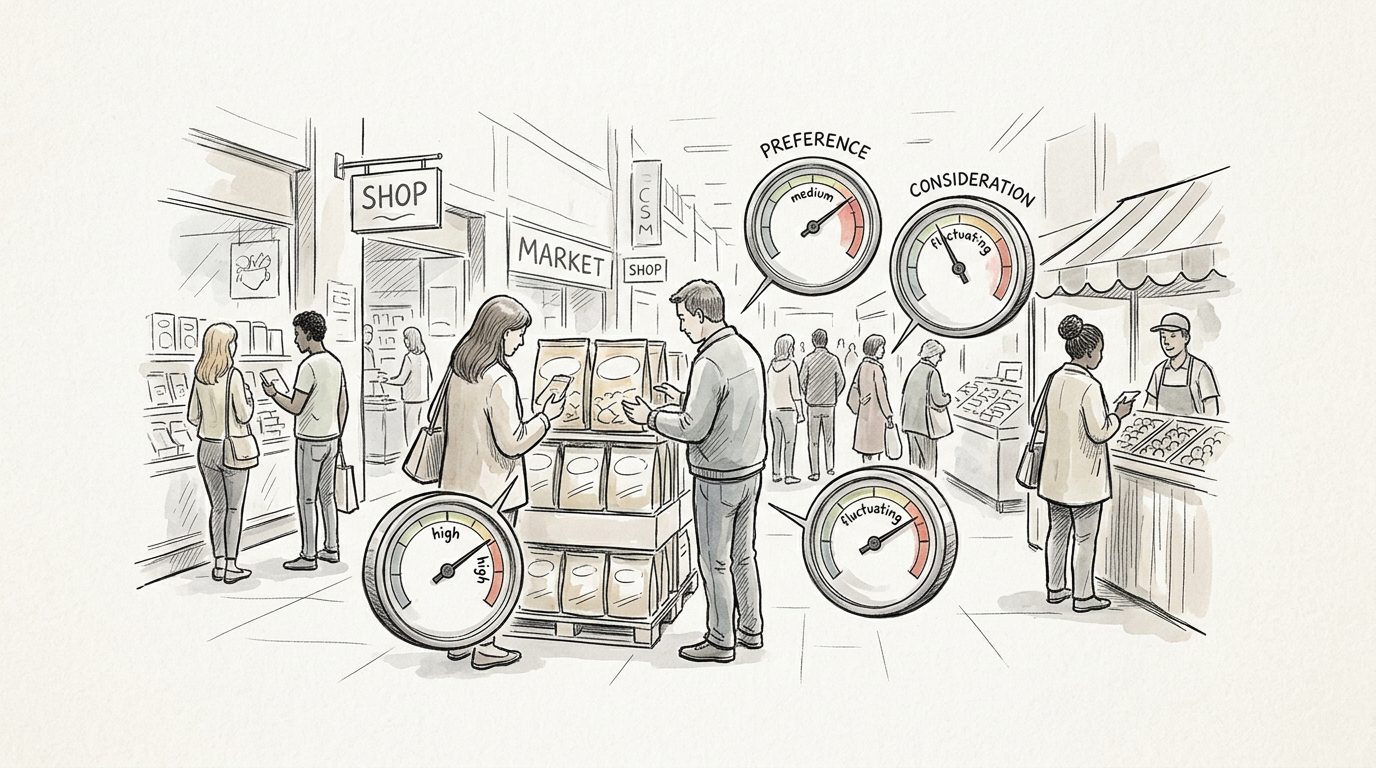
Brand awareness is one of the most cited measures in marketing, and one of the easiest to overinterpret. Leaders often ask whether people know the brand, whether advertising is lifting recall, or whether market visibility is improving. Those are legitimate questions. But they do not answer a more consequential one: what does that awareness actually mean for brand strength?
A brand can be widely known and weak. It can be recognized immediately but rarely chosen. It can dominate conversation while suffering from low trust, poor consideration, limited pricing power, or declining loyalty. It can even achieve high awareness because of controversy, ubiquity, or category saturation rather than because it occupies a strong and valued position in people’s minds.
For branding professionals, the distinction matters because awareness is only one component of brand equity. It reflects whether a brand is mentally available enough to be recalled or recognized. Brand strength, by contrast, is broader. It concerns the quality of the associations attached to that awareness, the expectations people hold, the confidence they place in the brand, the role it plays in choice, and the extent to which it can sustain demand and value over time.
Understanding that difference requires a closer look at how awareness is measured, what it can and cannot tell us, and how it relates to consideration, preference, trust, and purchase behavior.
Awareness is a threshold measure, not a complete diagnosis
Brand awareness usually refers to whether people know that a brand exists. In practice, that can be measured in several ways.
Unaided awareness asks people to name brands in a category without prompts. A survey might ask, “When you think of athletic footwear, which brands come to mind?” The answers indicate which brands are most easily retrieved from memory. Unaided awareness is often useful because it reflects mental accessibility without external cues.
Aided awareness asks respondents whether they have heard of a particular brand once it is named for them. This usually produces higher scores because recognition is easier than recall. Someone may not spontaneously name a regional bank, software provider, or packaged food brand, but may still know it when prompted.
Recognition adds another dimension. A person may recognize a brand name, package shape, color combination, mascot, tagline, app icon, or sonic cue without being able to recall it unaided. This is where distinctive brand assets become strategically important. Research from the Ehrenberg-Bass Institute has emphasized the role of distinctive assets in helping brands get noticed and identified in buying situations, especially when consumers are not conducting elaborate comparative evaluations. Awareness in this sense is not just verbal knowledge. It is the ability to connect a cue to the correct brand quickly and confidently.
These measures are useful, but they are incomplete. Awareness tells you that a brand has achieved some degree of salience. It does not tell you whether consumers think the brand is credible, relevant, superior, expensive, outdated, risky, convenient, unethical, low quality, aspirational, generic, or simply familiar.
In other words, awareness answers “Is the brand known?” Brand strength asks, “Known for what, by whom, under what circumstances, and with what consequence?”
Knowing a brand is not the same as considering it
One of the most common mistakes in brand analysis is to treat awareness as a proxy for demand. The gap between the two is consideration.
Consideration refers to whether a brand makes it into the set of options a person is willing to evaluate or choose from. A consumer may know dozens of hotel chains, auto insurers, athletic apparel brands, or productivity software companies. Yet only a small subset will be seriously considered when a real decision is made.
That gap is strategic, not accidental. Brands fall short on consideration for many reasons:
- They are known but not relevant to the consumer’s needs.
- They are associated with the wrong price tier or use case.
- They are seen as acceptable for others but not “for people like me.”
- They are recognized but poorly differentiated.
- They suffer from weak credibility in the specific purchase situation.
- They are present in memory but absent from the decision frame.
This is where positioning becomes more important than raw familiarity. A brand’s positioning is not its slogan or latest campaign line. It is the strategic choice about how the brand should be understood relative to alternatives in a given competitive frame. If awareness is broad but positioning is vague, inconsistent, or unconvincing, the brand may be remembered without being meaningfully considered.
For example, many telecommunications, airline, or retail banking brands have high awareness because they operate at national scale and invest heavily in media. But category familiarity does not guarantee active consideration, especially when people perceive offerings as interchangeable or when trust is uneven. In such categories, the challenge is often not making the brand known. It is making the brand feel like a sensible, lower-risk, or more rewarding choice.
Preference requires more than familiarity
Preference goes further than consideration. It reflects whether people would choose one brand over alternatives when those alternatives are available. Preference usually depends on a combination of functional expectations, emotional associations, prior experience, social meaning, perceived quality, and category-specific advantages.
This is where awareness can become actively misleading if used in isolation. A brand may achieve very high levels of recognition because it has been in the market for decades, advertises heavily, or dominates shelf presence. Yet if consumers do not perceive meaningful reasons to choose it, awareness contributes little to competitive advantage.
In branding terms, this is the difference between being mentally present and being mentally advantaged.
The distinction also helps explain why differentiation and distinctiveness should not be conflated. Distinctiveness concerns whether consumers can identify the brand through cues such as colors, shapes, names, taglines, sounds, or package structures. Differentiation concerns whether consumers perceive reasons to see the brand as meaningfully different or better suited to a need. A brand can be highly distinctive and easy to recognize but not especially preferred. It can also be differentiated in product substance yet weakly encoded in memory if its assets are inconsistent or generic.
Strong brands tend to work on both dimensions. They create recognizable cues and attach those cues to associations that matter in choice.
Trust changes the meaning of awareness
Trust is one of the clearest examples of why awareness and brand strength diverge.
Being well known can increase perceived legitimacy in some categories. Familiarity can reduce uncertainty. Consumers often prefer names they recognize, particularly in low-information or low-involvement settings. But familiarity is not the same as trust. In healthcare, financial services, technology platforms, food safety, and travel, trust depends on performance, transparency, experience, governance, reputation, and consistency over time.
A brand that is widely known for data misuse, hidden fees, poor service, unreliable quality, or corporate misconduct may have extremely high awareness and weak brand strength. In those cases, awareness can even magnify risk by making negative associations easier to retrieve.
This is one reason reputation and branding should not be treated as identical. Branding involves strategic choices about positioning, identity, architecture, communication, and experience. Reputation is the accumulated social judgment that forms around the organization and its brands. Brand managers can influence reputation, but they do not fully control it. Public behavior, operational decisions, labor practices, product performance, crisis response, and third-party commentary all shape whether awareness turns into trust or skepticism.
The Edelman Trust Barometer, while focused broadly on institutions rather than serving as a direct brand equity metric, has repeatedly shown that trust operates as a distinct dimension of stakeholder judgment rather than as a byproduct of visibility alone. For brands in sensitive categories, high recognition without trust can produce fragility rather than strength.
Purchase behavior is affected by branding, but not explained by branding alone
Commercial performance matters, but it should be interpreted carefully. Purchases are influenced by brand perceptions, yet they are also shaped by distribution, pricing, promotion, product quality, timing, switching costs, convenience, habit, and availability.
A brand may enjoy strong awareness but underperform because it is hard to find, badly priced, poorly reviewed, or unsupported by customer experience. Conversely, a brand may generate healthy sales in the short term through heavy discounting or distribution power while still having weak underlying brand equity.
That is why brand strength should not be inferred from either awareness or sales in isolation.
A more useful approach is to examine how awareness interacts with other indicators, including:
- Unaided awareness and top-of-mind recall.
- Aided awareness and cue-based recognition.
- Consideration rates within relevant segments.
- Perceived quality and trust measures.
- Preference relative to named competitors.
- Repeat purchase or retention where category conditions make that meaningful.
- Price premium tolerance.
- Share of search, direct traffic, branded search behavior, or other behavioral signals, interpreted cautiously.
- Distribution and availability context.
This kind of measurement discipline matters because branding is a long-term asset-building activity, not simply a campaign output. If a spike in awareness is not accompanied by improved understanding, consideration, trust, or buying relevance, it may not represent stronger brand equity.
Recognition depends on memory structures, not just media weight
Brand awareness is often discussed as though it is mainly an outcome of advertising volume. Media investment certainly matters, but the way awareness is encoded and retrieved depends on the quality and consistency of the memory structures being built.
That includes names, symbols, packaging, sounds, spokespersons, product forms, and recurring verbal patterns. Distinctive assets help people recognize a brand quickly in cluttered environments and fragmented media contexts. They serve as retrieval shortcuts.
This is one reason branding extends beyond communications. A brand name that is difficult to pronounce, a visual system that resembles category conventions too closely, an architecture that confuses the relationship between parent and product brands, or packaging that fails to cue the brand clearly can all weaken recognition even when media spending is substantial.
The issue is especially visible in rebranding programs. Organizations sometimes update visual identity systems in pursuit of modernization, simplification, or digital usability. Those goals may be valid. But if a redesign removes or dilutes the cues that consumers actually use to recognize the brand, awareness can become less actionable. People may still know the brand exists, but their ability to spot it quickly at the point of choice may decline.
This does not mean brands should never evolve. It means the task is not aesthetic novelty. It is managing continuity and change so that recognition survives while meaning improves.
High awareness can reflect very different kinds of brand meaning
Brands become widely known for different reasons, and not all of them are strategically valuable.
Some are known because they are category leaders and default options. Some are known because they have long heritage and dense distribution. Some are known because they are polarizing, heavily criticized, or culturally controversial. Some are known because they spent aggressively on advertising but failed to establish a credible reason to choose them. Some are known because they occupy a clear niche, even if they are not broadly preferred.
That is why professionals should always ask what kind of awareness they are looking at.
For example, top-of-mind awareness in a category may suggest strong mental availability, but the underlying associations might still be mixed. A brand might be first recalled because it is cheap, old-fashioned, difficult to cancel, socially visible, or frequently complained about. Those associations can still drive choice in certain situations, but they do not automatically indicate strong, healthy, or transferable brand equity.
The practical implication is straightforward: awareness metrics need interpretive context. Aided awareness of 90 percent means something very different for a mass-market soft drink, a B2B cloud platform, a local hospital network, and a luxury watchmaker. Category buying frequency, competitive structure, purchase involvement, and distribution conditions all affect what awareness is worth.
Brand architecture can inflate or obscure awareness metrics
Awareness becomes even more complicated in organizations with multiple brands, sub-brands, endorsements, and corporate identities.
In a branded house system, the corporate name may dominate awareness while individual offerings rely on that parent brand for credibility. In a house of brands, product-level awareness may be high even when consumers know little about the parent company. In hybrid systems, consumers may recognize some relationships and miss others entirely.
This matters because awareness can be measured at the wrong level. A company may report that “the brand” is highly known, but that may reflect awareness of the corporate name rather than the specific service line, product family, or sub-brand that must win actual consideration. The reverse can also be true. Product brands may enjoy strong recognition while the parent company remains vague or reputation-vulnerable.
Brand architecture is therefore not just an internal portfolio diagram. It shapes how awareness travels, whether equity transfers, how easily new offerings gain traction, and how damage in one part of the portfolio affects another. For professionals evaluating brand strength, the question is not simply whether the name is known, but which name is known, in what buying context, and with what associations attached.
Rebranding does not solve weak brand strength by itself
When organizations discover that they are known but not chosen, they sometimes respond with what is described as a rebrand. But if the real issue lies in weak positioning, poor experience, damaged trust, or architecture confusion, changing visual identity alone is unlikely to alter brand strength in a durable way.
A true rebrand may involve changes to target market, strategic positioning, naming, brand architecture, messaging, product framing, service design, and internal culture, in addition to identity expression. If only external symbols change, the result is more accurately described as an identity refresh.
This distinction matters because awareness is often easiest to move through communications, while trust and preference are harder to move without operational substance. If audiences already know a brand and hold unfavorable associations, greater visibility can simply reinforce those impressions. The strategic task is not to become more noticeable in a vacuum. It is to change what the brand is understood to mean and how consistently the organization delivers against that meaning.
That is why the strongest rebranding efforts typically align multiple layers of the brand system: market positioning, experience, language, design cues, employee behavior, and portfolio logic. Without that alignment, awareness may remain high while brand strength remains stagnant.
What a stronger measurement approach looks like
For brand leaders, the practical challenge is not abandoning awareness. It is putting it in the right place.
Awareness should usually be treated as an early or intermediate indicator rather than an all-purpose verdict. It can reveal whether a brand is entering memory, whether distinctive assets are functioning, whether communications are broadening salience, and whether competitive presence is improving. But it should be read alongside measures that address depth, quality, and consequence.
A more strategically useful dashboard often includes several layers:
- Awareness and recognition: unaided recall, aided awareness, asset recognition, branded attribution.
- Meaning and association: what consumers connect to the brand, including category fit, quality cues, emotional tone, and differentiating beliefs.
- Decision relevance: consideration, shortlist inclusion, stated likelihood to choose, and substitution patterns.
- Relationship strength: trust, satisfaction, repeat behavior, advocacy where appropriate, and resilience after service failures or price changes.
- Commercial implications: conversion, retention, share, margin support, and price elasticity, interpreted in light of distribution and operational realities.
The point is not to create a universal score. It is to avoid mistaking one stage of brand response for the entire brand system.
Why the distinction matters for long-term brand management
The strategic danger of overvaluing awareness is that it encourages shallow decision-making. Organizations may chase reach, publicity, or visibility while neglecting the less glamorous work of sharpening positioning, strengthening distinctive assets, improving customer experience, clarifying architecture, and building trust through consistent performance.
That can be especially costly in mature categories, where many competitors are already known and where buying behavior depends on subtle differences in perceived relevance, reliability, and ease. In those markets, the next point of awareness often matters less than the next point of consideration or trust.
It also matters in periods of brand change. When companies merge, rename, simplify portfolios, enter adjacent categories, or refresh identity systems, awareness numbers can remain deceptively stable while equity underneath shifts. A familiar name can hide a weakening value proposition. A recognizable asset can survive while its meaning erodes. Conversely, a less famous brand can be strategically strong if it is highly considered, trusted, and well positioned among the audiences that matter most.
Brand strength is therefore not the same as fame. It is the ability of a brand to occupy useful, credible, and resilient meaning in the minds of the right people, and to convert that meaning into enduring marketplace advantage.
Awareness is part of that process. It is not the end of it.
For branding professionals, that distinction is more than semantic. It shapes how brands are measured, how investments are justified, how rebranding decisions are evaluated, and how organizations understand the difference between being noticed and being chosen.
Leave a Reply