
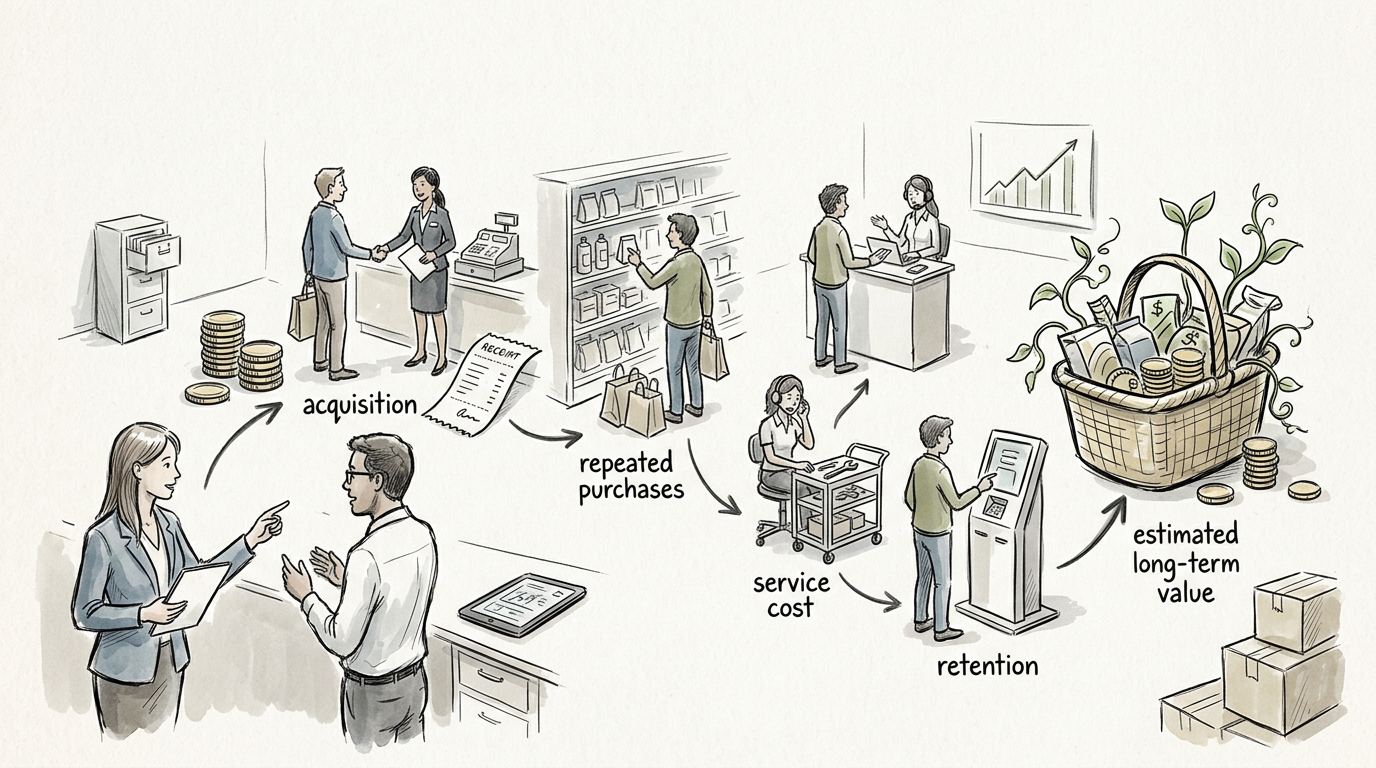
Customer lifetime value is one of the most appealing ideas in digital marketing because it promises a longer view than campaign dashboards usually provide. Instead of asking whether a click converted this week, CLV asks a broader business question: how much economic value does a customer contribute over time? For marketers working across ecommerce, subscription businesses, lead generation, email, search, paid media, and CRM programs, that question matters because many digital decisions look very different when judged over months or years rather than immediate conversion windows.
The appeal, however, often leads to misuse. Customer lifetime value is not a precise forecast of what any individual buyer will spend forever. It is an estimate built from historical behavior, assumptions about future retention and margin, and choices about how far into the future the business wants to look. Used well, it helps organizations make better acquisition, retention, and measurement decisions. Used poorly, it creates false precision, overstates growth potential, and justifies uneconomic media spending.
For digital marketers, the professional task is not simply to calculate CLV. It is to understand what the estimate represents, what assumptions it depends on, and how it should influence channels such as search, paid social, email, onsite conversion paths, ecommerce merchandising, and lifecycle automation.
What CLV is actually measuring
At its core, customer lifetime value estimates the net economic contribution of a customer relationship over time. Depending on the business model, that may be framed as revenue, gross profit, contribution margin, or another financial measure. In professional practice, margin-based approaches are usually more informative than revenue-only approaches because a dollar of sales does not equal a dollar of business value.
A simple way to think about CLV is:
- How often customers buy
- How much they spend when they buy
- How long they remain active
- How much margin those purchases generate
- What it costs to acquire and serve them
This is why CLV matters in digital marketing. The channels most marketers control or influence affect these variables directly. Paid search can change acquisition cost and audience mix. Landing page experience can influence first conversion and order composition. Email onboarding can affect second purchase rates. Ecommerce merchandising can increase average order value or cross-sell penetration. Retention campaigns can improve repeat purchase frequency. Service and post-purchase communication can reduce churn and increase future contribution.
The concept is not new. It has long been discussed in direct marketing, database marketing, and relationship marketing. What has changed is the amount of behavioral, transactional, and channel data now available through ecommerce platforms, analytics systems, ad platforms, CRMs, and customer data environments. That availability makes CLV more operationally useful, but it does not eliminate uncertainty.
Why CLV matters more than short-term conversion metrics alone
Digital marketing often defaults to near-term metrics because they are easy to observe. Cost per click, conversion rate, return on ad spend, and cost per acquisition are accessible and often updated in real time. Those metrics are useful, but they can favor channels, campaigns, and tactics that generate low-cost first orders while overlooking whether those customers become profitable over time.
A business that optimizes solely for immediate CPA may unintentionally acquire bargain-seeking customers who buy once and never return. Another may reject higher acquisition costs that would be justified if the acquired cohort has strong retention, higher margin purchases, or greater cross-category adoption later. CLV helps correct that bias by asking whether the customer relationship creates enduring value rather than merely producing a low-cost transaction.
This is especially important in several digital contexts:
In ecommerce, a first purchase may be unprofitable after discounting, paid media, shipping subsidies, and returns. The business case depends on repeat purchase and margin recovery over time.
In subscription or membership models, the first conversion event tells very little on its own. Free trial starts, low introductory pricing, and onboarding incentives can appear efficient while masking poor activation or rapid churn.
In lead generation, the initial form fill has little meaning unless marketers understand lead quality, pipeline progression, close rate, and retained customer value after acquisition.
In content-driven or SEO programs, traffic volume matters less than whether acquired audiences eventually register, subscribe, purchase, renew, or become high-value customers.
In all of these cases, CLV provides a bridge between digital activity and financial outcomes that matter to the business.
Acquisition cost only makes sense in relation to future value
Customer acquisition cost is often treated as a stand-alone efficiency metric, but its meaning depends on what kind of customers a channel produces. A $40 acquisition cost may be excellent for a customer who generates $300 in contribution margin over two years and terrible for one who generates $25 gross profit and never returns.
This is why mature digital programs increasingly evaluate acquisition through cohort performance rather than just blended CPA. Cohort analysis groups customers by shared characteristics such as acquisition month, channel, campaign, keyword theme, landing page, product entry point, or first-order type, then tracks how those groups behave over time. That approach helps marketers see whether an acquisition source produces durable value or merely cheap first conversions.
For example, branded paid search often captures existing demand efficiently, but it may tell marketers more about consumer intent that already exists than about the campaign’s ability to create future demand. Non-brand search may have higher acquisition costs but bring in customers earlier in the decision process. Affiliate traffic may convert strongly on first order because of aggressive discounting but deliver lower margin and weaker repeat rates. Email capture pop-ups may grow the database quickly, but if the incentive attracts only deal seekers, list growth can outpace list quality.
The practical lesson is straightforward: acquisition cost is not inherently good or bad. It is only rational when assessed against expected future contribution.
Retention is usually where CLV is won or lost
The most powerful drivers of customer lifetime value are often not in the first conversion event at all. They sit in retention, reactivation, product experience, and post-purchase relevance.
For digital marketers, retention is not simply sending more campaigns to existing customers. It involves the entire digital customer experience after conversion:
- Onboarding emails that help customers get value quickly
- Order and account communications that reduce uncertainty
- Product education that improves usage or satisfaction
- Replenishment reminders timed to actual consumption cycles
- Site and app experiences that make repeat purchase easy
- Cross-sell recommendations that are genuinely relevant
- Loyalty or membership mechanics that reward ongoing engagement
- Service and return experiences that preserve trust
In subscription businesses, retention often depends heavily on activation. A customer who signs up but never reaches the product’s core value is unlikely to produce meaningful lifetime value. In ecommerce, retention may depend less on loyalty messaging than on product quality, inventory consistency, shipping reliability, and return fairness. In B2B lead generation, retention may be more influenced by sales qualification, implementation, and account management than by media targeting.
This is why CLV should not be used to flatter the marketing team or isolate value creation entirely within communications. Marketing can influence retention materially, especially through email, CRM, personalization, and onsite experience, but customer value is also shaped by pricing, product quality, operations, service, and competitive alternatives.
Margin matters more than many CLV models admit
A common weakness in CLV discussions is the assumption that all revenue is equally valuable. It is not. Two customers can spend the same amount and produce very different economic outcomes because of product mix, discount dependence, return behavior, shipping cost, service intensity, payment fees, or channel costs.
For ecommerce marketers in particular, revenue-based CLV can be dangerously incomplete. A customer who buys high-return apparel with heavy promotional reliance may look valuable in top-line sales but contribute far less than a customer who buys lower-return, higher-margin items at full price. Similarly, customers acquired through marketplaces or expensive affiliates may carry structural costs that reduce their true contribution compared with direct-channel customers.
The same issue appears in lead generation. A lead source that produces high close volume may still be less valuable if those customers require heavy servicing, churn early, buy lower-margin solutions, or fail to expand.
Margin-aware CLV is more useful because it aligns marketing with business economics rather than just order totals. That does not mean every marketer needs a perfect cost accounting system attached to every user journey. It means the closer the model gets to economic reality, the more responsibly it can be used for decisions about bids, budgets, offers, and retention investment.
Repeat purchase is not one behavior
Repeat purchase is central to CLV, but marketers often collapse it into a single percentage and move on. In practice, repeat behavior varies substantially by category, buying cycle, and customer motive.
Some purchases are habitual and replenishable, such as consumables, beauty, pet supplies, or household goods. Here, lifecycle marketing can reasonably influence purchase frequency through reminders, subscriptions, bundles, and reorder convenience.
Other categories are episodic or occasion-based, such as furniture, travel, gifting, or major electronics. In those businesses, retention may show up less as rapid repeat purchase and more as cross-category buying, referral, or long-term brand preference when the next need arises.
Still others involve long evaluation cycles and account-based buying, where the first conversion event may be a content download or demo request rather than a sale. In those environments, “repeat purchase” may be better understood as contract renewal, account expansion, or usage continuity.
The implication is that CLV models should reflect real customer behavior rather than forcing every business into a retail-style reorder pattern. A useful estimate begins with the economics and cadence of the category, not a template formula.
CLV is an estimate, not a prophecy
This distinction is essential. Lifetime value is commonly discussed as if it reveals the future value of each customer with confidence. In reality, every CLV model makes assumptions about behavior that has not yet happened.
Those assumptions may include:
- How long a customer remains active
- What proportion will make another purchase
- How purchase frequency changes over time
- Whether average order value will rise, fall, or remain stable
- What gross margin will look like in future periods
- How discounts, returns, and servicing costs will evolve
- Whether channel mix or competition will change
- What time horizon counts as “lifetime”
Even advanced predictive models cannot remove this uncertainty. They can improve estimation by using richer behavioral data, but they still depend on historical patterns, and those patterns can shift when the market changes. Pricing changes, product launches, economic pressure, supply constraints, privacy restrictions, regulatory developments, or platform changes can all make previous customer behavior a less reliable guide.
This is why professionals should describe CLV carefully. It is an estimate of expected long-term economic contribution under stated assumptions, often most useful at the segment or cohort level rather than as an exact individual destiny.
Where digital systems support CLV analysis
CLV is not generated by one dashboard. It depends on how well digital systems connect acquisition, transaction, and retention data.
In ecommerce environments, the key systems often include the commerce platform, web analytics, email service provider, CRM, loyalty platform, payment and returns data, and ad platform integrations. In B2B, the stack may include marketing automation, CRM, sales pipeline systems, product usage data, and customer success platforms.
These systems help answer different parts of the value equation:
- Web analytics shows how users arrive, browse, and convert, but often does not fully represent long-term profitability on its own.
- Ad platforms report media spend and attributed conversions, but their attribution windows rarely capture the full customer relationship.
- Email and automation platforms show engagement and triggered journey performance, which can be useful indicators of retention health.
- CRM and transaction data usually provide the strongest foundation for repeat purchase, revenue, and account history.
- Finance and operations data are often necessary to move from revenue to margin.
The professional challenge is integration and governance. If acquisition source data is missing, channel-level CLV will be unreliable. If identity resolution is weak across devices or logged-out sessions, the journey will look more fragmented than it really is. If return behavior or cancellation data is delayed, recent cohorts may look healthier than they are. If CRM stages are inconsistently managed, lead-to-value analysis will be distorted.
CLV is therefore not just a modeling exercise. It is a data quality exercise.
How CLV should influence channel evaluation
One of the most valuable uses of CLV is improving channel evaluation beyond surface metrics. This does not mean every campaign should be judged exclusively on lifetime value. It means short-term and long-term measures should be connected.
For search marketing, branded and non-branded queries often produce different customer profiles. A lower-CPA branded program may capture many existing customers or high-intent shoppers already near purchase, while non-brand campaigns may bring in first-time customers earlier in research. Looking at later repeat purchase and margin by keyword cluster or campaign theme can produce more rational bidding and budget allocation.
For SEO, high traffic does not necessarily translate into high-value customers. Content aligned to low-commercial-intent searches may build reach and authority, but businesses still need to understand which organic entry points lead to registrations, qualified leads, product views, subscriptions, or repeat purchasers. Search intent matters not just for rankings but for downstream value.
For email, the right question is rarely “how many sends drove revenue this week?” Lifecycle programs should be evaluated by whether they improve activation, second purchase, churn reduction, replenishment timing, and long-term engagement without harming list health. Apple’s Mail Privacy Protection, documented by Apple at https://support.apple.com/guide/security/mail-privacy-protection-secbb0a1f9b4/web, also makes open rates less reliable as a proxy for engagement, increasing the importance of click, conversion, and retention outcomes over vanity metrics.
For paid digital advertising more broadly, CLV can justify different investment levels for different audiences, offers, or geographies. But it should do so only when the underlying value estimate is credible enough to support that decision.
For onsite conversion optimization, not all conversion lifts are equally valuable. A landing page change that increases first-order conversion by attracting lower-intent buyers or encouraging low-margin discount redemptions may improve front-end metrics while harming downstream value. A slower-looking path that includes more product education, qualification, or trust reinforcement may reduce initial conversion rate but improve customer quality and retention.
CLV changes how professionals think about conversion optimization
Digital marketing teams sometimes treat conversion optimization as the pursuit of the highest immediate conversion rate. CLV introduces a more disciplined view. The purpose of optimization is not to maximize form fills or first orders in isolation. It is to improve the quality and economic contribution of customer relationships.
This has practical implications for websites and landing pages.
A shorter lead form may increase submission volume, but if qualification drops and sales efficiency deteriorates, the higher conversion rate is not necessarily a business improvement. A more aggressive introductory discount may increase first purchases, but if it conditions customers to wait for promotions or attracts only low-retention buyers, the apparent gain may be temporary. A checkout experience that pushes accessories indiscriminately may raise basket size but also increase returns or reduce trust.
The best CRO programs start with a business hypothesis. For instance: adding clearer shipping and return information may reduce hesitation and improve conversion among customers more likely to reorder because trust is higher from the start. Or: restructuring a product page to help shoppers compare options may lower bounce rates on mobile and increase purchases in categories where confidence matters more than impulse.
Testing should follow from that logic. It should not become a hunt for isolated uplift without regard for downstream quality, margin, or customer satisfaction.
Attribution is useful, but it is not CLV
Marketers often mix three distinct ideas: attribution, CLV, and incrementality. They are related, but they are not interchangeable.
Attribution assigns credit for observed conversions across channels or touchpoints. CLV estimates long-term customer contribution. Incrementality asks whether a marketing activity caused outcomes that otherwise would not have happened.
A platform may report strong attributed purchases for a campaign, but that does not mean the campaign acquired valuable customers or caused all the reported outcomes. Likewise, a high-CLV customer segment is not proof that the last-click channel that closed them deserves full credit.
This matters because many digital acquisition decisions are made in environments with partial visibility. Browser restrictions, app ecosystems, identity fragmentation, and platform self-reporting all complicate the picture. Google’s documentation on attribution explains model differences and limitations within its own measurement environment at https://support.google.com/google-ads/answer/6259715, but even well-designed attribution models remain simplified representations of behavior.
CLV should therefore complement attribution, not replace it. Attribution can help marketers understand conversion paths and allocate credit for observed demand capture. CLV can help them understand whether the resulting customers are economically worthwhile over time. Incrementality testing can help determine whether spend actually changed outcomes. Responsible measurement uses these tools together while recognizing the limits of each.
Segmentation usually matters more than a blended CLV average
A single blended lifetime value number for the entire customer base is often too coarse to guide digital decisions. It may be useful for high-level financial planning, but channel strategy usually requires segmentation.
Useful segmentation approaches may include:
- Acquisition channel or campaign
- First product or category purchased
- New versus returning customer status
- Discounted versus full-price first order
- Subscription versus one-time purchase entry
- Geography or market
- Device or experience path when behavior differs materially
- Lead source and qualification status in B2B programs
This is where digital marketing becomes more practical. Instead of asking, “What is our lifetime value?” marketers can ask, “Which digital paths tend to produce healthier customer relationships, and why?” That question is more actionable because it can influence campaign targeting, offer design, landing page structure, merchandising, onboarding, and automation.
Segmentation also reduces the risk of making decisions based on averages that conceal major differences. A channel may look acceptable on blended CLV because a small number of very strong customers offset a large volume of weak ones. A first-order promotion may look profitable overall while eroding value in a strategically important segment. Looking at cohorts and segments helps expose those patterns.
Automation should support value, not simply volume
Marketing automation is frequently justified in the language of efficiency, but its contribution to CLV depends on whether it improves customer experience and relevance over time. More automated messages do not automatically create more value.
Useful automation is tied to customer behavior, lifecycle stage, and business logic. Welcome series should help new subscribers or buyers understand what to expect and how to get value. Browse or cart programs should address uncertainty, not merely repeat pressure tactics. Replenishment messages should reflect realistic usage timing. Win-back programs should distinguish between lapsed customers worth re-engaging and those whose economics no longer justify continued incentive spend.
The difference between a thoughtful lifecycle program and message overproduction is often visible in list health and customer response. Rising unsubscribes, complaints, or disengagement can indicate that automation is chasing short-term clicks at the expense of relationship quality. CLV logic should encourage restraint where appropriate. Some customers become more valuable because the brand communicates usefully and sparingly, not because it fills every available slot in the calendar.
What finance, marketing, and analytics teams need to agree on
CLV becomes far more useful when cross-functional teams align on definitions. Many internal disputes about marketing efficiency are actually disputes about the underlying math.
Teams should clarify several issues:
- Is CLV being measured on revenue, gross profit, or contribution margin?
- What costs are included or excluded?
- What counts as an active customer?
- What time horizon is being used?
- How are refunds, cancellations, and returns handled?
- How is acquisition source assigned?
- How often is the model refreshed?
- Is the estimate intended for planning, bidding, forecasting, or performance evaluation?
Without this discipline, CLV can become a rhetorical device rather than a decision tool. One team may cite a generous revenue-based estimate to justify media expansion, while another uses a stricter margin-based view to challenge the same investment. The issue is not that one team “believes in” CLV and the other does not. It is that inconsistent definitions produce inconsistent conclusions.
Common mistakes in using CLV
Several recurring mistakes reduce the value of CLV in digital marketing practice.
The first is treating CLV as an individual-level certainty. Even when businesses use predictive models to estimate expected value by customer, the output remains probabilistic. It can help prioritize retention treatment or acquisition bids, but it does not tell marketers exactly what any one customer will do.
The second is ignoring acquisition cost. Lifetime value without acquisition context can encourage indiscriminate spending. The relationship between CLV and CAC is what informs sustainable growth.
The third is relying on revenue instead of margin. Revenue-only models can overstate the value of discount-dependent or high-return customers.
The fourth is assuming retention patterns remain stable. In reality, customer behavior shifts with seasonality, competition, channel mix, economic conditions, and product changes.
The fifth is optimizing campaigns to a CLV model that has not matured long enough to observe actual outcomes. Young cohorts often look strong before cancellations, returns, or non-repeat behavior fully appear.
The sixth is overlooking non-marketing drivers. If product experience or service quality is poor, no amount of lifecycle messaging will produce the lifetime value the model assumes.
The seventh is using CLV to justify weak measurement discipline. Long-term value thinking should expand accountability, not weaken it. Marketers still need rigorous campaign tagging, reliable conversion tracking, cohort analysis, and experimental evidence where possible.
Responsible use means pairing CLV with humility
The most professional use of CLV is neither dismissive nor evangelical. It is pragmatic. Lifetime value matters because digital marketing increasingly shapes not only acquisition but also the ongoing customer relationship. Websites, search programs, email journeys, ecommerce experiences, paid media, CRM systems, and post-purchase automation all influence whether first conversions become profitable relationships. CLV helps connect those touchpoints to longer-term economics.
But the concept is only as useful as the assumptions behind it. Customer lifetime value should be treated as an estimate of expected long-term contribution, not a magic number and not a guarantee about individual behavior. It works best when grounded in real transaction data, informed by margin and retention, segmented by meaningful customer differences, and interpreted alongside acquisition cost, attribution, and customer experience metrics.
For digital marketers, that longer view is the real value. CLV encourages better questions. Which channels bring in customers who stay? Which offers generate buyers rather than bargain transients? Which onboarding journeys improve second purchase or activation? Which site experiences create trust strong enough to support retention? Which automated programs genuinely increase relevance instead of message volume?
Those questions are more demanding than asking what converted yesterday. They are also much closer to how durable digital growth is actually built.
Leave a Reply