
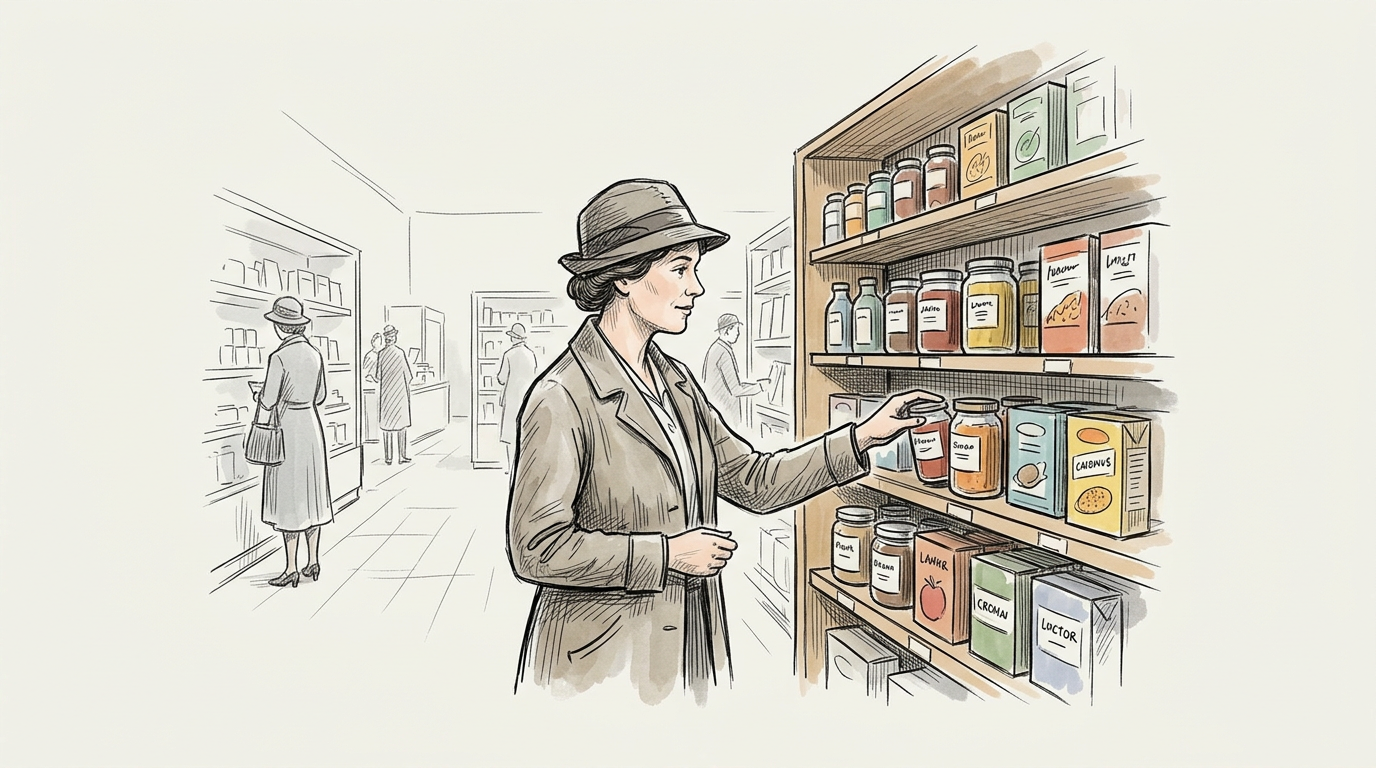
For much of the nineteenth century and into the early twentieth, many everyday purchases were made across a counter. Customers asked a clerk for flour, soap, crackers, coffee, canned goods, or patent medicines. The clerk retrieved the product, measured it if necessary, explained differences among brands or grades, and often made recommendations. In that retail world, packaging mattered, but it did not have to perform all of the communication work that modern marketers now expect from it.
The spread of self-service retail changed that arrangement. As shoppers increasingly selected goods themselves from open shelves rather than requesting them from store personnel, packages had to do more than contain and protect products. They had to identify the brand at a distance, signal quality, distinguish one offering from another, present usable information, fit merchandising systems, and help convert attention into purchase without a clerk standing nearby. That shift did not happen all at once, nor in every category at the same time. But it became one of the most consequential developments in the history of marketing, because it turned packaging into a central medium of brand strategy, retail competition, and consumer decision-making.
Understanding how self-service retail changed packaging helps explain why package design occupies such an important place in modern marketing. It also shows that packaging history is not simply a story of graphics or logos. It is a story about retail systems, distribution efficiency, consumer behavior, brand management, and the growing expectation that products must market themselves at the point of sale.
Before self-service, the clerk was part of the marketing system
In nineteenth-century general stores and many early urban groceries, a significant share of merchandise was sold in bulk or from larger containers. Dry goods were scooped, weighed, wrapped, and handed over. Crackers might be sold from barrels. Tea, sugar, flour, and coffee were often measured to order. Even when packaged goods were available, the retailer and clerk remained important interpreters of value and quality.
This did not mean branding was absent. National brands expanded in the late nineteenth century as mass production, rail distribution, trademark law, and print advertising made it possible for manufacturers to sell recognizable packaged goods at scale. Products such as Uneeda Biscuit, introduced by the National Biscuit Company in 1898, showed how sealed, branded packaging could reassure consumers about freshness and consistency. Historians of consumer culture and business have long noted that branded packages helped move trust away from the local merchant alone and toward the manufacturer as well.
Still, in a clerk-assisted environment, the package shared its communicative burden with the store itself. The merchant’s reputation mattered. Shelf visibility mattered less when goods remained behind the counter. Verbal explanation could compensate for limited labeling or weak visual distinction. In many categories, packaging was important, but not yet expected to operate as a near-independent salesperson.
The retail problem self-service was trying to solve
Self-service retail emerged from practical operating problems rather than from packaging theory. Grocers faced pressure to increase volume, reduce labor costs, standardize operations, and speed transactions. Urbanization and mass consumption created stores with more customers and more stock-keeping units. Manufacturer brands were proliferating. Handling each request through a clerk was labor-intensive and could limit throughput.
The store widely credited with popularizing self-service grocery retail in the United States was Clarence Saunders’ Piggly Wiggly, founded in Memphis in 1916. Saunders patented aspects of a self-service store layout and publicized the operational logic behind it: customers entered through turnstiles, followed a defined path, selected goods from shelves, and paid at a checkout point. The model reduced some service labor while encouraging larger baskets and more standardized product display.
Piggly Wiggly did not create all self-service practices from nothing, and retail historians are careful about singular origin stories. But Saunders’ stores were an important early demonstration that grocery retail could be reorganized around consumer selection from shelves rather than clerk retrieval from behind counters. Once that happened, the package moved into a new role. It became the main interface between manufacturer and shopper at the moment of choice.
That role expanded over the following decades. Self-service spread unevenly in groceries during the 1910s and 1920s, accelerated with chain retailing, and became more deeply embedded with the rise of the supermarket in the 1930s. Michael J. Cullen’s King Kullen, opened in 1930 in Jamaica, Queens, is commonly cited as an early supermarket format combining self-service, large volume, and low margins. As larger self-service stores broadened assortments and relied on open display, the package became even more critical as a unit of merchandising.
Why packaging had to change
Once consumers were expected to find, compare, and choose products on their own, packaging had to solve several business problems that clerks had once helped manage.
First, it had to make products identifiable quickly. In a dense retail environment, consumers needed to locate a familiar brand from several feet away. Color, typography, shape, and consistent visual systems became practical tools of navigation, not just decoration.
Second, it had to communicate product benefits succinctly. If a clerk was no longer present to explain what made one soap milder, one cereal healthier, or one detergent more effective, the package had to carry those selling points itself.
Third, it had to reduce purchase uncertainty. Standard weights, ingredient statements, preparation directions, freshness cues, seals, and quality claims all helped consumers make decisions with less interpersonal guidance.
Fourth, it had to compete physically on shelves. In a self-service environment, adjacent products were not abstract market rivals. They were literal neighbors, often inches apart. Package size, face width, shelf impact, and distinctiveness became part of competitive strategy.
Fifth, it had to work with retailer operations. Self-service depended on stock rotation, shelf loading, handling efficiency, and price marking. A package that looked attractive but stacked poorly or broke in transit imposed costs on retailers and distributors.
This is the point where packaging history becomes unmistakably marketing history. The package was no longer just a container designed by production engineers and printers. It became a managed instrument of branding, merchandising, and consumer communication.
The rise of packaged goods prepared the ground
Self-service could not have spread widely in food and household categories without earlier advances in packaging and distribution. The shift rested on several nineteenth- and early twentieth-century developments.
Industrial food processing increased the supply of standardized goods that could be distributed nationally. Improvements in canning, paperboard carton manufacturing, glass bottling, corrugated shipping containers, and later cellophane and flexible wraps made it easier to package products securely and consistently. Railroads and wholesaling systems moved goods over longer distances. Trademark registration and national advertising created demand for products consumers could recognize before reaching the store.
Manufacturers such as the National Biscuit Company, Procter & Gamble, Quaker Oats, and H.J. Heinz invested heavily in packaging as a means of standardization and trust. Heinz in particular made conspicuous use of clear glass in many products so consumers could inspect contents directly, a useful strategy in an era when adulteration and variable retail handling remained concerns. These developments did not depend on self-service alone. But they created the material and commercial conditions that made self-service workable.
Equally important was the broader movement toward consumer packages rather than retailer-measured bulk sales. A store built around self-service needed merchandise that ordinary shoppers could pick up and carry to checkout with minimal intervention. That favored factory-packed units, standardized sizes, and labels consumers could read on their own.
From package as container to package as salesman
By the interwar period, marketers increasingly described the package as a selling tool. Trade publications, package designers, and manufacturers treated the retail shelf as a new communications environment. The idea that the package functioned as a “silent salesman” became common in twentieth-century marketing discourse, though the phrase was used in multiple contexts and by many practitioners rather than traceable to one universally accepted origin. What matters historically is not a single coinage but the underlying change in commercial expectations.
Packaging had long protected products, facilitated transport, and identified manufacturers. Under self-service, it acquired a more explicit persuasive role. It had to gain attention, support brand recall, reassure buyers, and trigger trial. This was especially important for low-involvement, frequently purchased goods where the point of purchase carried unusual weight.
The package also helped transfer part of the persuasive burden from media to retail execution. National advertising could build awareness and preference, but in a self-service store the purchase still had to be completed at the shelf. Marketers increasingly understood that packaging and merchandising had to work together. A heavily advertised product with weak shelf recognition could lose sales to a more visible competitor. In this sense, self-service linked branding more tightly to physical retail presence.
Chain stores, supermarkets, and the shelf as a competitive arena
The spread of chain stores and supermarkets intensified these pressures. Chains sought standardization, high turnover, and efficient stocking. Supermarkets expanded assortment and relied on volume. The result was an increasingly visual and comparative shopping environment.
Shoppers could inspect several brands of canned soup, breakfast cereal, soap flakes, or coffee in one aisle. They did not need to ask a clerk what was available. They could see it. That changed competition in practical ways.
Package front panels became more important because only one face of the product might be visible. Brand names had to be legible at a glance. Visual consistency across line extensions helped consumers recognize a family of products. Standardized package dimensions could improve shelf use and facing counts. Bright colors and unusual structures could draw attention, but only if they remained manufacturable, stackable, and economical.
Retailers also gained leverage. Because packages competed for shelf position within the store rather than only for wholesaler distribution or clerk recommendation, shelf placement itself became a marketing variable. Endcaps, eye-level shelving, freestanding displays, and coordinated packaging for mass display all became more consequential as self-service matured. Modern merchandising practice, including category management and point-of-sale optimization, rests on this earlier reorganization of the store into a visual decision environment.
Design became a business function, not merely an artistic service
As packaging took on greater marketing responsibility, package design became more formalized. Early twentieth-century manufacturers had often relied on printers, in-house artists, or ad agencies for label and carton work. Over time, specialized industrial designers and package designers emerged, working at the intersection of manufacturing constraints, retail needs, and consumer psychology.
One influential figure was Walter Landor, whose firm, founded in 1941, later became closely associated with corporate identity and packaging design. Landor did not create the marketing importance of packaging, but his career reflected a mid-twentieth-century business world in which packaging had become strategic enough to support specialist consultancies. Raymond Loewy and other industrial designers also worked on packaging and retail presentation in ways that linked aesthetics to sales performance.
What changed was not simply style. Organizations increasingly had to coordinate product development, package engineering, legal labeling, brand strategy, and retail display. This required decisions that crossed departments. In many companies, responsibilities that had once been scattered among production, sales, and advertising moved closer to what would later be recognized as product management and brand management.
The development of brand management at Procter & Gamble is relevant here. Neil H. McElroy’s famous 1931 memo, often cited as a foundational document in brand management history, called for managers responsible for specific brands and attentive to all factors affecting brand performance. Packaging was not the only concern in that system, but the logic was compatible with self-service retail. If a brand competed on the shelf as well as in advertising, someone had to oversee its total market presentation, including package appearance, line consistency, and retailer execution.
Packaging had to educate as well as persuade
Self-service increased the informational burden on packages. This was especially true in categories involving new product forms, changing household technologies, or unfamiliar usage routines.
Prepared foods, cake mixes, frozen foods, detergents, and household chemical products often required instructions that consumers could consult without assistance. In the clerk-assisted store, some explanation might come verbally. In self-service, the package had to support trial and successful use after purchase. Directions, serving suggestions, diagrams, and storage guidance reduced the risk that consumers would misuse the product or abandon it after a poor first experience.
This educational function became increasingly important as the twentieth century brought more branded, processed, and convenience-oriented goods into the home. Package copy, structure, and graphics helped translate manufacturing innovation into consumer adoption. A product could not scale nationally if households did not understand what it was, how to use it, or why it was preferable to existing alternatives.
This is one reason modern packaging often combines claims, imagery, ingredient or contents information, and instructions in a tightly managed hierarchy. That practice did not emerge from graphic fashion alone. It developed because self-service retail demanded a compact communication system at the point of purchase and point of use.
Consumer research and the package as a tested marketing instrument
Once packaging became central to shelf competition, it also became a subject of research. Twentieth-century market research increasingly examined how consumers responded to packages, labels, color systems, and shelf displays. Methods varied in rigor across periods, and early package testing did not match contemporary standards. But the direction of change is clear: packaging became something marketers studied empirically rather than only judged by intuition.
Motivation research in the mid-twentieth century, associated with figures such as Ernest Dichter, encouraged some marketers to think about package form and color in psychological terms, though many of its claims were later criticized for weak methodology and overinterpretation. More operationally useful were product-use tests, store audits, sales comparisons, eye-level placement experiments, and package redesign tests linked to actual movement at retail.
Trade publications and packaging associations documented these developments. The Packaging Institute, founded in 1955, reflected the growing professional status of packaging as an interdisciplinary field. Packaging journals, retail research, and supermarket studies treated the package as part of a measurable marketing system that included display conditions, consumer traffic patterns, and brand recognition.
By the postwar decades, marketers were increasingly asking questions that are still familiar today: Can shoppers find the product? Do they understand the benefit? Does the redesign improve noticeability? Does a larger logo improve recognition? Does a structural change increase damage or reduce shelf efficiency? Those questions were historically tied to self-service retail and its demand for visible, legible, comparable products.
Merchandising and package design became inseparable
Self-service did not just change the package in isolation. It changed the relationship between package design and merchandising. A product package had to work as an individual unit in a shopper’s hand, but also as part of a repeated pattern on the shelf.
That altered design strategy in several ways. Repetition of color blocks could create a stronger shelf presence when multiple facings were displayed together. Product variants needed enough differentiation to help selection, but enough family resemblance to reinforce the parent brand. Cases and secondary packaging increasingly mattered because retailers wanted products that could be opened, shelved, or later displayed with minimal labor.
The supermarket era also expanded the importance of in-store promotion. Manufacturers supplied display materials, coupons, premiums, and temporary price reductions, but these tactics were more effective when packaging was immediately recognizable. The package provided continuity across newspaper circulars, in-store displays, and shelf facings. In effect, self-service made packaging the anchor of integrated retail communication long before that term became common.
The same historical logic extends into contemporary club stores, convenience stores, ecommerce thumbnails, and omnichannel retail. Different environments impose different constraints, but the underlying requirement remains the same: the product presentation must identify itself and communicate quickly in the selling environment available.
Regulation also shaped the communicative package
Not all packaging change came from voluntary marketing decisions. Regulation changed what packages had to disclose and how products could be represented. The Pure Food and Drug Act of 1906 and related Progressive Era reforms responded to adulteration, misbranding, and public concern over product safety and honesty. Later rules and standards expanded labeling requirements across categories.
These developments mattered to self-service because disclosure increasingly had to be attached to the unit the consumer handled directly. In a clerk-assisted world, some information might be conveyed verbally or remain embedded in merchant practice. In a self-service world, the package was the practical vehicle for both commercial claims and required information.
This did not eliminate misleading packaging or inflated claims, and packaging remained a site of controversy over slack fill, deceptive imagery, health assertions, and targeting practices. But the larger historical point is that the communicative package emerged at the intersection of marketing and regulation. It had to sell, but it also had to identify contents and conform to legal standards in a retail system where consumers encountered products directly and often independently.
Private labels and national brands learned from the same retail shift
Self-service packaging affected both manufacturer brands and retailer-controlled brands. National brands used packaging consistency to create recognition across stores and regions. Private labels used packaging to signal value, store loyalty, or acceptable parity with better-known brands.
As chain retailing expanded, retailers increasingly understood that package presentation could support their own market position. A private-label product on an open shelf needed to reassure the shopper just as a national brand did. That encouraged improvements in naming, color coding, typography, and quality cues. Over time, private-label packaging moved beyond plain utility in many categories and became an active instrument of store branding.
This is another reason the history matters for marketers today. Packaging strategy cannot be understood solely as the expression of a manufacturer’s brand identity. It has always been shaped by the retail system in which the product appears and by the power relationships among producers, distributors, and merchants.
What self-service changed in marketing thought
The spread of self-service helped push marketing toward a more integrated understanding of the purchase environment. Earlier business functions often separated production, sales, and advertising. But once consumers physically navigated shelves filled with branded packages, those divisions became less tenable.
Manufacturers had to think about the path from factory to shelf to home as a unified commercial process. Product characteristics affected packaging. Packaging affected distribution. Distribution affected shelf display. Shelf display affected purchase. Purchase affected repeat demand. This systems view encouraged closer coordination among product planning, market research, promotion, and retail sales support.
Academic marketing, which developed substantially in the early twentieth century through business schools and trade analysis, had long paid attention to distribution, wholesaling, and retail institutions. The self-service era reinforced the importance of channels and point-of-sale conditions as part of marketing, not merely as post-production logistics. Packaging became one of the clearest examples of how marketing linked physical distribution to consumer behavior.
Later frameworks such as the marketing mix would simplify this interconnectedness into categories like product, price, place, and promotion. In practice, self-service packaging sat at the intersection of all four. It was part of the product, an instrument of promotion, a condition of retail placement, and often a factor in cost and pricing.
From shelf impact to modern package design
Much of what now seems normal in package design descends from this historical shift.
The expectation that a package must communicate in seconds reflects the visual speed of self-service shopping. The use of hierarchy on the front panel reflects the need to guide unaided decisions. The insistence on consistent brand assets across line extensions reflects the need for quick recognition on crowded shelves. The close relationship between package dimensions and merchandising reflects decades of retail display logic. Even contemporary ecommerce packaging strategy, where a product image must stand out as a thumbnail before the physical package ever arrives, extends principles developed when the shelf first became a self-directed decision space.
Modern packaging also inherits tensions created by self-service. Marketers want visual distinction, but retailers want shelf efficiency. Consumers want information, but packages have limited space. Regulators require disclosure, while brands seek emotional appeal and simplicity. Sustainability concerns now challenge the long-standing assumption that more packaging or more visual complexity necessarily improves market performance. These are contemporary debates, but they rest on a century-old understanding of the package as a communication and merchandising instrument.
The larger historical lesson is not that packaging suddenly became important when clerks disappeared. Packaging had long carried meanings of trust, origin, and quality. What self-service changed was the degree and immediacy of its responsibility. As retail shifted from assisted selection to shopper navigation, the package had to become more legible, more informative, more differentiated, and more strategically managed.
That transformation helped redefine marketing itself. It moved the point of sale closer to the center of brand strategy. It made physical presentation a measurable competitive variable. And it helped create the modern expectation that a product must explain itself, distinguish itself, and help sell itself in the moment a shopper encounters it. In that sense, the history of self-service packaging is not a side story in marketing history. It is one of the clearest examples of how changes in retail institutions reshaped the practice of marketing from the shelf outward.
Leave a Reply