
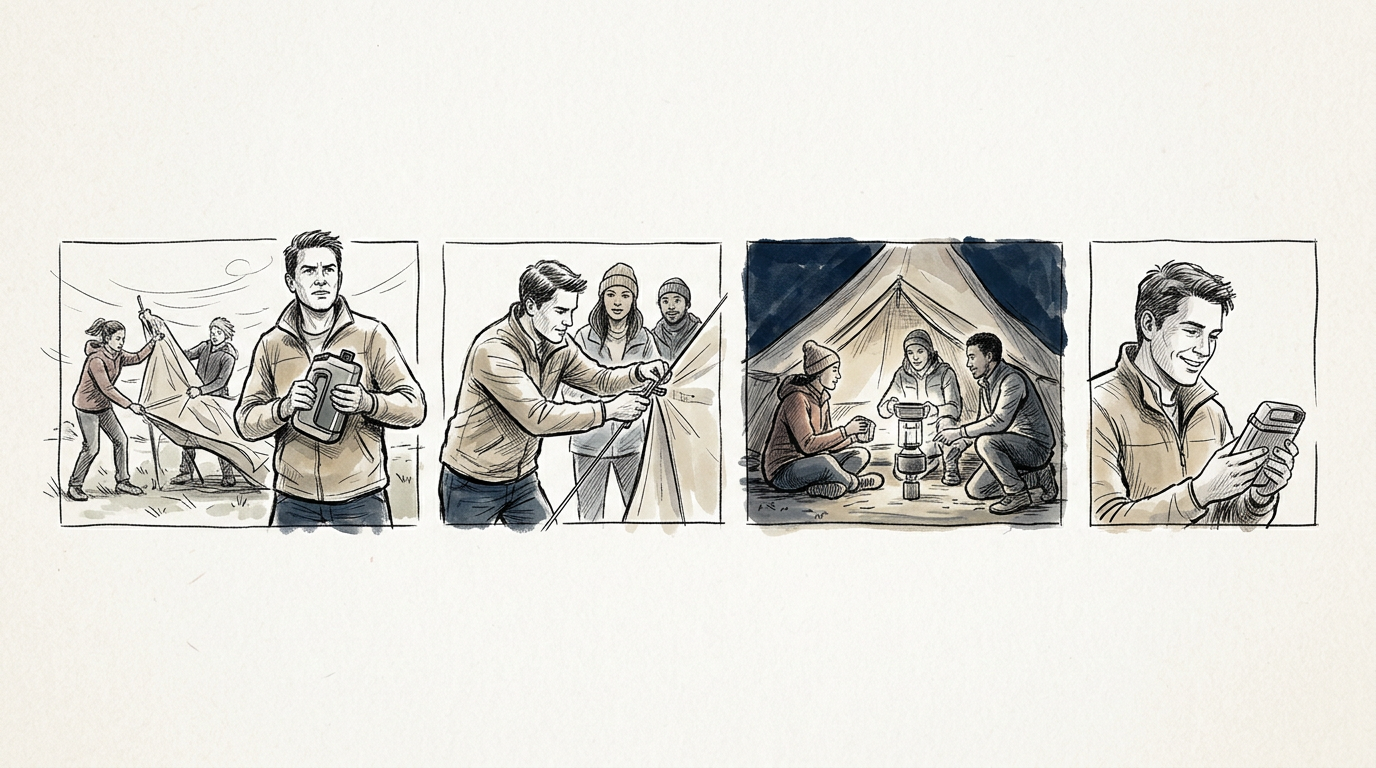
Narrative advertising often receives more credit than it deserves. A polished film with strong casting, cinematic production, and an emotionally coherent plot can leave viewers feeling that they saw good advertising even when the product barely mattered. For creative teams, that is a recurring discipline problem. The ad may be watchable, shareable, or award-friendly, but if the brand could be removed and replaced without damaging the story, the work is strategically weak.
That does not mean every advertisement needs to show the product constantly, explain features explicitly, or interrupt the story with sales copy. It means that when marketers choose narrative, the product, service, or brand should ideally play a meaningful role in what happens. It should influence the conflict, shape the experience, enable the action, or help resolve the tension. When the advertised offering contributes to the story rather than merely appearing at the end of it, brand linkage usually improves, comprehension becomes easier, and the creative idea is more likely to support business objectives.
This is a creative issue, not just a measurement issue. Product integration affects the concept itself, the script, the visual structure, the edit, the performance, and the audience’s memory of what the story meant. It also affects whether the work can extend across media without becoming hollow.
## A story is not automatically an ad
Advertising professionals know the pattern. A team falls in love with a premise because it is funny, moving, or visually striking. The client likes the mood or the social potential. The first round of reactions includes comments such as “people will talk about this” or “it feels premium.” Then, late in development, someone asks the practical question: where is the brand? The answer is often a logo, a pack shot, a closing line, or a quick insertion of product footage that was not structurally necessary to the idea.
That kind of attachment creates several problems.
First, it weakens memorability in the way that matters. People may remember the scene, joke, or emotional turn without remembering who it was for. Research on creative effectiveness has long shown that attention alone is not enough. The IPA’s work on effectiveness and related industry research repeatedly distinguish between engaging creative and branded communication that contributes to business effects. Distinctive assets, product cues, and meaningful brand presence matter because memory needs a retrieval path back to the advertiser, not just back to the entertainment.
Second, unrelated storytelling makes evaluation harder. If the ad underperforms, teams cannot easily determine whether the problem was the concept, the branding, the media context, or the offer. By contrast, when the product is part of the story logic, it is easier to test comprehension and message takeout because the communication objective is embedded in the narrative structure.
Third, detached storytelling often creates adaptation problems. If the original film is built around atmosphere rather than product contribution, the idea can become much weaker in cutdowns, social edits, display, audio, retail, CRM, or landing-page environments where narrative room is limited. A product-centered story usually survives compression better because the key relationship between problem and solution is already clear.
## What meaningful product integration actually means
Product integration in advertising is sometimes misunderstood as simple visibility. It is not just “show the package more” or “put the app screen in the hero shot.” Meaningful integration means that the offering changes what can happen in the ad.
In practice, that usually takes one or more of five forms:
– The product creates the experience.
– The product reveals a truth or insight.
– The product changes a character’s options.
– The service reduces friction that the audience recognizes.
– The brand point of view shapes the entire situation, not just the sign-off.
Those are strategic and narrative functions, not decorative ones.
A running shoe ad, for example, does not need to force a lecture about foam technology into every script. But if the shoe is central to the experience of movement, stamina, confidence, recovery, terrain, or self-comparison, then the story can dramatize what the product is for. A payments platform can become the enabler of a time-sensitive moment. A cleaning product can remove the obstacle that keeps the scene from moving forward. A food brand can be the social catalyst around which the interaction happens. A software tool can reveal hidden inefficiency and allow the protagonist to act differently. In each case, the narrative role is tied to the proposition.
The most useful question in concept review is simple: if the product were removed, what in the story would break? If the answer is “almost nothing,” the integration is probably weak.
## The classic strategic mistake: emotion with no mechanism
Brands understandably want emotional work. Emotion can support memory, persuasion, and longer-term brand effects. But emotion is not a substitute for communication structure. One of the most common failures in narrative advertising is building a touching or amusing human story without identifying how the advertised offering participates in that human reality.
This usually happens when the brief expresses an abstract ambition such as “show that we understand families” or “capture the joy of everyday life” without defining the role the brand actually plays. Creative teams then generate scenes that express the audience’s emotion but not the brand’s contribution. The result may still be pleasant. It may even test well on enjoyment. But if the audience cannot connect the emotional effect to the brand in a clear way, the work risks becoming generic sentiment.
A stronger brief asks harder questions. What does this offering enable that matters in people’s lives? Where does the audience actually encounter the product or service? What tension does it reduce, what desire does it satisfy, what behavior does it unlock, and what proof can the creative dramatize? Those questions lead to stories in which emotion and utility are not opponents. The feeling comes from the product’s role, not from an unrelated subplot.
## Product role can be literal or conceptual
Not every narrative needs the product to operate as a visible plot device. Sometimes the contribution is literal, and sometimes it is conceptual.
Literal integration is common in demonstration-led categories. Think of detergent removing a stain at the moment it matters, home technology simplifying a stressed household interaction, or a navigation app helping someone reach an important destination. Here the product is directly tied to the event.
Conceptual integration is subtler but still structurally necessary. The brand’s proposition may define the world or point of view of the story. Apple’s long-running “Shot on iPhone” platform is a useful example of product-centered storytelling that does not always require overt feature explanation in every execution. The work varies widely in tone and subject matter, but the organizing idea is inseparable from the product because the imagery itself functions as evidence of what the device makes possible. Apple’s own campaign materials frame the idea around photographs and films created with iPhone, which turns the product from sponsor into source. The stories and visuals may be expansive, but the product is still doing narrative work because it is the means of creation, not an end tag.
Likewise, many of Google’s product films work best when the product interface and utility are not merely inserted but used to structure the emotional arc. The company’s “Year in Search” films are primarily brand communications rather than product demonstrations, but other Google storytelling often derives its emotional effect from the role of Search, Translate, Maps, or Assistant in helping people navigate practical and human situations. When that connection is clear, the story feels earned. When it is vague, the emotion can feel borrowed from life rather than generated by the brand’s contribution.
## A useful positive example: when the product is the engine
One of the clearest demonstrations of meaningful product role is Volvo Trucks’ “The Epic Split” featuring Jean-Claude Van Damme, created by Forsman & Bodenfors in 2013. The film was visually arresting, but its durability came from more than spectacle. According to Volvo Trucks’ campaign materials, the stunt was designed to dramatize the precision and stability enabled by Volvo Dynamic Steering. Two reversing trucks maintain a controlled distance as Van Damme performs the split between them. The entertainment value and the demonstration are the same act. Remove the product capability and the film’s central tension disappears.
That is a valuable model because it avoids a common false choice. The piece is both dramatic and product-led. It does not stop the story to explain the feature; the feature is the story. The craft supports the proposition rather than competing with it.
The lesson is not that every category needs a stunt. It is that creative teams should look for scenarios in which the product truth creates the most interesting dramatic possibility. If the feature can only be expressed through a disconnected supers card, the team may not have found the right narrative form yet.
## Negative space matters: what happens when the brand is interchangeable
Some narrative work is difficult to discuss by name because the problem is not a factual error or craft failure. It is interchangeability. The ad shows a child overcoming self-doubt, friends reconnecting, a couple surviving a mishap, or a community rallying around someone in need. The film is competently made. The soundtrack swells. Then a logo appears.
The weakness is structural. The characters’ journey would make equal sense for a bank, telecom company, insurance provider, airline, grocery chain, or wellness app with minor script changes. That interchangeability tells creative leaders something important: the idea belongs to a category of feelings, not to a brand proposition.
This is where internal review discipline matters. Teams should ask whether the story could be claimed just as plausibly by a competitor. If so, the work may still be emotionally pleasant, but it is not strategically distinct. Distinctiveness does not always require bizarre imagery or a radical tone. It often requires something simpler: the brand is involved in a specific way that another advertiser cannot credibly copy without making the same product promise.
## Copywriting: script the product into the turning points
Product integration is often won or lost in the script, long before art direction or production elevates the work.
Writers can improve product role by locating it in the story’s turning points. Where does the tension first appear? What changes the character’s options? What enables the decision, action, realization, or payoff? If the product shows up only in the final line, the script is likely under-integrated.
This does not require clumsy exposition. In many of the best narrative ads, the dialogue is sparse and the product function is legible through behavior. But the structure is precise. The product is present where causality matters.
For copywriters, that usually means moving beyond thematic lines such as “for the moments that matter” or “made for real life.” Those lines can summarize a platform, but they cannot carry the burden of integration on their own. The script needs observable evidence of what the brand does in those moments.
A useful drafting exercise is to write the scene as a chain of causes:
The character wants X.
A problem prevents X.
The product or service changes Y.
That change allows Z.
Therefore the emotional resolution feels credible.
That chain can support comedy, drama, documentary realism, testimonials, or highly stylized film. Its value is not formula but discipline.
## Art direction and design: make the product legible without flattening the story
Visual teams face a real challenge here. Overcorrecting for weak integration often produces obviousness rather than clarity. The ad becomes a sequence of forced product beauty shots or interface inserts that interrupt the narrative rhythm. The audience notices the sell, but not in a helpful way.
Art direction should instead make the product legible as part of the scene’s meaning. That can involve framing, scale, screen choreography, prop logic, packaging behavior, or environmental cues that show how the product lives in context. In a service category, design may need to clarify user flow, trust signals, time savings, or ease of use in a few readable moments. In consumer packaged goods, the package may need to do more than appear; it may need to trigger recognition, action, or social interaction.
This is where visual hierarchy matters. If the audience must understand that a product attribute changes the scene, the camera and edit need to privilege that information at the right moment. If the brand’s distinctive color, shape, sonic cue, or interface element can act as a mnemonic anchor, it should be integrated early enough to matter. The goal is neither stealth branding nor constant branding. It is meaningful branding.
For digital and social environments, legibility becomes even more important because viewing conditions are compressed. Small screens, distracted attention, muted autoplay, and short completion windows reduce tolerance for delayed relevance. A story in which the product’s role is visible early has a better chance of surviving these conditions without losing narrative interest.
## Medium shapes how much story the product can carry
Product integration should be calibrated to medium, not discussed abstractly.
In longer online film, there is room to establish context before the product changes the situation. But the opening still needs cues that tell the audience why this brand is telling this story. Otherwise the first seconds may feel like content seeking a sponsor.
In television and connected TV, where interruptions are more explicit, viewers are quicker to ask whether the story is worth their time. Product-linked conflict usually helps because it gives the ad a clearer promise.
In social video, especially short-form placements, the product often has to appear sooner, not because subtlety is impossible, but because context collapses quickly. The narrative can still be elegant, but the audience needs to know what kind of story they are entering.
In audio, the problem is even sharper. If the product or service is not integrated into the premise or dialogue, the spot can sound like a generic sketch followed by a branded read. Audio storytelling rewards brands that script utility or product consequence directly into the scene.
In display, CRM, and landing pages, a narrative campaign built on genuine product contribution is easier to translate. The same conflict-resolution logic can be expressed through headlines, demos, testimonials, sequential messaging, or interface storytelling. Detached emotional campaigns struggle here because there is no narrative depth left to hide the weak brand role.
## Production can either strengthen or erase product meaning
Production decisions are not neutral. Directors, editors, designers, photographers, and post teams can either reinforce the product’s role or aestheticize it into irrelevance.
Casting matters because credibility affects whether viewers believe the behavior around the product. Performance matters because people do not interact with products in emotionally blank ways. Location and wardrobe matter because context signals whether the product fits the intended audience’s life. Editing matters because the duration of a glance, gesture, reveal, or interaction often determines whether the viewer registers the product as causal or incidental.
The danger with high-craft production is not craftsmanship itself. It is misallocation of attention. If every production decision intensifies mood while minimizing product causality, the work may feel expensive and still communicate little. Conversely, modest production can be highly effective when the product’s role is unmistakable and humanly relevant.
This is especially true in categories where authenticity matters more than spectacle, including healthcare services, financial tools, B2B software, education, utilities, and many local or regional brands. In those settings, production should serve comprehension and trust first. The product can still participate in a story, but the story must remain accountable to the audience’s real decision context.
## Collaboration: strategy, creative, account, and client teams all affect integration
Weak product integration is often blamed on creatives chasing entertainment or clients demanding logos. In reality, the problem usually starts earlier and is shared more widely.
Strategy teams may write a brief that identifies a human truth but fails to articulate the brand’s role in that truth. Account teams may frame success around broad emotional ambition rather than communication objectives. Clients may ask for “less product, more story” because they have seen overt selling done badly and assume the opposite is inherently better. Creative teams may pursue scripts that protect tone at the expense of proposition. Producers may inherit a concept whose product logic was never solved on paper.
Stronger collaboration starts with a more useful planning question: what can only this brand make happen, and how can that become material for the story? That moves the discussion away from “how do we work the product in?” and toward “how do we build from the product out?”
In review, feedback should distinguish between a problem and a preferred executional fix. Instead of saying “make the product bigger” or “add more branding,” stakeholders should identify the actual issue: “I do not yet understand how the service changes the character’s situation,” or “the emotional resolution feels disconnected from the brand.” That preserves room for better creative solutions.
Creative leaders have a particular responsibility here. They need to protect against two equal and opposite failures: reducing narrative to explanation, and reducing branding to decoration. The job is not to choose between art and selling. The job is to turn selling points into communicative drama.
## Simplicity is often stronger than elaborate narrative
One reason product-detached stories persist is that teams confuse complexity with ambition. A multilayered script with multiple characters, emotional reversals, and cinematic reveals can seem more “creative” than a direct product-centered premise. But if the audience must work hard to understand the relevance of the brand, the complexity is self-defeating.
Often the stronger idea is simpler: a sharply observed problem, a product behavior that matters, and a human payoff that feels true. Simplicity gives the product room to carry meaning. It also tends to adapt better across formats and markets.
This is not an argument against rich storytelling. It is an argument against unnecessary narrative architecture when the strategic proposition is more direct. Creative sophistication lies in selecting the form that best expresses the brand’s role, not the form that looks most cinematic in a case-study edit.
## Evaluating whether the product truly has a role
Creative teams need a practical way to assess product integration before production and after launch.
Before production, several questions are useful:
– What exactly does the audience need to understand, feel, or do after seeing this work?
– Is the product, service, or brand necessary to the plot, the experience, or the resolution?
– Does the story demonstrate the proposition or merely accompany it?
– Could a competitor plausibly run a similar film with minor changes?
– Will the idea still make sense in shorter edits, static formats, audio, or retail environments?
– Are the product cues present early enough and clearly enough for the medium?
After launch, success should be judged against objective, not just against enjoyment. Depending on the campaign, relevant measures may include branded recall, message comprehension, search lift, click-through to product pages, completed views with brand recognition, aided and unaided brand attribution, conversion, sales response, or longer-term brand metrics. If viewers praise the film but misattribute the advertiser or cannot explain what the product contributed, the integration probably failed.
Awards and social enthusiasm can document attention from peers or culture, but they are not substitutes for evidence that the story advanced the brand’s business problem.
## The discipline behind better narrative advertising
The best narrative advertising does not choose between story and selling. It recognizes that in commercial communication, the most durable stories are often those in which the product, service, or brand changes something meaningful. That change may be practical, emotional, social, or symbolic. But it needs to be real within the structure of the ad.
When teams attach a logo to an otherwise unrelated story, they may still produce content people like. What they are less likely to produce is advertising that is clearly branded, strategically distinctive, adaptable across media, and accountable to objective. The creative issue is not whether audiences enjoy stories. They do. The issue is whether the story gives the audience a reason to connect the experience back to the advertiser.
That is why product integration deserves to be addressed at the concept stage, not repaired in postproduction. The product should have a role because role creates meaning, meaning creates memory, and memory gives creative work a better chance of affecting real decisions. For brands that choose narrative, that is not a small executional preference. It is the difference between entertainment adjacent to marketing and advertising that actually communicates.
Leave a Reply