
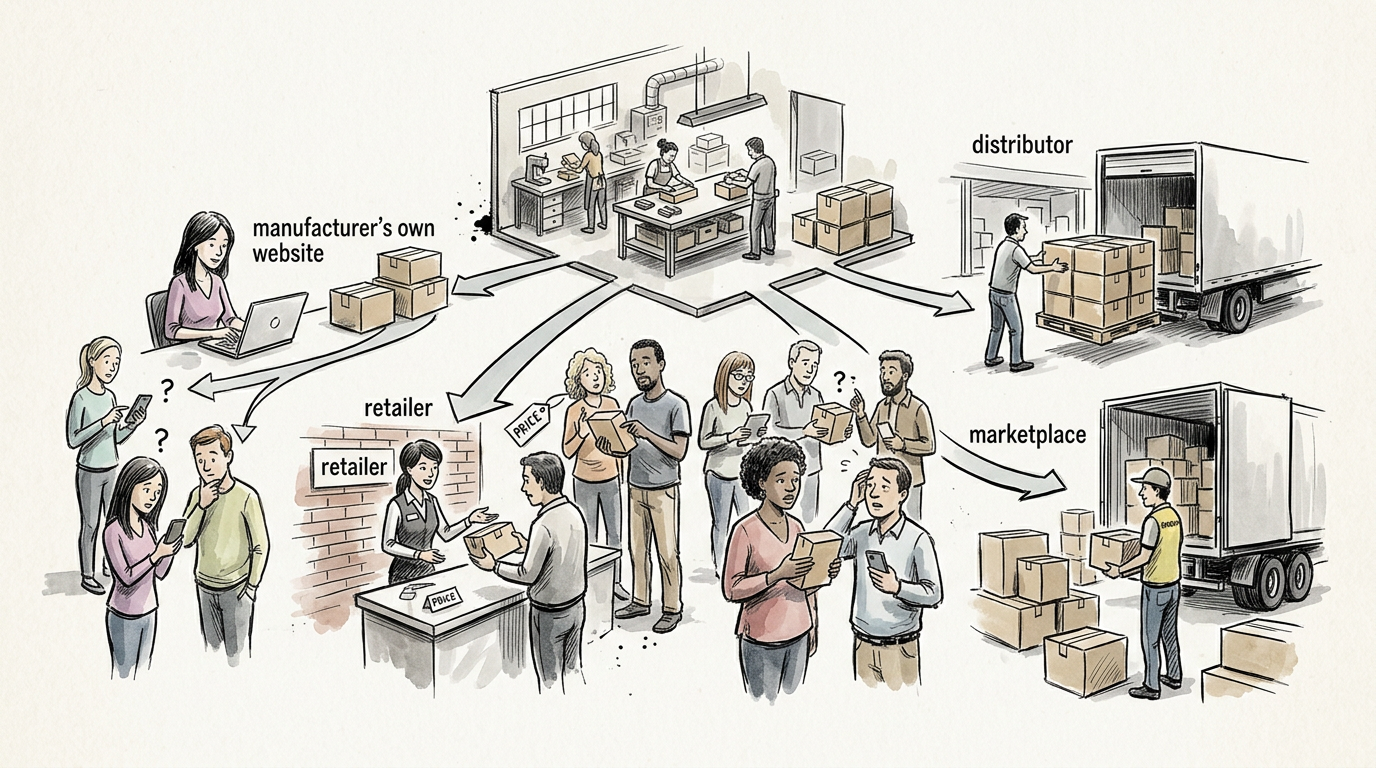
Channel conflict is often described as an execution problem. A brand launches ecommerce, a retailer complains about price parity, a distributor objects to territory overlap, or a marketplace seller undercuts everyone else. The symptoms appear operational, but the underlying issue is usually strategic. Conflict develops when an organization tries to use multiple routes to market without making sufficiently clear choices about who each channel serves, what role each channel plays, how value is created and captured, and which tradeoffs the business is prepared to accept.
That matters because modern go-to-market systems are rarely linear. Many brands sell through some combination of direct-to-consumer websites, field sales teams, distributors, dealers, marketplaces, national retailers, regional independents, and digital platforms. Each route offers a different mix of reach, margin, customer data, service responsibility, pricing control, speed, and capital requirements. Those differences are precisely why companies pursue multiple channels. They also explain why those channels can end up competing with one another.
Channel conflict, in strategic terms, is not simply disagreement between trading partners. It arises when two or more channels have overlapping claims on the same demand, but operate with different economics, incentives, or expectations. In those conditions, even sensible growth moves can destabilize pricing, damage partner relationships, weaken positioning, and raise customer acquisition costs.
Understanding how that conflict develops is important because the answer shapes distribution strategy itself. Companies do not eliminate channel conflict by insisting that everyone work together. They reduce harmful conflict by designing channel systems around customer needs, role clarity, economic logic, and enforceable operating rules.
## Why multichannel growth creates friction
The basic strategic appeal of multiple channels is easy to understand. Direct sales may deliver higher gross margins and better customer data. Retail and distribution partners may provide scale, local presence, merchandising support, installation, service coverage, and access to buyers a brand could not cost-effectively reach on its own. Marketplaces can generate immediate visibility and incremental demand, especially when customers begin product search there. According to Marketplace Pulse, Amazon alone accounts for a large share of U.S. ecommerce activity and remains a critical route to demand in many categories, particularly for product discovery and fulfillment convenience (
The strategic problem is that channels do not merely extend reach. They reshape competition inside the brand’s own commercial system.
A distributor that invests in local inventory and account relationships expects some territorial protection or economic reward for that effort. A national retailer expects pricing discipline and differentiated assortments if it commits shelf space. A direct-to-consumer business often wants full control over customer experience, first-party data, and retention economics. A marketplace seller may prioritize velocity, algorithmic visibility, and price competitiveness. These expectations are not naturally aligned.
Conflict becomes more likely when channel overlap expands faster than channel design. A business that adds a direct channel while telling partners nothing has changed is often ignoring a central fact of distribution strategy: when one route improves the brand’s economics or customer access, another route may see its own value proposition deteriorate.
That deterioration can take several forms:
– Margin compression from lower online prices or frequent direct promotions.
– Lead ownership disputes when multiple parties pursue the same account.
– Reduced reseller motivation if partners believe the brand will take customers direct after the channel has done the market development work.
– Brand dilution if inconsistent assortments, service levels, or listing quality alter customer expectations.
– Increased acquisition costs if channels bid against one another in digital media or search.
– Inventory and forecasting problems when one channel diverts demand from another unexpectedly.
None of these outcomes is accidental in a purely tactical sense. They follow from choices about coverage, pricing, access, and control.
## The economics behind channel conflict
Channel conflict is best understood through economics rather than etiquette. Every route to market has a distinct cost structure and profit logic.
A direct-to-consumer sale may look more profitable because the brand avoids wholesale discounts. But that comparison is often incomplete. The direct channel may require the brand to absorb customer acquisition costs, fulfillment, returns, service, payment processing, site operations, and demand volatility. A wholesale or distributor sale may produce lower unit margin while shifting parts of selling, stocking, service, and credit risk onto partners.
This is one reason direct channels can generate conflict even when they do not actually produce better economics at scale. If a manufacturer prices direct at or below reseller pricing, partners may conclude the company is using them to build demand and then reclaiming the most attractive orders. Whether that interpretation is fully accurate matters less than whether it changes partner behavior. Once distributors or retailers reduce promotion, inventory commitment, training effort, or local selling support, the overall system may become less productive.
The reverse can also happen. A company may protect channel partners with high direct prices, only to discover that its own website converts poorly, its customer data remains thin, and competitors with stronger direct models learn faster about customer behavior. What appears to be channel harmony may in fact be strategic underinvestment in a route that matters for the future structure of the market.
So the real question is not whether direct, retail, distribution, or marketplace channels are inherently better. It is whether the economics of each route justify the role the company wants that route to play.
## Four common ways channel conflict develops
Although the specifics differ by category, channel conflict tends to emerge through a small number of recurring mechanisms.
### 1. Price transparency outruns channel architecture
Digital commerce has made channel pricing much more visible. A customer standing in a store can compare prices online immediately. Business buyers can request quotes from multiple sellers with minimal effort. Marketplace listings can expose price gaps that would have remained obscure in a pre-digital environment.
This matters because many channel systems were built for lower transparency. They relied on regional differences, private negotiations, freight variables, service bundles, or delayed information. Once price becomes easy to compare, inconsistencies that were once tolerable start to look like unfairness or strategic encroachment.
Price conflict is not simply about a low advertised price. It often results from differences in what each channel is being asked to include. A dealer that provides installation, training, and after-sales support cannot match the effective price of a low-service online seller unless the brand has deliberately designed for that distinction. If it has not, customers compare unlike offers as if they were the same product.
This is why minimum advertised price policies, selective distribution agreements, differentiated SKUs, exclusive bundles, or service-based segmentation are sometimes used in channel systems. But none of those tools works well if the brand has not first decided which customer segments truly value support, speed, assortment, convenience, or low price.
### 2. Territory logic breaks down
Traditional channel systems often assigned territories because market development required local investment. Distributors hired salespeople, maintained stock, trained dealers, and cultivated accounts within defined regions. Ecommerce, remote selling, and national shipping weaken those boundaries.
Once geography matters less, a partner that built the local market may face competition from another authorized seller, from a marketplace merchant, or from the brand itself. The immediate dispute sounds territorial, but the strategic issue is broader: if local investment no longer creates defensible local rights, what motivates channel partners to keep investing?
This problem is especially visible in business-to-business markets with hybrid selling models. A manufacturer may use distributors for coverage while also building inside sales and ecommerce capabilities. If account ownership rules remain vague, distributors may hesitate to prospect smaller customers for fear the manufacturer will later migrate them to lower-cost direct service. Meanwhile, the manufacturer may believe it needs direct access because distributors underserve digitally active buyers. Both perspectives can be rational.
Conflict develops because the transition from field-based territory coverage to hybrid omnichannel access changes the basis of channel value, but organizations often preserve legacy expectations long after market behavior has shifted.
### 3. Incentives reward volume, not system health
Many channel systems create conflict because participants are paid for the wrong outcome. Internal sales teams may be compensated on direct revenue regardless of partner impact. Distributor programs may reward purchases into the channel rather than sell-through to end customers. Marketplace resellers may chase Buy Box visibility through aggressive pricing. Retail buyers may demand promotional funds that lift their own traffic but distort the broader market.
When each participant optimizes a local metric, the shared system becomes unstable.
This is not a minor operational flaw. Incentive design reveals what the company actually values. If the organization says partnerships matter but pays its direct sales force to bypass partners, conflict is structurally embedded. If a brand claims premium positioning but fills marketplaces through uncontrolled resellers, price erosion is not a surprise. If channel managers are measured on short-term shipment targets, oversupply and discounting are predictable consequences.
Strategically, channel conflict often intensifies when short-term demand capture overwhelms channel stewardship. Promotions, volume rebates, quarter-end pushes, and marketplace clearance can all make sense in isolation. Over time, however, they can train both partners and customers to treat the brand as interchangeable and negotiable.
### 4. Customer ownership becomes ambiguous
In many categories, the most consequential channel conflict concerns the customer relationship itself. Who owns the lead? Who holds the data? Who provides service? Who manages renewal, replenishment, upgrades, or cross-sell opportunities?
This question has become more important as customer lifetime value has gained strategic weight. A company may be willing to sacrifice margin on an initial transaction if it expects profitable repeat purchases, service revenue, subscriptions, consumables, or add-on products. A distributor or retailer may see the same customer as part of its own long-term economics. If both parties depend on downstream value, the first sale is only the beginning of the conflict.
The direct-versus-partner tension becomes sharper in categories where the installed base matters. Industrial equipment, software, home services, consumer electronics accessories, beauty replenishment, and health-related consumables all involve future revenue streams beyond the initial purchase. The channel that captures registration, usage data, or service touchpoints may gain an advantage that exceeds the margin on the original order.
This is why channel strategy increasingly overlaps with CRM strategy, pricing architecture, and product design. A brand that wants partners for reach but wants to retain lifecycle revenue must decide whether that expectation is economically acceptable to those partners. If not, conflict is likely to emerge as lower enthusiasm, weaker coverage, or active substitution toward competing brands.
## Direct channels do not merely bypass intermediaries
Much discussion of channel conflict treats direct-to-consumer expansion as the central cause. In practice, direct channels create conflict for several different reasons, and not all of them involve disintermediation in the narrow sense.
A direct channel can challenge partners by underpricing them, but it can also create conflict by changing the informational balance of the market. Once a brand sells direct, it learns which products convert, which messages resonate, which regions respond, what questions customers ask, and which segments have the highest lifetime value. That learning can improve the company’s strategic position, but partners may perceive it as a move toward eventual replacement.
At the same time, a direct channel can serve legitimate strategic purposes even when the majority of volume remains indirect. It may function as a flagship experience, a testing ground for new products, a source of customer insight, a retention channel for accessories and replenishment, or a means of serving niche segments that traditional retailers do not prioritize. Apple’s retail stores and online direct presence, for example, have long played roles beyond unit sales alone, including experience control, service, merchandising, and ecosystem reinforcement, while Apple also relies heavily on carriers, retailers, and other partners worldwide through a broad distribution network described in its filings (
The strategic issue is not whether direct channels are disloyal to partners. It is whether the brand has clearly defined the direct channel’s role and aligned its pricing, assortment, service model, and incentives with that role.
If the direct site exists to showcase the full portfolio and capture high-value repeat business, it should not be managed like a liquidation outlet. If it exists to serve geographies or customer types that resellers ignore, that should be reflected in account rules and support design. Problems arise when the direct channel’s stated purpose and actual market behavior diverge.
## Marketplaces amplify conflict because they separate visibility from control
Third-party marketplaces deserve special attention because they compress several channel tensions into one environment. They offer immediate access to demand, logistics infrastructure, and customer trust, but they also reduce a brand’s control over pricing, presentation, assortment coherence, and reseller behavior.
For many brands, marketplaces are strategically attractive because customer search begins there. Surveys and market research regularly indicate that a substantial share of product discovery in ecommerce starts on major marketplaces, particularly Amazon. Refusing to participate can mean conceding visibility to competitors or unauthorized sellers. Participating, however, can expose the brand to price competition that spills into retail and direct channels.
Conflict develops because marketplaces alter the source of market power. Instead of negotiating only with known distributors or retailers, brands operate inside algorithmic systems that reward price competitiveness, fulfillment performance, content quality, availability, and review volume. That environment can favor high-velocity sellers whose priorities differ from those of full-service retail partners.
Unauthorized resale is particularly corrosive because it undermines both economics and trust. Products may appear through gray-market sources, diverted inventory, or sellers not following brand standards. Customers usually do not distinguish carefully between authorized and unauthorized offers when comparing prices. The result is that legitimate partners may pressure the brand for matching economics, while the brand struggles to preserve positioning and service expectations.
Strategically, the marketplace question is not just whether to sell there. It is whether the company can operate there with a model that supports, rather than erodes, the rest of the channel system. Some brands use marketplaces selectively, limiting assortment or reserving certain products for direct or specialty partners. Others treat marketplaces as customer acquisition vehicles while directing loyalty, service, or replenishment into owned channels. Still others accept broader marketplace participation because the category is already commoditized and availability matters more than strict price discipline.
Each choice has consequences for brand meaning, partner confidence, and long-term margin structure.
## Retailers, distributors, and dealers are not interchangeable intermediaries
A common mistake in channel strategy is to treat all indirect channels as if they perform the same function. They do not.
Retailers primarily aggregate consumer traffic and merchandising access. Distributors primarily provide coverage, inventory, logistics, credit, and local sales reach, especially in fragmented markets. Dealers and franchisees may combine local selling with installation, customization, financing, or after-sales service. Value-added resellers and integrators can shape the entire buying decision by combining multiple products into a solution.
Conflict often develops because the brand uses one indirect route to solve a problem created by another without redefining roles. For example, a manufacturer frustrated by uneven distributor coverage may add ecommerce, only to discover that distributors were also providing technical support and account development that ecommerce does not replace. A brand seeking scale through mass retail may alienate specialty dealers whose higher-touch selling was essential for complex products. A company may add national accounts to drive volume and then find that regional partners no longer see enough margin potential to support smaller customers.
These are not simply channel management errors. They reflect insufficient clarity about what job each route performs in the market.
A strong channel strategy starts with customer and market structure. Are buyers concentrated or fragmented? Do they require education, demonstration, installation, or financing? Is purchase frequency high enough to justify direct acquisition? Is brand preference strong enough that customers will seek the product out, or does the brand depend on intermediary recommendation? Are service failures blamed on the reseller, the manufacturer, or both?
The more a category depends on local service, trusted recommendation, complex configuration, or immediate availability, the more carefully a brand must weigh the cost of disrupting capable intermediaries. The more the category depends on convenience, search visibility, rapid replenishment, and data-driven retention, the stronger the case for direct and digitally integrated routes.
## Positioning can be damaged by channel inconsistency
Channel conflict is often discussed as a margin problem, but it is also a positioning problem. Brands are understood partly through where and how they are sold.
If a premium product appears in discount-heavy environments, customers may revise their assumptions about quality, exclusivity, or service. If a value-oriented brand is available only through high-cost specialty channels, it may create friction between intended affordability and actual buying experience. If different channels communicate incompatible reasons to buy, the market may stop recognizing the intended position altogether.
This does not mean every brand should be highly selective. Broad availability can be strategically correct in convenience-driven categories. But broad availability still requires disciplined decisions about assortment, presentation, and price architecture.
Luxury and prestige brands have long managed distribution selectively because channel choice is part of the offer itself. Mass brands face the same issue in less obvious ways. A company that differentiates on advice, reliability, or after-sales support cannot ignore channel effects on those attributes. If customers encounter inconsistent delivery, confusing returns, poor merchandising, or unsupported installations, the brand’s value proposition weakens even if the product remains unchanged.
In other words, channel conflict can erode differentiation by making the brand harder to understand and trust.
## Growth strategies often trigger conflict at predictable moments
Channel conflict frequently intensifies at points of growth transition.
One trigger is digital maturation. A company that historically relied on wholesalers or retailers adds a direct ecommerce business once digital demand reaches meaningful scale. Another is geographic expansion. The firm uses distributors to enter new regions, then later centralizes sales once the market becomes established. A third is portfolio expansion. The company launches adjacent products and routes them through different channels than the core line, creating overlap and resentment. A fourth is margin pressure. Leadership attempts to improve profitability by shifting mix toward direct or lower-cost channels without fully accounting for the market-development work partners currently provide.
The logic behind these moves may be sound. The problem is that growth initiatives often focus on incremental revenue rather than channel system equilibrium.
Suppose a manufacturer enters a marketplace to capture demand it believes is already there. If that demand is mostly incremental, the move may be attractive. If instead the marketplace mainly diverts purchases from existing retailers while compressing price, total sales may rise modestly while profit and partner commitment fall. Similarly, moving smaller accounts from distributors to direct inside sales may lower cost-to-serve, but it may also make distributors less willing to prospect new small accounts that could later grow.
This is why channel conflict cannot be evaluated only at the transaction level. The strategic question is how a channel change affects total customer acquisition, retention, service, and brand economics across the system over time.
## What harmful conflict looks like in practice
Not all channel conflict is bad. Some internal competition can sharpen performance, reveal unmet demand, and prevent channel complacency. Harmful conflict has more specific warning signs.
One sign is partner withdrawal from value-adding activities. Retailers reduce shelf support, distributors trim inventory, dealers stop training staff, or sales reps redirect effort to competing brands. Another is persistent price leakage, where promotions or unauthorized listings in one channel force costly matching in others. A third is customer confusion, shown through complaints about inconsistent offers, warranties, service terms, or product availability. A fourth is rising acquisition inefficiency, such as channels bidding against each other in paid search or duplicating prospecting costs on the same accounts.
Another warning sign is organizational distortion inside the brand. Teams begin arguing over credit rather than customer outcomes. Ecommerce, field sales, key account management, and partner teams produce different versions of the same strategy because each is defending its own economics. That usually indicates the company has not made a sufficiently explicit choice about channel roles and priorities.
When these symptoms appear together, the issue is rarely solved by communications alone. Better partner newsletters do not repair incompatible incentives. Stricter pricing language does not fix a flawed assortment strategy. Joint business planning helps only when the underlying economics are workable.
## Strategic choices that shape channel conflict
Organizations have several broad strategic options, none of which eliminates tradeoffs.
One option is clear channel differentiation. Different routes serve different customer segments, use cases, service requirements, price tiers, or product configurations. This approach can reduce direct overlap, but it requires enough genuine difference to be meaningful. Cosmetic differentiation rarely holds up in transparent markets.
A second option is selective distribution. The brand chooses fewer partners and offers stronger economics, territory clarity, or support in exchange for tighter standards. This can strengthen positioning and execution, but it limits reach and may reduce bargaining flexibility.
A third option is broad distribution with disciplined rules. The company accepts overlap but enforces tighter pricing governance, content standards, account attribution rules, and partner eligibility. This can preserve scale in competitive categories, but it requires monitoring capability and willingness to enforce decisions that may reduce short-term volume.
A fourth option is direct-led distribution. The brand prioritizes owned channels for customer relationship control and uses partners selectively for awareness, service, or physical access. This can work when the brand is strong, demand is already formed, products are easy to fulfill, and direct economics remain attractive after acquisition and service costs. It is much harder in categories where intermediaries materially influence discovery, trust, financing, installation, or ongoing support.
A fifth option is partner-led distribution with direct support roles. Here, direct channels exist mainly for brand building, product education, service, lead capture, or niche demand rather than broad transactional competition. This can preserve partner motivation, but it limits first-party data capture and may slow the company’s ability to adapt to changing customer behavior.
The right choice depends on market structure, customer buying behavior, bargaining power, product complexity, and the company’s capabilities. What does not work well is trying to hold all five positions at once.
## Pricing strategy is usually where conflict becomes visible
Because price differences are easy to see, many channel disputes become pricing disputes first. But pricing strategy only works when it reflects a coherent distribution model.
A manufacturer that sells through full-service partners and direct ecommerce may need a price architecture that recognizes service differences rather than assuming one posted price fits all situations. That may involve exclusive bundles, differentiated pack sizes, installation-included offers, financing options, service contracts, loyalty benefits, or product variants. The goal is not to obscure price unfairly. It is to align what the customer pays with what each channel actually delivers.
This is particularly important when channels compete with different cost bases. A low-overhead marketplace seller can undercut a specialty dealer that provides consultation and support. If the branded product is identical and easily comparable, the dealer’s value becomes difficult to monetize unless the manufacturer gives the dealer some strategic advantage through assortment, protected services, leads, or account structure.
Promotional strategy matters as much as list price. Frequent direct promotions can train customers to delay purchase and pressure retailers to match discounts they did not plan for. Cooperative funding can strengthen retailer commitment, but only if it supports profitable sell-through rather than constant deal dependency. In business markets, opaque discounting can produce similar effects, especially when channel partners discover large account-specific concessions that make their own quotes noncompetitive.
Price discipline does not mean rigid uniformity. It means the company can explain, operationalize, and defend why prices differ across channels.
## Governance matters because channel strategy is cross-functional
Many channel conflicts persist because no single executive function truly owns the whole system. Sales, ecommerce, marketing, operations, finance, legal, and product teams all influence channel outcomes, often with different objectives.
Marketing may want broad availability to support reach and mental availability. Sales may want protected accounts and partner loyalty. Finance may favor direct mix improvement. Operations may prefer fewer, more predictable routes. Ecommerce may optimize for conversion and customer data. Legal may focus on policy compliance rather than commercial practicality.
These perspectives are legitimate, but unless they are reconciled through explicit governance, the market receives inconsistent signals. Conflict then appears externally because it already exists internally.
Strategically mature organizations define channel roles at the business-model level, not just in account policy documents. They decide which channels are expected to drive acquisition, which support retention, which are used for premium experience, which cover fragmented demand, and which serve price-sensitive or convenience-seeking segments. They also define the metrics that matter for each route. A distributor channel may be judged partly on market coverage and service availability, not just gross margin percentage. A direct channel may be judged partly on customer insight and repeat purchase quality, not only immediate revenue.
Without that governance, channel conflict tends to be managed case by case
Leave a Reply