
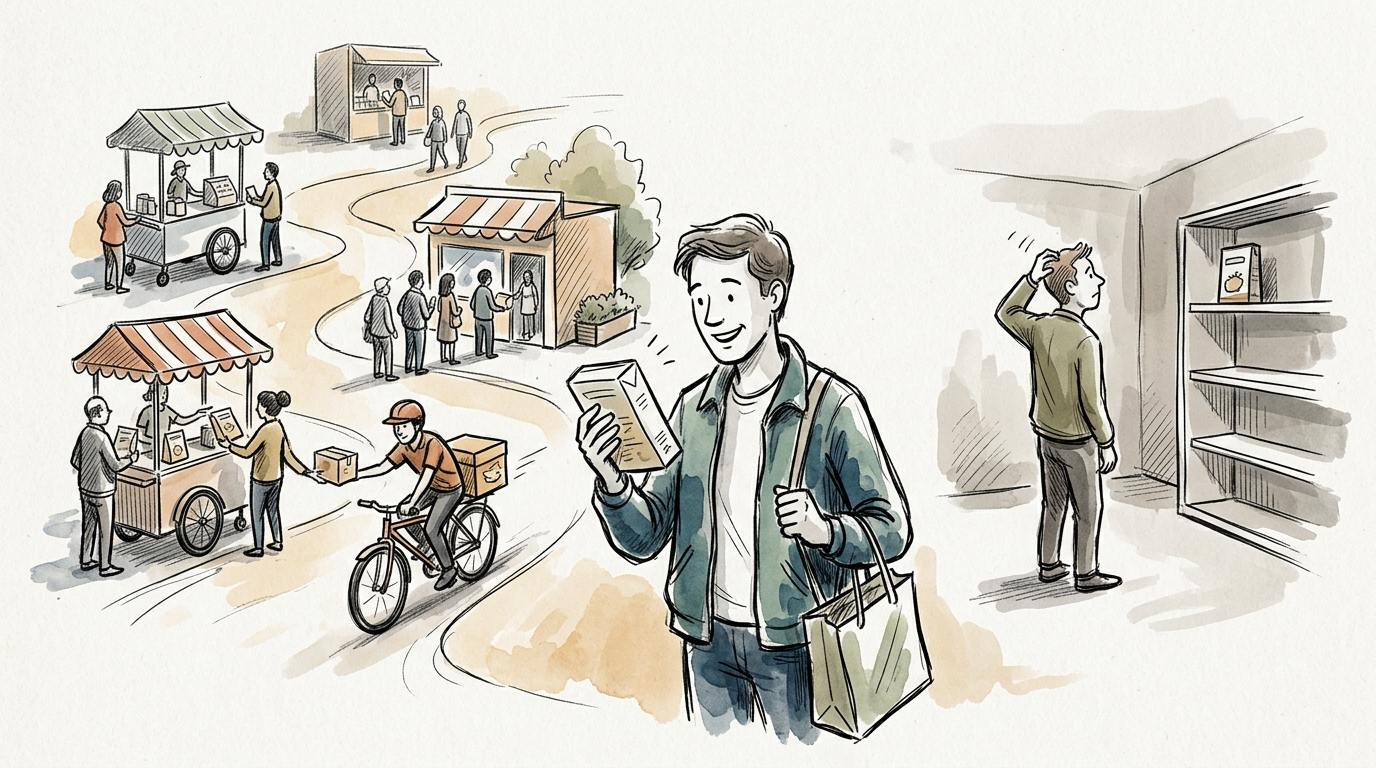
Distribution is often treated as a downstream execution issue, something to be solved after product, pricing, and messaging have been decided. Strategically, that view is far too narrow. Distribution determines where and how customers can buy, how easily they can compare alternatives, what service they receive, how much margin intermediaries take, what customer data the company can access, and how quickly competitors can intercept demand. In many categories, those choices shape market outcomes at least as much as product features do.
That matters because many organizations compete in markets where product differences are modest, easy to copy, or difficult for customers to evaluate before purchase. In those settings, strong distribution can create advantage through availability, convenience, trust, lower acquisition friction, better economics, and better control over the customer experience. A company may not need the most differentiated product in the market if it is consistently easier to find, easier to buy, easier to receive, and easier to use.
The strategic question is not simply whether to sell direct, through retailers, through distributors, through marketplaces, or through a field sales force. It is how channel choices affect who the company can reach, what value proposition it can credibly deliver, what margins it can sustain, and what competitive position it can defend over time.
Distribution is a strategic choice about access
Distribution strategy begins with a basic but consequential question: where does access to customers actually reside in this market?
In some categories, access sits with large retailers that control shelf space and shopper traffic. In others, access sits with digital platforms that control search behavior, app discovery, or marketplace rankings. In business-to-business markets, access may sit with channel partners, systems integrators, value-added resellers, distributors, dealers, or enterprise sales teams that have existing relationships and local service capacity. In still other categories, access sits with the company itself because customers are willing to buy directly and repeatedly from the brand.
This is why distribution should not be reduced to a logistics question. It is a market access question. The organization that controls access to buying occasions often shapes the economics of competition. That control may show up as bargaining power over suppliers, ownership of customer data, preferred placement, geographic reach, replenishment speed, service quality, or the ability to bundle adjacent offerings.
For marketers, the implication is straightforward. Distribution does not merely support demand. It influences whether demand can be captured at all.
Availability is often the first competitive advantage
Byron Sharp and colleagues at the Ehrenberg-Bass Institute have argued that brands grow in part by increasing mental and physical availability, meaning buyers are more likely to notice, recall, and find them in buying situations. Whatever one thinks of the full scope of that research tradition, the practical relevance of physical and digital availability is hard to dispute. If customers cannot conveniently buy the product when they are ready, competitors gain an opening.
Availability matters differently across categories. In fast-moving consumer goods, broad retail distribution can increase the number of buying occasions a brand can capture. In healthcare, provider networks and formulary access can determine whether a treatment is realistically available. In industrial markets, distributor networks and spare-parts availability can influence whether a product is considered reliable enough to specify. In software, integrations, app stores, and cloud marketplaces can affect procurement friction and enterprise adoption.
The strategic value of availability is especially strong when customers exhibit low involvement, weak loyalty, or limited willingness to search. In those markets, the best product does not necessarily win. The most available acceptable option often does.
That is one reason distribution can protect businesses whose product differentiation is limited. A private-label household cleaner, a regional beer, a mid-tier office-supply brand, or a comparable industrial component may win share not because buyers see dramatic product superiority, but because the offering is present where demand occurs, stocked reliably, priced appropriately for the channel, and easy for intermediaries to support.
Convenience is part of the value proposition, not a tactical add-on
Distribution creates customer value not only through reach but through convenience. Convenience includes proximity, delivery speed, installation, returns, financing, service access, subscription replenishment, procurement simplicity, and the reduction of uncertainty.
This is a strategic issue because convenience changes the effective value proposition. Two products with similar technical performance can deliver very different customer value if one is easier to order, arrives faster, integrates into the buyer’s workflow, and can be serviced locally. In that case, convenience is not a marketing wrapper around the product. It is part of the product-market fit.
Amazon’s long-term investment in fulfillment infrastructure is a widely discussed example. The company’s advantage was not simply ecommerce demand generation. It built a distribution system designed to reduce search friction, purchasing friction, and delivery waiting time across a very broad assortment. Amazon’s annual reports have long emphasized fulfillment centers, transportation capacity, Prime benefits, and seller services as part of the customer proposition and operating model, not as secondary support functions. For many consumers, convenience became the differentiator even when identical or nearly identical products were available elsewhere.
That logic applies beyond large-scale ecommerce. A building-products manufacturer with local inventory availability may beat a technically similar rival because contractors value speed and reliability more than minor performance differences. A software company that sells through cloud procurement marketplaces may convert faster because the buying process is easier for IT and finance. A food brand with better cold-chain distribution may gain repeat purchase because product quality at the point of consumption is more consistent.
In each case, distribution affects perceived value directly.
Channel choices shape margin, not just reach
A common mistake is to frame channel strategy as a simple tradeoff between scale and control. The economics are usually more complex.
Indirect channels can reduce customer acquisition cost, accelerate market entry, and expand geographic reach. Retailers, distributors, franchisees, and channel partners already have traffic, relationships, local knowledge, and infrastructure. That can make them strategically attractive, especially for companies that lack brand awareness, field coverage, or service capabilities.
But those benefits come at a cost. Intermediaries require margin. They may demand trade spending, slotting support, cooperative marketing funds, favorable payment terms, training resources, and exclusive arrangements. They may also constrain pricing, presentation, service standards, and access to end-customer data.
Direct channels appear attractive because they can preserve gross margin and improve customer insight. Yet direct distribution often carries high hidden costs: media spend, site conversion optimization, customer service, warehousing, reverse logistics, payment processing, fraud management, and the organizational complexity of operating a channel well. Direct-to-consumer is not automatically superior simply because it removes intermediaries.
Nike’s channel strategy illustrates this tension. In recent years the company has emphasized direct relationships through its own digital properties and stores, while also recalibrating its wholesale relationships after reducing and then selectively restoring some partner distribution. Nike’s investor communications have repeatedly linked direct channels to stronger consumer insight, fuller storytelling, and potentially better economics, while still recognizing that strategic wholesale partners contribute reach and brand visibility in important markets. The lesson is not that direct is always better. It is that distribution mix is a portfolio decision. Different channels serve different strategic roles.
For marketers, this means channel evaluation should include at least four economic questions:
- What customer acquisition costs does the channel absorb versus shift back to the brand?
- What margin is given up, and what operating costs are avoided in return?
- What customer quality, basket size, repeat rate, and retention profile does the channel produce?
- How does the channel affect pricing power and long-term bargaining power?
A channel that delivers lower gross margin may still be strategically superior if it expands access to attractive customers efficiently. A channel that appears margin-rich may be inferior if it requires unsustainably high acquisition spend or produces weak retention.
Distribution also determines who owns the customer relationship
One of the most important strategic consequences of distribution is control over customer data and customer learning.
When a company sells primarily through third parties, it may gain volume while losing visibility into who buys, why they buy, what else they considered, how often they repurchase, and what predicts churn or cross-sell. Retail scan data, syndicated research, and partner reporting can help, but they rarely substitute fully for direct first-party behavioral insight.
That loss matters because customer knowledge affects segmentation, pricing, retention, innovation, and resource allocation. A company that knows only aggregate sell-through may struggle to identify high-value customer segments, personalize service, improve onboarding, or test pricing structures. It may also find itself dependent on retailer or platform algorithms that can change without warning.
At the same time, not every business needs full direct ownership of the relationship. In some markets, intermediaries create real value by aggregating demand, simplifying procurement, handling local compliance, offering credit, or providing service. The strategic question is whether the company can learn enough through the channel structure it has chosen and whether that structure supports the level of customer intimacy the business model requires.
This is why many organizations adopt hybrid models. They may sell through distributors or retailers for scale, while building direct digital touchpoints for registration, support, loyalty, subscriptions, replenishment, education, or community. The goal is not ideological commitment to directness. It is selective ownership of the relationship where that ownership improves economics or strategic flexibility.
Customer experience is often delivered through the channel, not the advertisement
Marketers frequently speak about brand experience as if it were primarily determined by communications and creative expression. In practice, a large share of the customer experience is channel experience.
How easy was the product to find? Was inventory available? Was the listing accurate? Was the store environment appropriate for the brand? Did staff explain the product well? Did delivery arrive on time? Was installation competent? Was it easy to get service or process a return?
Those are not minor operational details. They influence satisfaction, repeat purchase, review quality, referral behavior, and price tolerance. In categories where the product is hard to evaluate before use, channel quality may heavily shape brand perception.
Luxury brands understand this clearly. Many continue to limit distribution because the point of sale, service environment, assortment control, and pricing discipline are integral to perceived value. According to investor and company materials from firms such as LVMH and Hermès, selective distribution and retail control are not merely commercial preferences. They are part of how the brands preserve exclusivity, presentation quality, and price integrity.
Mass brands face the same strategic logic in a different form. A consumer electronics brand sold through untrained resellers, inconsistent ecommerce listings, and poor after-sales service may erode trust even if the product itself is strong. Conversely, a less differentiated product can gain preference if its channel experience feels more reliable and less risky.
Distribution, then, is often a core component of positioning. Premium positioning is difficult to sustain in channels built around constant discounting and limited service. Value positioning is difficult to scale if distribution adds complexity or friction that undermines convenience.
Distribution can create barriers to entry and competitive insulation
Strong distribution can become a defensible competitive asset, particularly when it is difficult, expensive, or slow to replicate.
This defensibility can take several forms. It may come from exclusive agreements, preferred shelf placement, local warehouse density, service networks, route density, procurement integrations, installed-base support, dealer loyalty, or accumulated capability in managing a complex omnichannel system. In some markets, incumbents benefit from channel relationships that newcomers cannot quickly reproduce, even when the new entrant has a strong product.
Coca-Cola and PepsiCo have long demonstrated the strategic importance of distribution scale in beverage markets. Their advantages do not come only from brand strength. Bottling systems, retail relationships, merchandising capacity, cooler presence, fountain contracts, foodservice reach, and route density all affect availability and visibility. Competing effectively in beverages is not simply a matter of creating a comparable drink. It often requires building or accessing a distribution system capable of national or regional execution.
The same principle appears in B2B markets. Grainger’s branch footprint, inventory systems, and digital capabilities have been part of its value proposition to maintenance, repair, and operations customers. McKesson, Cencora, and Cardinal Health operate distribution networks in pharmaceutical supply that combine scale, compliance, logistics, and customer access. These companies are not simply moving goods. Their distribution capabilities are deeply tied to market structure and competitive position.
For challengers, this has an important implication. Entering a category where incumbents control effective distribution may require a different route to market rather than a better version of the same offer. That might mean beginning in underserved niches, using alternative channels, partnering with specialists, targeting different use cases, or designing a product and service model that reduces dependence on incumbent-controlled pathways.
Channel conflict is a strategic problem, not a sales inconvenience
Once a company operates across multiple channels, conflict becomes likely. Direct channels may undercut resellers on price. Retail partners may object to marketplace listings. Enterprise sales teams may clash with self-serve ecommerce. Geographic distributors may resist national account structures. Premium channels may object to discount-heavy ones.
These conflicts are not mere coordination headaches. They expose deeper strategic ambiguity. If a company cannot explain the role of each channel, the target customer for each, the pricing architecture, and the service expectations, conflict is inevitable.
A coherent channel strategy requires explicit choices about what each route to market is meant to accomplish. One channel may provide broad awareness and entry-level access. Another may serve high-service customers. Another may support replenishment and retention. Another may handle smaller accounts economically. Another may establish presence in geographies the company cannot serve directly.
Without that clarity, the organization often defaults to opportunistic distribution expansion. In the short term, that can lift revenue. Over time, it can erode margins, confuse positioning, weaken partner trust, and train customers to arbitrage channels.
This is particularly relevant in omnichannel environments. According to the National Retail Federation and major retail reporting, customers increasingly move across online and offline touchpoints. That reality does not eliminate channel strategy. It makes channel design more important, because customers now compare availability, price, fulfillment, and service across touchpoints more easily. The company must decide where consistency matters, where differentiation by channel is acceptable, and how channel economics support the overall brand and customer model.
Distribution affects pricing power and price perception
Pricing strategy cannot be separated from distribution strategy. Channels influence reference prices, discount visibility, assortment structure, and customers’ willingness to pay.
Products sold in high-promotion environments may struggle to maintain premium pricing even if they offer premium features. Marketplace environments can intensify price comparison and commoditization. Specialty retail or consultative sales environments may support higher prices because they reduce decision risk and add service value. Direct channels may allow more experimentation with bundles, subscriptions, financing, or premium service tiers.
Channel mix also affects net realized price. A list price that looks attractive in a spreadsheet may deteriorate once trade terms, rebates, marketplace fees, fulfillment costs, and return rates are included. Conversely, a higher list price in a more selective channel may produce stronger contribution margin if the channel supports lower return rates, better attachment sales, and higher retention.
Apple provides a useful example. Through its retail stores, online direct business, carrier relationships, and authorized reseller network, Apple has maintained broad access while tightly managing merchandising, service, and price presentation. Its distribution strategy supports premium positioning not only because products are widely available, but because the buying environment, post-purchase support, and channel discipline reinforce value perception.
The broader lesson is that price is experienced within a channel context. Distribution can either support willingness to pay or steadily undermine it.
Different markets call for different channel structures
No distribution model is universally superior because markets differ in customer behavior, economics, and operational demands.
In low-involvement packaged goods, broad retail and wholesale reach may matter more than direct relationship depth. In enterprise software, partner ecosystems may accelerate implementation and trust, especially in complex or regulated categories. In industrial equipment, local dealer service can be decisive because uptime matters more than list price. In fashion or luxury, selective distribution may be essential to preserve brand meaning. In digitally native subscription categories, direct channels may be central because retention and customer lifetime value depend on owning the relationship.
Market concentration also matters. If a few retailers dominate a category, brands may have little choice but to work through them while trying to reduce dependence over time. If customer concentration is high in B2B, direct account coverage may be justified. If geography is fragmented, local intermediaries may be more efficient than building direct operations. If regulation complicates shipping, financing, installation, or service, channel partners may have structural advantages.
This is why market attractiveness cannot be evaluated separately from channel realities. A fast-growing market may still be strategically unattractive if customer access is controlled by powerful intermediaries that compress margins and withhold data. Conversely, a mature market may be attractive if the company has privileged access to a high-value channel others find difficult to penetrate.
Distribution strategy is also a growth strategy
Many growth plans implicitly assume that demand can be scaled if marketing spend rises. In reality, growth is often constrained by channel capacity, reach, partner economics, or fulfillment capability.
Distribution-led growth can come from several sources:
- Expanding numeric distribution into more outlets, geographies, or accounts.
- Improving weighted distribution by gaining presence in higher-volume locations.
- Adding channels that reach different customer segments or use occasions.
- Improving in-channel conversion through better assortment, availability, merchandising, or service.
- Increasing repeat purchase through easier replenishment or support.
- Reducing churn by improving service access and post-purchase experience.
These growth paths are strategically different. Expanding into more points of sale may boost share, but it can also dilute exclusivity or strain working capital. Moving into marketplaces may generate fast demand capture but weaken pricing power. Opening direct channels may improve customer lifetime value but require substantial acquisition investment. International distribution can increase total addressable market while exposing the company to local channel power and operational complexity.
The right choice depends on the organization’s objective. If the goal is fast trial in a low-involvement category, broad distribution may be worth margin sacrifices. If the goal is premium margin expansion, selective distribution may be wiser. If the goal is retention and recurring revenue, direct or hybrid structures may deserve more investment than broad wholesale expansion.
Growth through distribution is therefore not just about more coverage. It is about choosing the kind of coverage that aligns with value creation and unit economics.
What marketers should evaluate before recommending a channel move
Because distribution decisions cut across marketing, sales, finance, operations, and service, they are easy to oversimplify. Before recommending a major channel shift, marketers should test several strategic questions.
First, what customer problem does the channel solve better than the current model? Better reach is not enough if it attracts poor-fit customers or erodes service quality.
Second, what role will the channel play in the portfolio? Is it for acquisition, retention, premium experience, entry-level access, geographic expansion, or account coverage?
Third, how will the channel affect the value proposition? Does it improve convenience, trust, speed, and support, or does it create price transparency that weakens differentiation?
Fourth, what are the true economics after fees, trade spend, returns, service costs, and internal operating complexity?
Fifth, what customer data will be gained or lost, and how important is that information to future pricing, innovation, and retention?
Sixth, what competitive response is likely? Incumbents may defend shelf space, increase trade support, match logistics capabilities, or pressure partners.
Seventh, what organizational capabilities are required? Many failed channel expansions are not bad ideas in theory. They are capability mismatches in practice.
These questions help distinguish a strategic distribution move from a simple attempt to add another sales outlet.
Why similar products produce different outcomes
In many mature categories, firms overestimate the strategic importance of incremental product differences and underestimate the market effects of distribution quality. If products are reasonably comparable, outcomes often turn on which offer is easier to access, easier to trust, better supported, and embedded in the customer’s preferred buying path.
That is why distribution can create durable advantage even without dramatic product uniqueness. It affects physical and digital availability, convenience, service consistency, customer data, margin structure, and the ability to defend access against competitors. It influences who sees the product, when they encounter it, how they evaluate it, what they pay, how satisfied they are afterward, and whether they come back.
For marketing leaders, the practical conclusion is clear. Distribution is not a neutral pipeline through which strategy passes. It is one of the mechanisms by which strategy becomes real in the market. Organizations that treat distribution as a source of access, value creation, and competitive leverage are often better positioned to grow than those that treat it as a late-stage implementation choice. In markets where products are increasingly similar, that distinction can decide who captures demand and who merely generates it.
Leave a Reply