
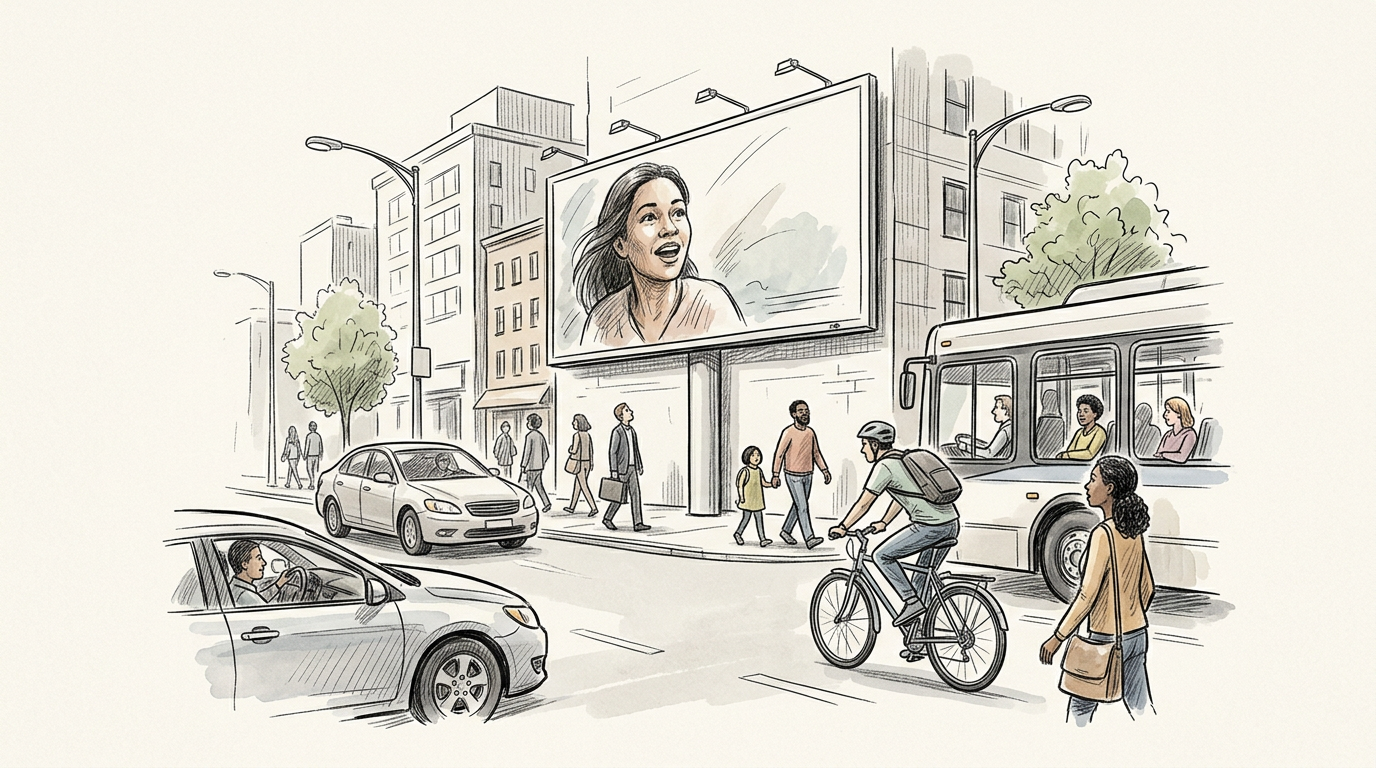
Out-of-home advertising reaches people in motion. That basic fact makes it one of the oldest mass media and one of the most distinct. Unlike television, streaming, print, or social platforms, OOH does not wait for audiences to choose content. It is encountered in streets, stations, stores, airports, elevators, office lobbies, arenas, and along commuting routes. Its value comes from presence, placement, and repeated exposure within the geography of everyday life.
For media planners, that creates both an opportunity and a discipline. OOH can deliver broad local reach, reinforce other media, and put brands into physical environments close to shopping, travel, entertainment, and work. But OOH is often misunderstood when its audience is reduced to traffic counts or when impressions are treated as confirmed attention. Passing a billboard, walking through a transit hub, or riding past a digital screen is not the same as seeing, processing, or remembering an ad. The medium works through probability, movement patterns, visibility, and repetition, not through guaranteed visual engagement.
Understanding OOH therefore requires looking closely at location, audience flow, exposure conditions, geographic coverage, and the economics of inventory.
OOH is a location medium before it is a format medium
Media discussions often begin with format: billboard, poster, transit shelter, digital screen, spectacular, in-store display. In practice, OOH planning starts with location. The same creative unit can perform very differently depending on where it sits, what kinds of people pass it, how quickly they move, what obstructs visibility, how often they repeat the journey, and what else competes for attention in the environment.
The Out of Home Advertising Association of America describes OOH as a medium spanning billboards, street furniture, transit, place-based media, and related formats across public and commercial spaces. That taxonomy is useful, but strategy usually depends less on the category label than on the audience behavior surrounding the placement. A roadside bulletin on a commuter corridor serves a different role from a platform poster in a subway station, a digital screen in an urban retail district, or a screen in a medical waiting room. Each combines different dwell times, sightlines, audience compositions, and contextual signals.
That makes OOH unusually sensitive to physical environment. A media planner is not just selecting a channel. The planner is selecting a route, a neighborhood, a transportation pattern, a viewing distance, a pace of movement, a time-of-day audience, and a set of contextual associations.
How moving audiences are actually reached
OOH reaches audiences through circulation rather than appointment. People do not tune in to a billboard. They encounter it while doing something else. As a result, exposure is tied to mobility patterns.
Those patterns generally fall into several broad contexts:
- Commuting and repeated travel: highways, arterial roads, rail lines, bus routes, subway systems, park-and-ride locations, and pedestrian commuter corridors.
- Urban circulation: downtown foot traffic, retail districts, entertainment zones, mixed-use neighborhoods, and tourism centers.
- Destination-based movement: airports, arenas, shopping centers, campuses, healthcare facilities, and convention venues.
- Place-based dwell environments: gyms, bars, restaurants, office buildings, rideshare vehicles, elevators, and waiting rooms.
What matters is not only how many people pass through these environments, but how consistently the same people return. Repeated travel patterns are one of OOH’s most important media characteristics. Daily commuters may encounter the same structure five days a week. A transit user may pass the same station dominations each morning and evening. A neighborhood screen may become part of the visual backdrop for regular visitors. This is where OOH frequency is often built: not by long session time in a single sitting, but by habitual route repetition over days and weeks.
That repetition can be especially useful for simple brand messages, directional cues, reminders, and creative designed to accumulate familiarity over time. It can also be a limitation when planners assume a high-traffic unit automatically delivers broad unique reach. A location with heavy recurring commuter flow may deliver a great deal of frequency to a relatively concentrated population rather than wide deduplicated reach across a market.
Location, traffic, and visibility are related but not interchangeable
The core planning variables in OOH are often discussed together, but they do different jobs.
Location determines the surrounding audience and context. A board near a financial district may deliver affluent weekday professionals. A location near a suburban retail corridor may index toward shoppers and family travel. An airport unit may reach business travelers, leisure travelers, and airport workers, but at a very different cost and cadence.
Traffic indicates potential audience flow. This may include vehicular traffic, pedestrian counts, transit ridership, or venue attendance. Traffic helps establish the scale of circulation around a placement, but it is only the starting point for audience estimation.
Visibility concerns whether the unit is positioned in a way that gives people an opportunity to notice it. Size, illumination, angle, height, distance from the road or walkway, speed of travel, clutter, landscaping, weather, construction, and competing signage all matter.
A large-format roadside billboard on a heavily traveled route can look impressive on a market map, but if the approach angle is poor, the copy is dense, or surrounding structures crowd the line of sight, the exposure opportunity may be weaker than its traffic number suggests. Conversely, a smaller placement in a constrained dwell environment can generate stronger notice because the audience is stationary or moving slowly.
This is why OOH planning cannot be reduced to “high traffic equals high effectiveness.” Exposure opportunity is conditional.
Why passing a placement is not the same as attention
The editorial and strategic distinction at the center of OOH measurement is the difference between circulation and attention. A person can be present in the vicinity of a unit without consciously looking at it. Even a counted impression is not proof of active cognitive processing.
The Media Rating Council’s OOH audience measurement standards and guidance from Geopath, the major U.S. OOH audience measurement body, are built around the concept of visibility-adjusted audience and likelihood of exposure rather than direct proof that every person saw every ad. Geopath’s methodology combines audited inventory data with mobility and demographic datasets to estimate how many people had the opportunity to see a unit, taking visibility factors into account. That is more sophisticated than raw traffic counts, but it still does not convert exposure probability into guaranteed attention.
This distinction matters because OOH exists in environments full of competing demands. Drivers are watching the road. Pedestrians are navigating crowds, signals, phones, companions, storefronts, and transit schedules. Travelers in airports may be orienting themselves, queuing, or multitasking. In-store audiences may be shopping, comparing products, or hurrying through a trip. In all of these cases, media exposure competes with real-world tasks.
Attention in OOH is therefore contingent on several conditions:
- Opportunity to notice the unit
- Time available to process it
- Creative simplicity and legibility
- Environmental clutter
- Relevance of the context
- Repetition across multiple encounters
This is also why OOH creative discipline matters so much. The medium often works best when the message can be grasped quickly, from distance, and under imperfect attention conditions. Media value and creative execution are tightly linked in OOH because the exposure window is often short.
How OOH reach and frequency differ from screen media
Reach in OOH is generally the number or proportion of people who had an opportunity to be exposed to a placement or campaign over a defined period in a market or geography. Frequency is the number of times those exposed people are likely to encounter the advertising during that period. As in other media, the balance between reach and frequency is constrained by budget.
But the mechanics are different from most person-based digital systems. OOH reach and frequency estimates rely heavily on movement patterns, visibility modeling, and geography. They are shaped by route overlap, daily behavior, and placement density.
An OOH plan with many units concentrated on one commuter corridor may generate high frequency among a repeating audience but limited incremental reach beyond that corridor. A broader market coverage plan that distributes units across neighborhoods, arterial roads, transit assets, and retail zones may sacrifice some intensity at any single location in order to expose more unique audiences across the designated trade area.
This makes duplication a central planning concern. If several units sit along the same route, the campaign may effectively dominate that path, which can be valuable for memory and salience. But if the objective is to maximize market-wide awareness, too much route duplication can constrain incremental reach.
OOH planners often think in terms of geographic layering: combining high-traffic anchors with additional units that extend into underserved zones, secondary commuting routes, or neighborhoods that align with target audience residence or shopping behavior. The objective is not simply to buy more faces, but to buy patterns of movement.
Measurement has improved, but OOH is still an opportunity-to-see medium
OOH measurement has become far more data-driven than the old stereotype of simple traffic estimates. In the United States, Geopath provides audience location measurement using mobile and travel datasets, roadside and pedestrian visibility adjustments, and demographic modeling to estimate impressions for audited units. This has brought OOH closer to the planning language used in other media, including impressions, reach, frequency, and audience composition.
The World Out of Home Organization and other industry bodies have also emphasized more standardized audience measurement practices internationally, reflecting the broader push toward accountability in media buying.
Still, professionals should be clear about what these systems do and do not observe.
They can estimate:
- How many people traveled near a placement
- How often movement occurred
- When audiences were present
- How visibility conditions affect opportunity to see
- Likely demographic composition based on modeled data
They do not directly prove:
- That each counted person looked at the ad
- How long that person looked
- What the person remembered
- Whether the exposure changed attitude or behavior
- How exposure overlaps perfectly with all other media channels
This limitation does not make OOH unmeasurable. It simply places OOH in the broader category of media where exposure probability must be distinguished from confirmed attention and from effect. The same discipline applies elsewhere in media, even if the technical conventions differ. A digital display impression is not guaranteed attention either. OOH just makes that distinction more visibly obvious because the audience is moving through a physical world rather than scrolling on a screen.
Geography is one of OOH’s strongest strategic advantages
Few media channels combine scale and local specificity as effectively as OOH. A national advertiser can use OOH to create visible market presence in top DMAs, while a regional or local advertiser can tightly align investment with trade areas, store footprints, event zones, commuter inflows, or neighborhood demographics.
This geographic flexibility is one reason OOH remains useful despite audience fragmentation elsewhere. Brands can match the medium to practical business questions such as:
- Where do potential customers live?
- Where do they work or commute?
- Which routes lead to our stores or dealerships?
- What neighborhoods over-index for likely buyers?
- Where can we establish presence near competitors?
- Which markets need awareness support before launch or promotion?
For local and regional advertisers, this can make OOH less about abstract awareness and more about territorial communication. A healthcare system may want to dominate commuter routes leading to a service area. A university may focus on feeder markets and event-heavy campuses. A restaurant chain may emphasize units near store clusters and lunchtime traffic. A streaming service launching a marquee show may target high-visibility urban entertainment districts for cultural impact rather than broad commuting reach.
These are all OOH strategies, but they rely on different definitions of success. Some prioritize mass market coverage. Others prioritize proximity, local salience, or symbolic presence.
Different OOH formats create different audience conditions
Treating OOH as a single medium hides major differences in how its inventory works.
Roadside billboards provide scale, repeated commuter exposure, and broad geographic signaling. They usually favor simple creative and work well for market presence, brand fame, and directional messaging. Their audiences are often fast-moving and variably attentive.
Street furniture, including bus shelters, kiosks, and urban panels, tends to operate at closer range and slower speeds, often in pedestrian-heavy settings. This can improve readability and contextual relevance, though absolute scale may be smaller than major bulletins.
Transit media ranges from station posters and platform dominations to wrapped vehicles and interior cards. These units reach audiences at different stages of travel: waiting, boarding, riding, transferring, and walking through transit systems. Dwell time can be an advantage, but audience composition depends heavily on the transit network and time of day.
Digital out-of-home, or DOOH, adds dayparting, creative rotation, dynamic messaging, and more flexible campaign flighting. It can be bought directly or programmatically in some environments, although the inventory and transaction models vary widely by owner and venue.
Place-based media in gyms, offices, retail stores, bars, or waiting rooms can offer slower-paced exposure and tighter contextual targeting, but often with less standardized audience measurement and more fragmented supply.
The planning implication is straightforward: OOH format choice should follow the mobility context and communication objective, not generic enthusiasm for “big screens” or “urban presence.”
Digital OOH changes operations more than it changes the core media logic
Digital out-of-home has expanded flexibility in a medium once defined by static posting cycles. Advertisers can now run shorter flights, swap creative by daypart, respond to weather or events, and use data triggers in some environments. Programmatic pipes have also made some DOOH inventory easier to access alongside other digital workflows.
But it is important not to overstate how much this changes the underlying audience relationship. DOOH still reaches people in physical space. Its exposure still depends on traffic, visibility, dwell time, and location. The screen may be digital, but the audience is still moving through the world.
DOOH also introduces specific media considerations:
- Share of voice: multiple advertisers may rotate on a single screen, reducing continuous ownership relative to a static placement.
- Loop length and spot duration: exposure opportunity depends on how often a creative appears and how long viewers remain in view of the screen.
- Contextual flexibility: dynamic creative can improve relevance, but only if the message remains legible under brief exposure conditions.
- Buying complexity: some inventory is sold directly, some via networks, and some via programmatic channels, with differing transparency and measurement.
In other words, DOOH increases operational flexibility, but it does not eliminate the need to understand physical audience movement.
Buying OOH means buying inventory, geography, and time
OOH buying is often less standardized than digital display buying and more tied to asset ownership, market structure, and local availability. Major media owners control large inventories in many markets, while transit authorities, venue operators, place-based networks, and regional companies control others. Buying structures vary by format and owner, but common approaches include direct negotiation, package buys, market coverage deals, network buys, sponsorship-style arrangements, and increasingly selective programmatic transactions for some digital inventory.
Operationally, buyers consider factors such as:
- Unit availability and posting period
- Geographic distribution and adjacency
- Illumination and production requirements
- Competitive separation or category conflict policies
- Makegoods or replacement terms if units are unavailable
- Installation, posting, and proof-of-performance procedures
Static inventory typically involves fixed display periods and production lead times. Large-format units may also involve substantial printing, vinyl, installation, and maintenance costs. Digital inventory reduces some production friction, but that does not automatically make it cheaper or better. The value depends on market, placement quality, rotation load, and audience conditions.
As in other media, the lowest unit cost is not necessarily the best value. A cheaper board in a weak location may underperform a more expensive placement that delivers stronger visibility, better route repetition, or more relevant geographic context. OOH economics are inseparable from site quality.
Context is not a side benefit in OOH. It is part of the media value
A central strength of OOH is that the ad appears within a real-world setting that can shape meaning. A transit takeover in a financial district, airport branding for a B2B service, a cinema lobby campaign for an entertainment release, or a retail district spectacular for a fashion brand each carries contextual cues that screen-based impressions often do not.
This can work in several ways. Context may reinforce relevance, as when quick-service restaurants advertise near meal-decision moments. It may signal stature, as with iconic large-format urban displays. It may add utility, as with directional messaging near points of sale. It may create social visibility, where highly photographed urban OOH placements spill into earned media or social sharing.
But context also creates risk. A beautifully produced campaign can lose force in cluttered surroundings, mismatched neighborhoods, low-light conditions, or environments where the audience is too hurried to process anything beyond a logo. Context is therefore both a strategic asset and a planning constraint.
OOH often works best as part of a broader media system
Although OOH can function as a standalone medium in local markets or for highly visible branding campaigns, it is frequently most effective when paired with other channels. Its role in the media mix is often to establish physical presence, reinforce memory, extend local reach, or bridge upper-funnel brand communication with place-based relevance.
For example, television or streaming may supply broad audiovisual storytelling, while OOH reinforces salient brand cues during the workweek commute. Audio can add repetition during drive time, while billboards provide visual confirmation in the same mobility context. Mobile media can support action after OOH exposure, but should not claim credit too simplistically. Cross-channel effects are often cumulative and difficult to assign cleanly.
This is where media professionals need discipline. OOH should not be judged only by direct response metrics that favor clickable media, nor should it be defended only with vague claims about awareness. The proper question is what job OOH is doing in the total communication plan: market presence, route domination, event amplification, store traffic support, launch visibility, local reinforcement, or status signaling.
Attention, effectiveness, and proof remain distinct questions
The industry’s broader interest in attention metrics has naturally reached OOH. Eye-tracking studies, facial orientation systems in certain venues, mobile location analysis, and various modeled attention products attempt to refine understanding of whether exposure became notice.
These tools can be useful, but they should be interpreted carefully. Attention is not a single universal metric across all OOH formats. A driver glancing at a bulletin, a commuter standing on a platform, and a traveler waiting at baggage claim experience very different attentional conditions. Some studies offer directional insight into relative performance across environments or creative treatments, but they do not create perfect comparability across the medium.
Nor does attention alone prove business effect. A noticed ad may still fail to persuade. A lightly noticed campaign may still contribute through cumulative repeated exposure over time. As with other media, effectiveness depends on objective, category, creative quality, market conditions, and how the medium works alongside others.
Professionals should therefore separate three questions:
- Was there an opportunity to see?
- Did the audience likely notice or attend to the message?
- Did that exposure contribute to brand or business outcomes?
OOH can answer the first question more confidently than the second, and the second more confidently than the third. Better planning comes from keeping those distinctions clear.
What advertisers should understand about OOH’s enduring role
OOH remains valuable because it reaches people not as users or subscribers, but as travelers, commuters, shoppers, workers, and citizens moving through shared space. Its power is physical. It can make a brand visible at urban scale, put a message near a point of decision, or build familiarity through repeated route exposure in ways few other media can replicate.
Its limitations are just as important as its strengths. OOH is not click-based. It does not guarantee attention. It should not be evaluated by traffic counts alone. High circulation, prominent scale, and premium geography create opportunity, not certainty. The real craft of OOH planning lies in understanding how moving audiences inhabit places, how often they return, what they can realistically notice, and what role that exposure should play within the larger media plan.
For advertisers, that means treating OOH neither as a nostalgic branding medium nor as a simple impressions business. It is a location-driven reach medium shaped by mobility patterns, visibility conditions, repetition, and context. When those elements are planned well, OOH can do something increasingly rare in fragmented media markets: make advertising unmissably present in the physical world, even if being present is not the same as being seen.
Leave a Reply