
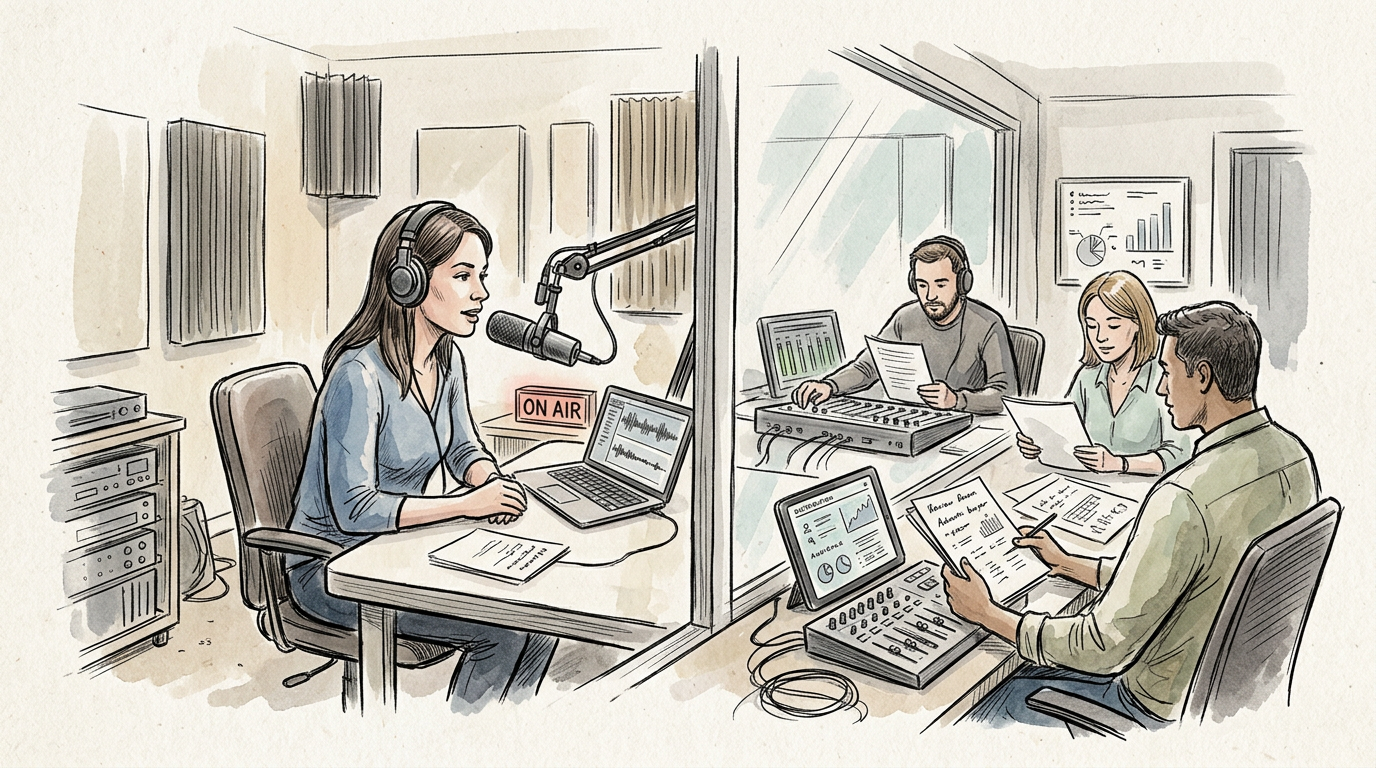
Podcast advertising is often discussed as if it were a single channel with a single audience and a single buying model. In practice, it is a collection of distinct media environments tied together by one habit: people choosing spoken-word or music-adjacent audio on demand. That matters for advertisers because the way a podcast ad is delivered, heard, measured, and valued depends heavily on the program, the publisher, the listening app, and the buying arrangement behind it.
The appeal of podcast advertising is not difficult to understand. Podcasts can offer attentive listening, strong host-audience relationships, niche editorial environments, and national distribution without the production economics of television or the clutter levels often associated with digital display. But the medium is also operationally uneven. A host-read endorsement in a weekly interview show works differently from a dynamically inserted pre-roll in a large network’s catalog. A download is not the same thing as a listen. A listen is not the same thing as attention, recall, or response. And because podcasts sit between publishing, audio distribution, and ad technology, planners have to understand both the intimacy of the format and the limits of the measurement.
That is what makes podcast advertising strategically interesting. It is less a pure performance channel than a media environment where context, trust, frequency, and audience fit can matter as much as raw scale.
What advertisers are actually buying in podcast media
At a basic level, podcast advertising is the sale of commercial access to an audience gathered around a show, a network, or a broader catalog of programming. That access may be sold by an individual publisher, a podcast network, a sales rep firm, a hosting platform, or a programmatic marketplace. The inventory itself is usually organized around ad positions within an episode, commonly pre-roll, mid-roll, and post-roll, though those terms can obscure meaningful differences in execution and value.
Mid-roll inventory often commands the most interest because it tends to appear after the listener has committed to the episode and before the end of the program, when drop-off may be higher. Pre-roll offers earlier exposure and can be useful when scale matters, while post-roll often trades at lower value because not all listeners remain through the close of the episode. Those are broad tendencies, not universal rules. Some shows with highly loyal audiences sustain strong completion rates, and some formats integrate commercial messages so tightly into the editorial flow that position matters less than the credibility of the delivery.
Podcast ads are typically sold in several forms:
- Host-read endorsements, in which the show’s host delivers the message in their own voice, often using approved talking points.
- Produced spots, which resemble conventional audio ads and may be inserted across many shows.
- Announcer-read ads, where a network voice or presenter other than the show host reads the copy.
- Sponsorship packages, which can combine ad positions with branded segments, episode sponsorship, social posts, newsletter mentions, live events, or other promotional elements.
- Dynamically inserted inventory, which allows ads to be served after an episode is published and replaced over time.
Each format creates a different media product. Buying host-read ads in a finance podcast is not just buying audio impressions. It is buying association with a host, a tone, a community, and an editorial setting. Buying produced spots through dynamic insertion is closer to buying scalable digital audio inventory, even if the surrounding content remains editorially distinctive.
Why host-read advertising became central to podcast economics
Host-read advertising is the format most associated with podcasting because it aligns with the medium’s strongest qualitative advantage: the perceived closeness between hosts and listeners. Many podcasts are consumed through headphones, during commuting, exercising, household tasks, or other routines that create a sense of companionship. Listeners often spend long stretches with the same voices every week. That repeated, habit-based exposure can make an endorsement feel more like a recommendation than a conventional interruption, at least when the fit is credible.
For media planners, that can be attractive for categories that benefit from explanation, reassurance, or product demonstration through language alone. Subscription services, financial products, health and wellness brands, software tools, direct-to-consumer goods, books, entertainment releases, and B2B services have all used podcasts because hosts can explain why a product exists, who it is for, and how it fits into daily life. Some hosts also add personal anecdotes, though many advertisers and publishers now manage such claims carefully for legal and regulatory reasons.
The commercial benefit of host-read inventory is not simply that it sounds more natural. It also often carries a different attention profile than standard recorded spots. A listener may skip any ad they can technically avoid, but a host-read message integrated into the pacing of the show may retain more listening than a generic creative unit dropped into the feed. That does not make host reads universally superior. Some hosts are persuasive; others are not. Some shows have audiences that tolerate commercial integration; others do not. Host-read effectiveness depends on credibility, tone, repetition, and category fit, not just on the format label.
Host reads also present practical constraints. They are harder to standardize, can require copy approvals and talent coordination, and may be less scalable across many programs. They can be expensive relative to more commoditized audio inventory because the advertiser is paying not just for audience delivery but for the host’s voice, relationship, and implied endorsement.
Produced spots and the push toward scale
Produced podcast spots solve a different media problem. They allow advertisers to run consistent creative across larger pools of inventory, often with less dependence on individual hosts. This can support broader reach, creative control, easier legal review, and faster trafficking. It can also make podcast inventory more compatible with audio buying systems used for streaming audio and digital radio.
For brands that need campaign consistency across channels, produced spots can be operationally attractive. A company already running audio creative on streaming platforms may adapt it for podcast placements without rebuilding each message around a host. That makes produced spots useful when the objective is national scale, message standardization, or integration into a wider audio plan.
The tradeoff is that produced spots may not benefit from the same parasocial relationship or contextual integration that makes host-read podcast advertising distinctive. In other words, they can be easier to buy and easier to scale, but also easier for audiences to treat as ordinary advertising. That does not mean they are ineffective. It means they should be evaluated as a different media product with different strengths.
Dynamic ad insertion changed podcast inventory
One of the most important operational developments in podcast advertising has been dynamic ad insertion, often abbreviated DAI. In a traditional baked-in model, the ad is embedded permanently into the audio file. In a dynamically inserted model, the ad can be served when the episode is downloaded or streamed, allowing the publisher to refresh campaigns in back-catalog episodes, target by geography or time period, and monetize content long after original publication.
This matters because podcasts have long shelf lives. A listener can discover a show months or years after an episode first ran. If every ad were permanently baked in, advertisers would either keep receiving old impressions against outdated offers or publishers would leave archive listening under-monetized. DAI turns older episodes into reusable inventory.
It also changes buying and measurement. Dynamic insertion makes podcast media more flexible and more legible to ad-serving systems, but it can create ambiguity about what was actually heard. Depending on the delivery method, a platform may know an ad was inserted or a file was requested, yet still have limited visibility into whether the listener played the ad through, skipped ahead, or abandoned the episode.
DAI can support targeting by location, device type, or other available signals, but podcast targeting is still generally less granular than many forms of display advertising, especially in open RSS-based distribution. The medium’s strength is often context and audience affinity rather than hyper-detailed personal targeting.
Direct sponsorships remain an important part of the market
Despite automation and marketplace expansion, podcast advertising is not purely a programmatic business. Direct sponsorships remain important because many podcast buys are built around show selection, category fit, and negotiated integration rather than open-market bidding alone.
A direct sponsorship may involve category exclusivity, guaranteed ad positions, a minimum number of episodes, host participation, branded content rights, custom promo codes, newsletter mentions, social amplification, or live-read requirements. For advertisers, this structure can create greater certainty around adjacency, format, and share of voice. For publishers, it can support premium pricing and reduce the commoditization of inventory.
The economics here look more like publishing sponsorship than conventional digital display. The buyer is often not just purchasing available impressions but securing a place inside a show’s commercial architecture. In some cases, the sponsorship extends beyond a single feed and becomes a network relationship across multiple titles.
This is one reason podcast CPMs have often appeared high relative to some other digital channels. The inventory may include more than basic file delivery. It may bundle endorsement value, category alignment, exclusivity, custom creative treatment, and access to a concentrated niche audience.
Podcast audiences are fragmented, but that fragmentation can be useful
Podcasting is a fragmented medium. There is no single mass feed, no universal ratings currency across all listening environments, and no uniform distribution model. Audiences are spread across thousands of active shows, different apps, different genres, and different release cadences. That fragmentation makes broad reach harder to build than in traditional mass media, but it also creates one of podcasting’s main strategic advantages.
Many podcasts gather audiences around specific identities, professions, interests, lifestyles, and subcultures. Business decision-makers, avid runners, fantasy sports enthusiasts, true crime fans, software developers, new parents, policy followers, beauty consumers, and hobby communities can all be reached through editorially focused environments. For planners, that means podcasting can function as a high-affinity medium where the audience is not only demographically relevant but self-selected by content choice.
That self-selection is different from broad behavioral targeting. A person who downloads several episodes of a cybersecurity show is expressing a stronger contextual signal than someone who merely fits a generalized audience segment assembled from browsing data. For certain categories, that can justify premium pricing even when absolute audience numbers are modest.
The planning challenge is that niche access does not eliminate the need for reach discipline. Buying many small shows can improve relevance but create operational complexity, duplicate exposure, and uncertain incremental reach. Podcast strategy is therefore often a balance between depth and scale: a few larger shows for audience accumulation, plus smaller specialist titles for credibility and concentration.
How podcast ads are bought
Podcast inventory is bought through several distinct mechanisms, and understanding the structure matters because it shapes pricing, reporting, and control.
Direct buying remains common, especially for host-read placements, premium shows, and sponsorship packages. In these cases, rates are typically negotiated on a CPM basis, often using downloaded impressions or another delivered quantity as the billing unit. The Interactive Advertising Bureau has published podcast measurement technical guidelines to improve consistency in how downloads are counted and filtered, including standards for removing invalid traffic and applying time windows for unique file requests. Those standards help, but they do not convert a download into a confirmed listen. They simply establish a more consistent way to count a qualified download event. The IAB’s guidance is available at iab.com/guidelines/podcast-measurement-guidelines.
Podcast buying has also become more platform-mediated. Large publishers and hosting companies now offer campaign management, audience extension, and dynamic insertion tools that let advertisers buy across portfolios rather than title by title. Some podcast inventory is available programmatically, particularly dynamically inserted spots sold through digital audio systems. That can make podcast media easier to integrate into larger audio or omnichannel buying workflows, though supply quality, transparency, and contextual suitability still require human judgment.
As with other media, the cheapest available unit is not necessarily the best value. A low-priced run-of-network insertion across loosely matched inventory may deliver volume, while a higher-priced host-read placement in a trusted niche show may deliver fewer counted impressions but stronger response or memory. Efficiency and effectiveness are not the same metric.
What a podcast download actually means
Measurement is where many misunderstandings begin. The most common top-line metric in podcast advertising is the download, but download does not mean the same thing as listening, and listening does not guarantee attention.
In a podcast context, a download generally refers to a qualified request for an episode file. Depending on the measurement framework, this may include automatic downloads by podcast apps, user-initiated downloads, or streams that trigger file delivery. Standards exist to filter duplicate and invalid requests, but the counted event is still fundamentally a delivery event, not a census of human ears.
That distinction is essential. A person may download an episode and never play it. They may start it and abandon it before the ad break. They may skip through the advertising. They may listen offline in a way that reduces observable playback data. They may consume the same show on multiple devices. Or several people in a household may hear the same playback from one device request. None of those possibilities is fully resolved by a server-side download count.
This is why professionals should treat download-based reporting as useful but incomplete. It indicates opportunity for exposure within a distributed audio environment. It does not provide verified person-level audience delivery in the way some buyers might assume.
Listening measurement is improving, but it is not uniform
The measurement picture gets more complicated because podcast listening happens across open and closed systems. In open podcasting, many shows are distributed via RSS feeds to multiple apps. The publisher may see file requests through its hosting provider but not always detailed playback behavior inside each listening app. In closed environments, such as proprietary platforms or apps, the platform may have richer first-party listening data, including starts, stops, completion behavior, or ad-serving logs, but that data is not necessarily standardized across the market.
This creates a patchwork of measurement approaches:
- Server-side download counts based on episode file requests.
- Platform or app analytics showing streams, consumption patterns, or completion rates within a controlled environment.
- Publisher reporting from hosting systems and ad servers.
- Survey-based audience research used to estimate listener profiles, habits, and ad recall.
- Brand lift and response studies that measure outcomes rather than pure delivery.
Industry audience studies from Edison Research and others have helped establish podcasting’s growth and demographic reach in the United States, but those studies typically measure claimed listening behavior through surveys rather than ad-by-ad exposure. Edison’s ongoing work, including The Infinite Dial, is widely used to track podcast adoption and listening incidence, and can be found at edisonresearch.com/the-infinite-dial.
For advertisers, the practical implication is straightforward: no single metric captures the whole picture. Downloads estimate delivery opportunity. Platform analytics can reveal some listening behavior where available. Surveys can describe the audience. Promo codes and vanity URLs can capture some direct response. Brand studies can detect memory or persuasion. None of these should be mistaken for a complete exposure census.
Reach and frequency work differently in podcasts
Podcast planning still depends on reach and frequency, but the mechanics are less standardized than in some other media. Reach is the number or proportion of people exposed over a period, while frequency is how often exposed people encounter the advertising. In podcasting, both are harder to pin down because the market often observes episode delivery better than deduplicated people.
A campaign running across several shows may generate substantial download volume but uncertain unique audience reach if the same people consume multiple titles in the buy. This is especially common within genre communities, network portfolios, or host ecosystems where audience overlap can be high. A weekly listener to several technology podcasts may hear the same advertiser repeatedly across different feeds. That may be beneficial if reinforcement is the objective, but it can also create waste if the brand is unintentionally over-serving a narrow user base while failing to expand reach.
Frequency is also shaped by publishing cadence. A daily news podcast offers very different repetition potential from a monthly narrative series. Evergreen back-catalog inventory through dynamic insertion can extend campaign duration and create additional exposures long after launch. Host-read integrations may be memorable enough that fewer repetitions are needed than in a more skippable environment, but there is no universal ideal frequency. The right level depends on category, message complexity, budget, purchase cycle, creative quality, and how much duplication exists across the buy.
Because precise person-level frequency control is limited across much of the podcast ecosystem, many advertisers manage repetition through careful show selection, flighting, and network coordination rather than relying solely on automated caps.
Attention in podcasting is real, but hard to prove consistently
Podcasting is often sold on attention. There is logic behind that claim. Audio can create immersive listening conditions, particularly through headphones and long-form content. Podcast listeners often choose content intentionally rather than receiving it passively from a continuously programmed feed. Some shows build unusually strong loyalty and habit.
But attention should be discussed carefully. An episode start is not proof of focused attention. Podcast consumption frequently happens alongside commuting, exercising, cooking, cleaning, or working. In those contexts, listeners may be attentive, intermittently attentive, or simply tolerant of the program’s presence. They may hear the host’s endorsement clearly, or they may tune out during commercial breaks even while continuing playback.
This does not weaken podcasting as a medium. It simply means the industry should avoid overstating what it can directly observe. Exposure opportunity, listening duration, and completion rates are useful indicators. They are not the same as cognitive attention. When advertisers cite ad recall or response in podcasts, those findings are most useful when tied to specific methodology rather than generalized as a universal property of the medium.
Audience behavior shapes ad value
One of podcast advertising’s defining characteristics is that listeners exercise unusually high control over when and where they consume content. Episodes can be queued, downloaded for later, paused, resumed, binged, or skipped. This flexibility affects both media planning and inventory economics.
For advertisers, on-demand listening creates extended campaign tails. A campaign in a weekly show may continue generating impressions after the nominal flight ends because episodes remain available and, with dynamic insertion, continue carrying current creative. That can be an advantage for efficient delivery, but it complicates timing-sensitive messaging. Promotions with hard deadlines, local events, pricing changes, or inventory-sensitive offers require careful coordination to avoid stale creative.
Listener behavior also influences format choice. A highly loyal audience may tolerate or even expect host-read sponsor messages. A more casual listener may skip standard ad breaks more readily. Some genres, such as comedy, business, culture, wellness, sports, and true crime, have developed different commercial norms and audience expectations. There is no single “podcast listener” behavior pattern that applies equally across all programming.
Podcast advertising sits between branding and response
Podcast advertising has often been associated with direct response because promo codes, vanity URLs, and host-specific offers provided an early proof-of-value mechanism. Those tools still matter, especially for advertisers seeking attributable action. But they can also undercount the medium’s broader effect. Many listeners who hear a podcast ad do not type in a custom URL or remember a discount code. They may search later, visit directly, purchase through another device, or simply become more familiar with the brand.
That means podcast evaluation often has to combine response metrics with broader media effectiveness measures. Promo code redemption can identify some directly attributable conversions. Brand lift research can test awareness or consideration. Matchback analysis can connect campaign periods to site activity or sales patterns, though it requires careful controls. Media mix modeling can help estimate podcast contribution in a wider plan, especially for brands using audio alongside streaming video, social, search, or retail media.
This is important strategically because channels that create memory or trust can look weaker than they are if judged only by last-click or immediately observable conversions. Podcasting often operates in that zone. Its value may lie partly in direct action, but also in durable brand effects generated through repeated, contextual listening.
Publisher economics reward trust and consistency
From a publisher standpoint, podcast advertising economics are shaped by audience loyalty, release cadence, monetizable catalog depth, and the ability to package inventory effectively. A show with a smaller but highly engaged audience may earn more attractive sponsorship rates than a larger but less distinctive program because advertisers value host credibility and audience concentration.
Networks can improve economics by bundling shows, standardizing sales operations, and using dynamic insertion to monetize archives. Platforms and hosting providers have become economically important because they supply the infrastructure for distribution, ad serving, analytics, and sales support. At the same time, the open nature of podcasting means no single distribution model controls the entire market in the way a closed social platform might.
That partial openness is both a strength and a complication. It preserves publisher independence and broad distribution, but it also makes standardized audience measurement and cross-platform deduplication more difficult. The medium’s commercial future therefore depends not just on audience growth, but on improving the comparability and credibility of buying and measurement systems without flattening what makes podcasts distinct.
What podcast advertising is best used for
Podcasting is rarely the most efficient medium for instant mass reach. It is often better understood as a medium for targeted reach, repeated exposure, contextual relevance, and persuasive communication within self-selected communities. It can work especially well when advertisers need time to explain an offer, build trust, associate with a knowledgeable voice, or speak to a clearly defined audience segment.
That does not mean every brand needs host-read ads, or that every podcast plan should prioritize niche titles. Some campaigns benefit from broad network scale and produced spots. Others need deep integration with a handful of flagship shows. Some use podcasting as a mid-funnel persuasion environment that works alongside video, social, and search. Others use it as a direct-response engine with codes, landing pages, and offer testing.
The strategic question is not whether podcasting works in the abstract. It is what role it should play in a specific media mix, given the objective, budget, audience, and measurement standard the advertiser can realistically support.
Podcast advertising is valuable precisely because it is not just digital audio inventory by another name. It combines elements of publishing, personality, subscription-era listening habits, and ad-supported media economics. But that distinctiveness comes with tradeoffs. The intimacy of host-read endorsements can create unusual persuasive power, yet those endorsements are less scalable. Dynamic insertion increases monetizable inventory and campaign flexibility, yet it does not fully solve exposure verification. Niche audiences can be highly effective, yet audience fragmentation complicates broad reach and deduplicated frequency.
For media professionals, the practical discipline is to respect both sides of the medium. Podcast advertising can be highly effective when the show, host, audience, and message align. It can also be overclaimed if downloads are treated as listeners, listeners as attention, and attention as sales. Better planning starts by recognizing what podcast inventory actually represents: not certainty, but a distinctive and often powerful opportunity for audio exposure within environments people have actively chosen to hear.
Leave a Reply