
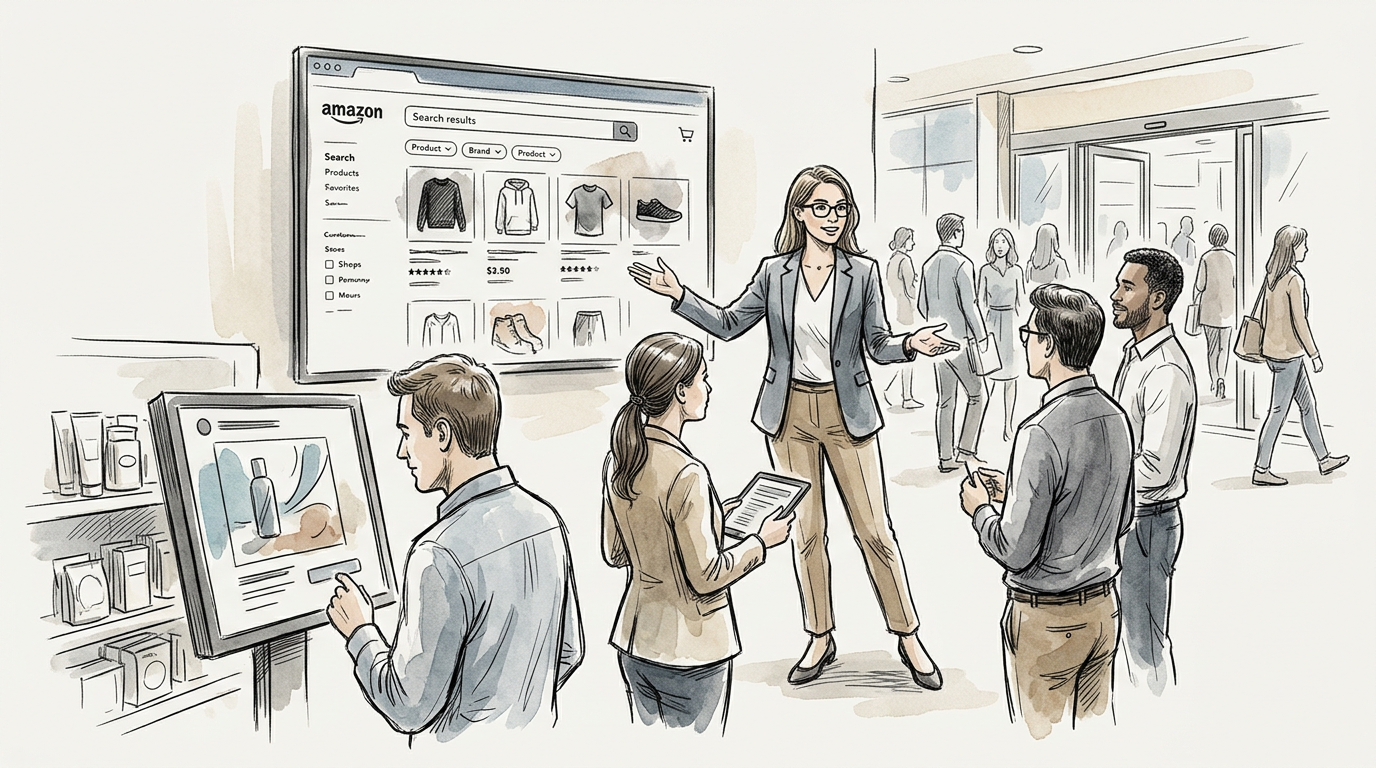
Retail media has moved from a trade marketing adjacency to one of the most consequential developments in the advertising business because it changes who sells media, where ads appear, how audiences are defined, and what counts as performance. A retailer is no longer only a place where transactions happen. It is also a publisher, a search environment, a display network, a source of audience data, and in many cases a seller of off-site advertising that follows shoppers beyond the retailer’s own properties.
That combination has strategic appeal for advertisers. Retailers sit close to purchase. They operate high-intent search environments on their sites and apps. They can package on-site placements, in-store screens, and off-site media using customer data tied to shopping behavior. They can also offer closed-loop reporting that connects ad exposure to commerce signals more directly than many other media channels can. At the same time, retail media introduces familiar media problems in new forms: fragmented inventory, inconsistent definitions, frequency management challenges, uneven buying interfaces, and measurement systems that are often powerful within a retailer’s own walls but hard to compare across the wider media mix.
Understanding retail media now requires more than seeing it as sponsored product listings. It is a media marketplace with distinct formats, economics, and planning tradeoffs.
Why retailers became media sellers
Retailers did not become media companies by accident. They had three structural advantages as advertising shifted toward addressability, measurable outcomes, and first-party data.
The first is audience proximity to purchase. Retailers observe browsing, search, basket behavior, loyalty activity, and completed transactions in environments that consumers already use to shop. That makes retailer-owned media especially attractive to brands trying to influence category choice, defend share, launch products, or convert demand at the point where shoppers are evaluating options.
The second is the value of first-party customer data. As browser-level tracking became more restricted and privacy expectations rose, retailers gained importance because they already had authenticated customer relationships through loyalty programs, logged-in commerce, apps, and payment-linked purchase histories. Those relationships enabled audience creation based on actual shopping behavior rather than only inferred interest.
The third is economics. Advertising carries higher margins than core retail operations for many companies, especially in categories where merchandising margins are thin. Major retailers have been explicit that advertising has become a meaningful business line. Industry estimates from Insider Intelligence/eMarketer have shown U.S. retail media ad spending growing rapidly and taking an increasingly material share of digital budgets, led by large platforms such as Amazon, Walmart, and others with scaled commerce traffic and ad infrastructure. Amazon, which reports advertising within its “Advertising services” line, has built one of the largest advertising businesses in the world through commerce-linked media inventory and data-enabled targeting in and around its marketplace. Walmart, Target, Kroger, Instacart, CVS, Walgreens, and many other retailers have expanded their media offerings for similar reasons.
Retail media, then, is not simply an add-on revenue stream. It is a structural response to how advertising value has shifted toward observable audiences, commerce environments, and measurable demand.
Retail media is several media businesses at once
One reason retail media can be misunderstood is that the term covers multiple channels with very different media mechanics. The planning task is not to “buy retail media” in the abstract. It is to understand which retail media environment is being used, what audience behavior is taking place there, and what role that exposure can play.
Sponsored search and sponsored products
Sponsored search is often the entry point. On retailer sites and apps, brands can pay for prominent placement in search results or category listings when shoppers look for products. These ads resemble paid search in that they respond to declared intent, but they operate in a retail environment rather than a general search engine. The query often reflects immediate shopping consideration, and the ad unit sits beside competing products with visible prices, fulfillment options, ratings, and promotions.
That environment makes sponsored search a media channel with unusually high commercial intent, but it also means the auction is shaped by retailer-specific factors such as category taxonomy, inventory availability, buy-box status, content quality, fulfillment speed, and retail algorithms. It is not purely a bid-driven system. A brand cannot assume that search tactics developed in open-web search will transfer perfectly to a retailer’s marketplace.
Measurement is also narrower than many marketers first assume. A click or attributed sale in sponsored search indicates response within the retailer’s system, not total category impact or long-term brand growth. Sponsored placement may capture demand that already existed, defend existing traffic from competitors, or shift rank order among similar products. That can be commercially valuable, but planners still need to ask whether the media is creating incremental demand, protecting branded queries, improving category visibility, or simply taxing presence in a marketplace where competitors are also bidding.
On-site display and digital video
Retailers also sell display and, in some cases, video inventory across their websites and apps. These placements can include homepage features, category page banners, product detail page units, recommendation modules, and app placements. Compared with sponsored search, on-site display tends to serve broader jobs: category awareness, cross-sell, upsell, seasonal promotion, new-product introduction, or reinforcement during the shopping journey.
The media value here depends heavily on context. A display placement on a grocery retailer’s recipe page or a beauty retailer’s routine-builder can carry different audience expectations and attention patterns from a standard banner on a general publisher site. The retailer environment may also bring stronger commercial relevance because the surrounding experience is organized around comparison and purchase, not only content consumption.
But an impression in on-site display should still be understood as an impression, not proof of attention or persuasion. Technical delivery tells advertisers that the ad was served under the retailer’s system. Depending on the placement, the ad may or may not have been viewable under common digital standards such as those established by the Media Rating Council and IAB. Even when a retailer reports viewability, that indicates an opportunity to be seen under defined conditions, not confirmed visual attention.
Off-site retail media
Many retailers now extend their media businesses beyond owned properties through off-site advertising. In these programs, retailer data is used to define audiences that can be reached on other digital media, including display, online video, connected television, social platforms, and the open web. The retailer may execute this directly, through a demand-side platform, through a clean room arrangement, or with measurement and activation partners.
This is where retail media begins to affect the broader media marketplace more dramatically. The retailer is no longer selling only scarce shelf-adjacent placements on its own properties. It is monetizing customer data as a planning and activation asset across external inventory. A grocer can help a packaged goods brand reach lapsed category buyers on streaming TV. A home improvement retailer can build audiences for outdoor project intenders and activate them off-site. A marketplace can use purchase signals to refine prospecting, retargeting, or suppression strategies.
For advertisers, that creates an appealing bridge between upper-funnel media and commerce outcomes. For media planners, it also raises familiar cross-media questions. If a retailer-defined audience is reached on the open web or in connected television, how should that exposure be compared with publisher audiences, platform audiences, or TV audiences built under different identity systems? How should frequency be managed when the same retailer audience is activated across multiple channels? Those are media planning questions, not merely data questions.
In-store and physical retail media
Retail media is not confined to screens at home. It increasingly includes in-store screens, cooler-door displays, end-cap digital signage, self-checkout media, receipt media, sampling, audio announcements, cart media, and other place-based formats. These formats matter because physical stores remain high-traffic media environments in many categories, especially grocery, drug, mass retail, and convenience.
In-store media behaves differently from digital media consumed on personal devices. Audience movement, dwell time, store layout, trip mission, and shopping speed all shape exposure. Passing a digital sign in a store does not guarantee attention, just as passing an out-of-home unit does not confirm notice. Yet physical retail environments offer something few other media channels can: proximity to actual product selection. A message delivered near shelf can support recall, redirect choice, or reinforce offers at a moment when substitution is possible.
Measurement here is often less standardized than in digital formats. Some networks use store traffic counts, loyalty data, point-of-sale linkage, footfall estimates, or modeled exposure based on store zones and device signals. Those methods can be useful, but they are not interchangeable with impression counting in digital media or ratings in television. Media buyers need to understand exactly what the retailer is measuring and what remains inferred.
What advertisers are really buying
Retail media looks performance-oriented because many placements are sold against clicks, attributed sales, or return-on-ad-spend metrics. But the inventory itself varies widely in strategic value.
In sponsored search, the advertiser is often buying prominence inside a retailer-controlled discovery system. In on-site display, it may be buying category adjacency, homepage scale, or basket-building influence. In off-site campaigns, it may be buying audience qualification rooted in purchase behavior. In-store, it may be buying physical presence in shopping environments with high commercial relevance.
Those are different media products. They should not be judged with a single rule of thumb.
Pricing models vary as well. Sponsored search often uses auction-based cost-per-click or similar bidding structures. On-site display and video may be sold on CPMs through managed service, self-service platforms, or private arrangements. Premium homepage takeovers, category sponsorships, and in-store programs may involve fixed fees, share-of-voice commitments, or custom packages. Off-site activation can layer retailer data fees, platform costs, media costs, and measurement charges into the total investment. As in other media channels, the lowest unit cost is not necessarily the best value. A premium placement with stronger category context, lower clutter, or better shopper relevance may outperform cheaper impressions that generate little incremental effect.
Customer data is an asset, not a complete answer
The strongest argument for retail media is the quality of retailer data. Loyalty files, purchase histories, basket composition, trip frequency, and product-level transaction data can be far more commercially specific than many general digital audience signals. A retailer may know that a household regularly buys premium pet food, has lapsed in a beverage category, responds to promotions in household cleaning, or shops a category seasonally. That helps advertisers build audiences around observed behavior rather than broad demographic assumptions.
This is important strategically because retail media often allows planning around category realities. A cereal brand may want to conquest households buying competitors. A beauty brand may want to reach replenishment buyers before expected reorder timing. A CPG marketer may want to suppress loyal brand buyers from certain prospecting messages and reserve spend for switchers or category expanders. Those are meaningful media uses of customer data.
Still, purchase data does not solve every planning or measurement problem. It is retailer-specific. It may overrepresent one shopping environment and underrepresent others. It may reflect household purchasing but not individual-level media consumption. It may be strong for categories frequently bought at that retailer and weaker for categories purchased elsewhere. It can also bias optimization toward lower-funnel activity that is easiest to observe. A retailer may show what happened within its own commerce ecosystem more clearly than what happened in the total market.
The result is that retail media data can be highly actionable without being universally complete.
Closed-loop measurement is powerful, but it is not neutral ground truth
Retail media’s rise owes much to closed-loop measurement, the ability to connect media exposure or interaction to downstream commerce events such as product views, add-to-cart actions, online sales, in-store sales linked through loyalty, new-to-brand purchases, or repeat purchase behavior.
That is a meaningful advantage. Compared with channels that rely on proxy actions, retail media can sometimes show whether exposed shoppers purchased a specific item, category, or basket combination. This has made retail networks especially attractive to consumer packaged goods marketers, endemic marketplace sellers, and brands under pressure to demonstrate commercial accountability.
However, closed-loop measurement has limits that media professionals should keep in view.
First, attribution rules differ. Retailers can define lookback windows, click-through and view-through credit, household matching logic, and new-to-brand calculations differently. A “sale” attributed by one network is not automatically comparable with a sale attributed by another.
Second, exposure definitions vary. Some reporting is based on served impressions, some on viewable impressions, and some on retailer-defined engagement events. Especially in off-site media, the advertiser may be combining retailer data with third-party delivery and verification systems that do not align perfectly.
Third, closed-loop systems are strongest at measuring outcomes within the retailer’s own transaction environment. That helps explain performance on that property, but not necessarily the total effect on brand demand, competing retailers, long-term penetration, or category growth.
Fourth, incrementality remains separate from attribution. If a shopper buys after seeing a sponsored product ad, the ad may have caused the sale, accelerated it, defended it from a competitor, or simply intercepted a purchase that was already likely. Those are different effects. True incrementality requires experimental design or other robust causal methods, not only attributed reporting dashboards.
This is why organizations such as the IAB and the Media Rating Council have been involved in retail media standards discussions, including work on common definitions and measurement expectations. Standardization efforts matter because media buyers need more than platform-native performance claims. They need metrics that can be interpreted consistently enough to support cross-channel planning and accountability.
Fragmentation is the retail media boom’s central planning challenge
Retail media’s promise is rooted in retailer specificity, but that same specificity creates fragmentation.
Each retailer has its own audience scale, category strengths, ad products, taxonomy, buying interface, reporting logic, and identity system. A grocery retailer is not the same media environment as a marketplace, a pharmacy chain, a home improvement chain, or a specialty beauty retailer. Even when they offer similar formats, the shopper missions differ. So do the economics of the inventory.
For planners, this means retail media is not one consolidated channel. It is a collection of media sellers with uneven standardization. Campaign setup, creative specifications, audience definitions, attribution windows, and optimization tools can differ materially from network to network. Large advertisers may manage dozens of retailer relationships, each with different operational requirements and varying degrees of self-service maturity.
Fragmentation affects scale as well. A brand can often achieve meaningful category relevance within a given retailer, but broad national reach across the retail media landscape may require assembling campaigns across multiple networks. That raises the classic media challenge of duplication. The same household may appear in several retailer systems, but cross-retailer identity resolution is imperfect. As a result, deduplicated reach and actual frequency are harder to manage than many marketers expect.
Retail media therefore increases the need for channel discipline. A planner should be clear on whether the goal is retailer-specific conversion, category defense, share capture, household penetration, launch support, regional activation, or broader brand reinforcement. Without that clarity, a retail media budget can become a patchwork of retailer demands and platform opportunities rather than a deliberate media plan.
Reach and frequency still matter, even in commerce media
Because retail media often emphasizes conversion metrics, some advertisers underplay core media planning concepts such as reach and frequency. That is a mistake.
Retail media campaigns still involve tradeoffs between reaching more shoppers and repeating exposure among the same shoppers. Sponsored search may efficiently reach active searchers, but it reaches only the portion of category demand already in-market and using the retailer’s search environment. On-site display can broaden exposure within the retailer audience but may quickly build repeated impressions among loyal users. Off-site media can extend reach but may add cost, identity complexity, and weaker immediate purchase intent. In-store media can reinforce decisions near shelf but usually lacks the scale and exposure controls of digital channels.
There is no universal ideal frequency in retail media. The right level depends on the objective, category purchase cycle, creative, retailer traffic patterns, competitive pressure, and campaign duration. What matters is that advertisers do not mistake high repetition inside a retailer environment for broad market impact. A campaign heavily concentrated among frequent existing shoppers may deliver efficient attributed sales while contributing little incremental household penetration.
This is one reason retail media should be planned as part of the broader media mix rather than treated as a self-justifying performance silo.
Retail media changes publisher and platform economics
Retail media does not only affect brands. It alters the competitive structure of the media business itself.
When retailers become media sellers, they compete for budgets that might otherwise have gone to search engines, digital publishers, social platforms, trade promotion, shopper marketing programs, or lower-funnel display. They introduce additional media supply, but that supply is not generic. It is tied to commerce context and customer data, which can make it unusually valuable even when absolute audience size is smaller than that of major platform media.
For traditional publishers, this can be unsettling. A retailer with purchase data and commerce proximity may capture dollars that once flowed to content environments. For platforms, retail media can function as both a partner and a rival. Retail audiences may be activated off-site through major ad platforms, but the retailer owns the customer relationship and the commerce signal. That gives retailers negotiating leverage and a differentiated role in the advertising value chain.
For retailers themselves, the economics are attractive precisely because advertising monetizes existing traffic and data assets. But there are strategic tensions. Too much ad load can worsen the shopping experience. Aggressive sponsored placement can create clutter, perceived bias, or navigation friction. If monetization undermines trust in search results or product discovery, the retailer risks weakening the commerce environment that made the inventory valuable in the first place. In that sense, retail media faces the same long-term balancing act as many ad-supported media businesses: maximize revenue without degrading audience utility.
How audiences experience retail media
From the audience side, retail media is often encountered less as “advertising media” than as part of shopping infrastructure. Sponsored results may blend with organic listings. Recommendation units may feel like navigation aids. In-store screens may operate as environmental messaging rather than destination content. Off-site retail media may be invisible to consumers as a retailer-driven audience strategy at all.
That has implications for both effectiveness and transparency. Ads integrated into shopping journeys can be commercially useful because they are contextually relevant and close to decision-making. They can also be easy to ignore if shoppers are moving quickly, filtering by price, or relying on habitual brand choices. High-intent environments are valuable, but they are not guaranteed attention environments.
Audience behavior also differs by retail category. Grocery shopping patterns are not the same as those for consumer electronics, beauty, office supplies, home improvement, or apparel. Replenishment categories can reward timely reminder media and basket-level nudges. Research-heavy categories may benefit more from richer content, comparison tools, video, or off-site education before retailer conversion. Media planning should reflect those category-specific shopping behaviors rather than assuming all retailer traffic behaves alike.
Buying retail media requires both media and commerce fluency
Retail media buying increasingly sits at the intersection of media teams, ecommerce teams, shopper marketing teams, and sales organizations. That can create organizational confusion. Who owns the budget? Who defines success? Is the objective market share within a retailer, total commerce growth, household penetration, or media efficiency?
These questions matter because retail media buying is not only a procurement task. Inventory must be chosen with an understanding of shelf visibility, retailer relationships, category management, content readiness, product availability, pricing, promotions, and supply constraints. A sponsored ad cannot drive sales for an item that is out of stock, poorly merchandised, or disadvantaged by the retailer’s own ranking systems.
At the same time, retail media should not be reduced to a sales support function. It is a genuine media channel with exposure dynamics, audience constraints, contextual effects, and cross-channel implications. The most effective advertisers tend to connect retail media buying to broader media planning rather than isolating it as a separate commerce dashboard.
What better retail media decision-making looks like
Retail media deserves its growing role in the media mix because it offers something distinctive: advertising inventory in and around shopping environments, informed by real customer behavior and often tied to measurable commerce outcomes. Sponsored search, on-site display, off-site audience activation, and in-store media each create different ways to influence shoppers, from demand capture to category discovery to point-of-purchase reinforcement.
But the channel’s strengths should not obscure its limitations. Retail media is fragmented. Measurement is not fully standardized. Closed-loop reporting is valuable but not synonymous with causation. Reach can be narrower than attributed dashboards suggest. Frequency can become concentrated within retailer ecosystems. Off-site extensions add scale but also identity and comparability challenges.
For media professionals, the practical implication is straightforward. Retail media should be treated neither as a miracle solution nor as a mere ecommerce add-on. It is a fast-growing part of the media marketplace with its own inventory economics, audience behavior, buying structures, and measurement rules. The advertisers that benefit most will be the ones that evaluate it with the same discipline they apply to every other channel: define the objective clearly, understand the audience and context, know what the metric actually measures, and judge retail media not only by what it can attribute, but by the specific role it plays in the larger communications plan.
Leave a Reply