
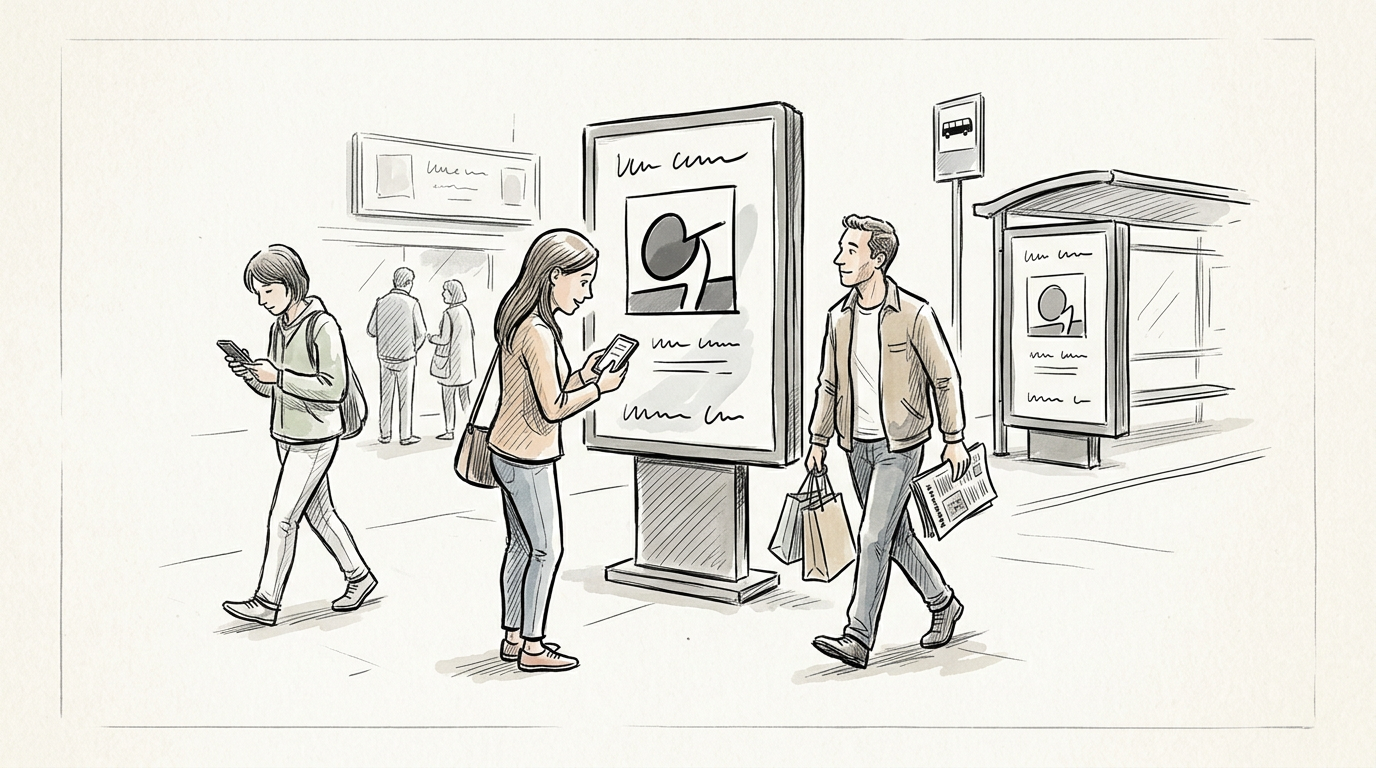
Frequency is one of the most familiar terms in media planning, and one of the most routinely oversimplified. In everyday campaign discussion, frequency is often treated as a shorthand for repetition, pressure, or even persuasion. In practice, it is narrower and more technical than that. Frequency measures how often the people who were reached encountered an advertisement during a defined period. That is useful, but it is not the same thing as attention, recall, liking, or sales impact.
For media professionals, that distinction matters. Frequency sits at the center of budget allocation, channel selection, flighting, inventory quality, and cross-platform measurement. It affects whether a campaign lightly touches a broad market or concentrates pressure on a smaller audience. It also shapes how buyers evaluate duplicate delivery, waste, and incremental reach. Yet frequency only becomes strategically meaningful when it is interpreted in context: who was exposed, over what period, in what media environment, with what creative, for what objective, and with what distribution of actual exposures.
A simple metric with complicated consequences
At its most basic, frequency is the average number of times exposed individuals encounter an ad or campaign within a set time frame. In planning practice, it is commonly derived by dividing gross impressions or gross rating points by reach, using the measurement conventions of the medium involved. In television, planners have long used the relationship between GRPs, reach, and average frequency. In digital media, frequency is typically reported through ad-serving or platform delivery systems as the average number of impressions served to reached users, devices, households, or accounts, depending on the system.
That last distinction is where complexity begins. Frequency is not always measured at the person level. In connected television, for example, exposure may be counted at the household or device level rather than for individual viewers. In digital display, a platform may manage frequency against a browser, login, mobile ad ID, or modeled identity graph. In audio, impressions may reflect downloaded or dynamically inserted ad opportunities rather than verified listening at a person level. The metric still describes repeated delivery, but what counts as the exposed unit changes by medium and measurement system.
Professionals therefore have to ask not only “What was the frequency?” but also “Frequency against what?” A campaign showing an average frequency of 4.0 against households is not directly equivalent to one reporting a frequency of 4.0 against individuals. Nor is a served digital impression equivalent to a television commercial exposure, a viewable display impression, or a podcast ad that remained in a downloaded episode for months.
Why average frequency can mislead
Average frequency is useful because it gives planners a compact summary of delivery concentration. The problem is that averages conceal distribution. Two campaigns can post the same average frequency and produce very different audience experiences.
Consider a campaign that reaches 50 percent of a target with an average frequency of 4. That average could reflect a relatively even pattern, with many exposed people seeing four ads each. It could also reflect a skewed pattern in which some people saw one ad, others saw two, and a smaller group absorbed ten or more exposures. Both scenarios yield the same average, but they do not have the same communication implications or the same efficiency.
This is why media planners often examine frequency distribution rather than relying on the average alone. Distribution asks how many people received one exposure, two exposures, three exposures, and so on. In television planning, distribution analysis has long been important because the planner needs to know whether weight is spreading broadly enough to generate initial awareness or clustering heavily enough to reinforce memory. The same logic applies in digital media, where campaigns can easily develop uneven delivery because of auction dynamics, retargeting pools, publisher supply concentration, or imperfect identity resolution.
Averages can also hide over-frequency. If a campaign is bought in a way that repeatedly serves inventory to the same logged-in users, highly active app users, or heavy streamers, a respectable average frequency may still mask a subset of people receiving far too many exposures. That can create waste, annoyance, and diminishing returns, even while underexposing much of the intended audience.
Defined period matters as much as the number
Frequency has no meaning without a time window. A frequency of 3 over three days is a different media condition from a frequency of 3 over three months. The raw number is identical, but the spacing of exposures changes how repetition is experienced and what role the campaign can realistically play.
This is one reason universal frequency rules are so unreliable. A fast promotional campaign for a limited retail event may require concentrated delivery in a short period to have any chance of influencing behavior before the offer expires. A brand campaign intended to sustain mental availability over a long purchase cycle may use lower weekly frequency but maintain continuity over months. In both cases, frequency is part of the plan, but its interpretation depends on duration, timing, and expected decision windows.
Campaign duration also interacts with media behavior. A commuter may pass the same out-of-home unit twice a day for several weeks. A streaming viewer may consume several episodes in one sitting and encounter the same advertiser repeatedly in a compressed session. A podcast listener may hear embedded ads sporadically over a longer period as they work through downloaded episodes. Frequency is not simply about count. It is about repeated opportunity for exposure across a pattern of use.
Weekly, monthly, and campaign-total frequency should therefore not be treated as interchangeable. When planners evaluate delivery, they need to specify the cadence relevant to the objective. Short-term response campaigns may care about pressure within days. Seasonal campaigns may evaluate weekly build. Long-term brand advertisers may focus on sustained reach and accumulated frequency over quarters.
Reach and frequency are always in tension
Frequency is inseparable from reach because both draw from the same budget. If spending is fixed, pushing frequency upward usually means accepting lower reach, and extending reach usually means lowering repetition among exposed individuals. That tradeoff is not a planning inconvenience. It is one of the central strategic decisions in media.
Broad-reach channels such as national television, large digital video platforms, audio networks, major social platforms, and high-traffic out-of-home systems can introduce a message to many people quickly. But broad reach can become expensive if the goal is to repeatedly expose those same people at substantial levels. More concentrated or targeted inventory can raise average frequency within a defined audience, but often at the cost of incremental reach and sometimes with greater duplication.
This tradeoff becomes more difficult in fragmented media markets. As audiences spread across more channels, platforms, publishers, and devices, it can take more placements and more budget to achieve the same level of unduplicated reach. That fragmentation often raises duplication risk as well. A brand may buy linear television, connected TV, online video, social video, streaming audio, and retail media display, then discover that a portion of the audience was repeatedly reached across all of them while other prospects were barely touched.
Frequency management is therefore not only about increasing repetition. It is also about controlling duplication so that additional impressions create useful reinforcement rather than accidental saturation.
The exposure unit is not always the person
One of the most persistent reasons frequency becomes distorted in modern planning is that different media count exposure against different entities. Traditional audience currencies generally aimed to estimate people or households. Digital systems often observe devices, cookies, logins, app IDs, or platform accounts. Retail media may anchor delivery to authenticated shoppers. Connected TV frequently relies on device or household data, sometimes calibrated with panels or modeled audiences.
Cross-media planning becomes difficult when the same individual appears in several systems under different identifiers. A campaign may cap frequency at three within one platform and still expose the same person several more times through another platform, another publisher, or another device. Frequency caps usually work only within the environment where they are applied unless an advertiser has the data, technology, and inventory access to manage them across suppliers.
That challenge is widely recognized across the industry. The World Federation of Advertisers and the Association of National Advertisers have both published guidance on cross-media measurement and cross-platform frequency challenges, emphasizing that deduplicated reach and frequency remain difficult because of fragmented identifiers and inconsistent measurement frameworks. The Media Rating Council has also continued to focus on standards and auditing in areas such as digital measurement, but standardization does not eliminate the underlying identity problem.
For planners, the implication is straightforward. Reported frequency may be precise within a given platform and still incomplete as a picture of total market exposure.
Why more frequency is not automatically better
Repeated exposure can support communication. People often need more than one encounter to notice, process, remember, or act on an ad. But frequency is not a linear force. The tenth exposure does not necessarily add the same value as the second or third. In some situations it may add almost none. In others it may create irritation.
This is where media context matters. A six-second video in a cluttered feed may require different repetition than a high-attention cinema placement, a host-read podcast endorsement, or a striking full-page magazine insertion. A brief tactical message with a price point may not require the same reinforcement as a new category introduction, a complex product demonstration, or a business-to-business campaign aimed at a narrow set of decision-makers over a long sales cycle.
Competitive intensity matters too. In categories with heavy ad volume, higher repetition may be needed simply to maintain salience. In low-clutter environments, fewer exposures may suffice. Seasonality, geography, and purchase frequency all change the calculation. A quick-service restaurant trying to influence near-term store visits behaves differently from an insurer, an automaker, or a higher education institution.
The point is not that frequency lacks importance. It is that its value depends on what the advertising is trying to do and the conditions under which audiences encounter it.
Attention is related, but not the same thing
Frequency measures repeated opportunities for exposure. It does not measure whether people paid attention. That distinction is essential across digital, television, audio, print, and out-of-home media.
In digital display, an impression may be served, and a portion of those impressions may qualify as viewable under standards set by the Media Rating Council and the Interactive Advertising Bureau. A display ad generally counts as viewable when at least 50 percent of pixels are in view for at least one continuous second, while digital video typically requires 50 percent in view for at least two continuous seconds under current MRC/IAB guidelines. But a viewable impression is still not proof that the user looked at the ad, processed it, or remembered it. Frequency built on viewable impressions is more informative than frequency built on unviewable delivery, but it is still an exposure measure, not an attention measure.
In television and streaming, commercial delivery may occur while viewers leave the room, look at a second screen, or skip mentally even when they cannot skip technically. In audio, a listener may hear an ad while driving, working, or multitasking. In out-of-home, passing a billboard or transit screen creates opportunity for exposure, not guaranteed visual attention. Print carries its own variation: an insertion reaches a readership context with potentially strong attention conditions, but actual ad noticing varies by placement, environment, and reader behavior.
This does not make frequency unimportant. It means frequency should be interpreted alongside media context, ad format, clutter, position, and attention indicators where available.
Channel differences change what frequency does
Frequency behaves differently across media because the audience experience is different.
In linear television, frequency is influenced by program selection, daypart, network mix, and schedule weight. Delivery patterns can be modeled using ratings and audience duplication estimates, but actual exposure varies with household viewing behavior. TV still offers substantial reach, especially in live events and sports, but fragmentation between broadcast, cable, and streaming has made efficient frequency management more complex than in earlier eras.
In connected television and streaming, frequency often rises quickly within specific user pools because inventory is bought against narrower targets and because heavy streamers generate a large share of ad opportunities. Some streaming services maintain relatively light ad loads, which can make each impression more valuable but inventory scarcer. Others offer broad reach but with varying levels of identity persistence and cross-platform coordination. Buyers often value CTV for premium video environments and household targeting, yet it is also one of the clearest examples of why apparent frequency control inside one platform does not equal total frequency control across a campaign.
In social and online video, auction mechanics can concentrate delivery among users predicted to be cheaper or more responsive, which may inflate repetition for some users unless campaign settings and optimization goals are managed carefully. Frequency here is also shaped by autoplay behavior, feed velocity, view thresholds, and platform reporting definitions.
In audio, high-frequency schedules are common because radio and streaming audio are often used for continuity, local reinforcement, and habitual listening environments such as commuting or workplace listening. But repeated exposure in audio depends heavily on listener routine and station or playlist loyalty. Podcasts differ again, especially when host-read ads draw on audience trust and longer-form message integration. A small podcast buy may produce substantial frequency within a loyal niche audience, but that is not equivalent to broad market repetition.
Out-of-home presents another variation. Frequency is often estimated from traffic, circulation, mobility data, and visibility adjustments rather than person-level confirmed viewing. Repeated daily travel patterns can produce meaningful cumulative exposure over time, but the metric reflects opportunity to see, not verified attention. For local advertisers or campaigns needing geographic presence, that repeated proximity can be highly effective, yet it should not be interpreted as if it were identical to screen-based impression frequency.
Print creates slower, more durable exposure patterns. A weekly or monthly publication may deliver fewer ad contacts over time, but each contact can occur in a more focused editorial environment. Frequency in print is often lower in count and longer in interval, yet the contextual value can be higher for certain categories and audiences.
Buying methods also affect frequency outcomes
How inventory is bought shapes how frequency accumulates. Direct deals, sponsorships, upfront commitments, programmatic guaranteed, private marketplaces, and open auctions all create different delivery patterns.
In negotiated traditional media buys, planners often have a clear sense of schedule weight, placement context, and expected duplication. In programmatic systems, optimization algorithms may prioritize performance signals, low-cost impressions, or available inventory pools that naturally cluster around certain users or environments. That can improve short-term efficiency metrics while worsening frequency distribution.
Retargeting is an obvious example. It often produces high average frequency because the reachable audience is deliberately narrow. That may be appropriate when the objective is reminder messaging near conversion, but it becomes wasteful when buyers continue spending after most reachable users have been overserved.
Retail media can show similar dynamics. On-site sponsored product or display placements may deliver strong relevance because they appear near active shopping behavior, but frequency can build rapidly among frequent shoppers or among users persistently assigned to an audience segment. Off-site retail media introduces another layer, extending delivery into broader digital inventory where identity quality and frequency control may differ from the retailer’s owned environment.
Media buyers therefore have to evaluate not just price and targeting but also how the buying mechanism will distribute impressions over time. Cheap inventory that repeatedly reaches the same people can look efficient on paper while underperforming strategically.
Frequency caps help, but only to a point
Advertisers often use frequency caps to limit repeated delivery, especially in digital channels. Caps can reduce waste, moderate annoyance, and help spread impressions more broadly. But they are not a universal fix.
First, caps are only as strong as the identifier behind them. If a user appears on multiple devices, browsers, or platform accounts, the cap may not apply consistently. Second, caps operate within the systems where they are set. An advertiser may cap at two impressions per day on one video platform, three per week on a display platform, and four per month in a streaming service, while the same person continues accumulating total campaign exposure across all of them. Third, strict caps can reduce efficiency if they cut off delivery before the message has had a fair chance to register in low-attention or high-clutter environments.
Caps are therefore a tactical control, not a strategy. They should be informed by objective, creative, duration, and the expected role of the channel in the wider media mix.
Measurement quality determines how much confidence frequency deserves
Frequency is only as trustworthy as the measurement system beneath it. Different media rely on different inputs: panel-based audience estimates, census-level server logs, return-path data, automatic content recognition, device graphs, publisher first-party IDs, surveys, circulation audits, traffic counts, and modeled calibration.
Each method has strengths and blind spots. Panels can estimate people-level behavior and support demographic projection, but sample limitations matter. Census-style digital logs capture large volumes of delivery data, but they typically observe devices or accounts rather than people and may miss off-platform exposure. Identity graphs can improve deduplication, but they rely on probabilistic or deterministic matching with varying accuracy. Out-of-home measurement can use mobility and visibility models to estimate opportunities to see, but not actual visual attention at scale.
The practical consequence is that reported frequency often mixes observed and modeled elements. That is not a flaw unique to one medium. It is a basic reality of modern audience measurement. Professionals should treat frequency as an informed estimate of repeated exposure, not a perfect count of human encounters.
The Association of National Advertisers has repeatedly emphasized this in its work on cross-media measurement, as have industry standards bodies and measurement firms working to create deduplicated frameworks. The challenge is not a lack of interest in solving frequency. It is that media consumption is fragmented, identity is unstable, and each platform controls different pieces of the exposure record.
Why no universal ideal frequency exists
The search for a single ideal frequency level persists because planners want simple rules for complicated decisions. But one universal answer does not exist because frequency works differently under different conditions.
Objective is the first reason. Awareness campaigns often prioritize broad reach before deeper repetition. Consideration campaigns may need more sustained reinforcement. Promotional campaigns tied to a narrow selling window may require concentrated pressure. Loyalty or retention messaging may operate against a much smaller but already familiar audience.
Message complexity is another reason. A simple reminder ad may need fewer exposures than a new product explanation, a regulated-category message, or a multi-benefit offer.
Category and purchase cycle matter as well. Frequently purchased packaged goods, event-driven retail, durable goods, travel, financial services, and B2B solutions all place different demands on repetition and memory over time.
Creative quality matters too. Strong creative can make each exposure work harder. Weak or generic creative can survive many impressions without becoming more persuasive. Media strategy cannot solve a creative problem simply by adding repetition.
Media environment matters because ad loads, clutter, context, and attention differ across channels. The same nominal frequency may have different communication value in prime-time television, a low-clutter premium video stream, a podcast read by a trusted host, a social feed, an audio playlist, or a commuter billboard.
Competitive conditions matter because share of voice and category clutter influence how much repetition is needed just to be noticed.
And duration matters because ten exposures in one week are different from ten exposures across ten weeks.
For all of these reasons, responsible planners do not ask for the ideal frequency in the abstract. They ask what level and pattern of repetition are likely to be sufficient for this audience, this message, this category, this budget, this campaign period, and this media mix.
What professionals should examine instead of chasing a magic number
A more useful planning discipline is to evaluate frequency through several linked questions:
How broad is the intended reach, and what level of repetition can the budget realistically support within that reach?
What does the exposure distribution look like? Are enough people getting at least some repetition, or is delivery bunching around a small heavy-exposed segment?
Over what period is frequency being measured? Does that period align with the communication task and buying cycle?
What is the exposure unit? Are the metrics person-based, household-based, device-based, or account-based?
How much duplication exists across publishers, platforms, and channels?
What is the media context? Are these exposures likely to occur in attentive, cluttered, skippable, or low-engagement environments?
How much of the frequency is incremental and how much is simply repeated delivery to the same already-reached people?
What evidence exists beyond raw frequency, such as brand lift, attention studies, sales experiments, incrementality tests, or media mix modeling?
These questions do not eliminate uncertainty, but they move the discussion from folklore to practical media judgment.
Frequency is a planning tool, not a planning answer
Used properly, frequency helps advertisers understand the concentration of exposure among reached audiences. It clarifies whether a campaign is spreading too thin, repeating too heavily, or balancing reach and reinforcement in a way that fits the task. It is indispensable in media planning and buying because budgets are finite, audiences are fragmented, and repeated contact is rarely distributed evenly on its own.
But frequency does not tell professionals whether the right people saw the ad with attention, whether the message made an impression, or whether the next impression will produce meaningful incremental value. It does not produce a universal threshold for effectiveness. It cannot be interpreted apart from duration, distribution, medium, buying method, audience behavior, and measurement design.
What frequency really measures is repetition among those reached during a defined period. That sounds simple, and technically it is. Strategically, however, the number only becomes useful when planners treat it as one part of a broader exposure system shaped by media context, audience duplication, creative demands, and campaign goals. In a fragmented marketplace, that disciplined interpretation matters far more than any inherited rule about how many times people supposedly need to see an ad.
Leave a Reply