
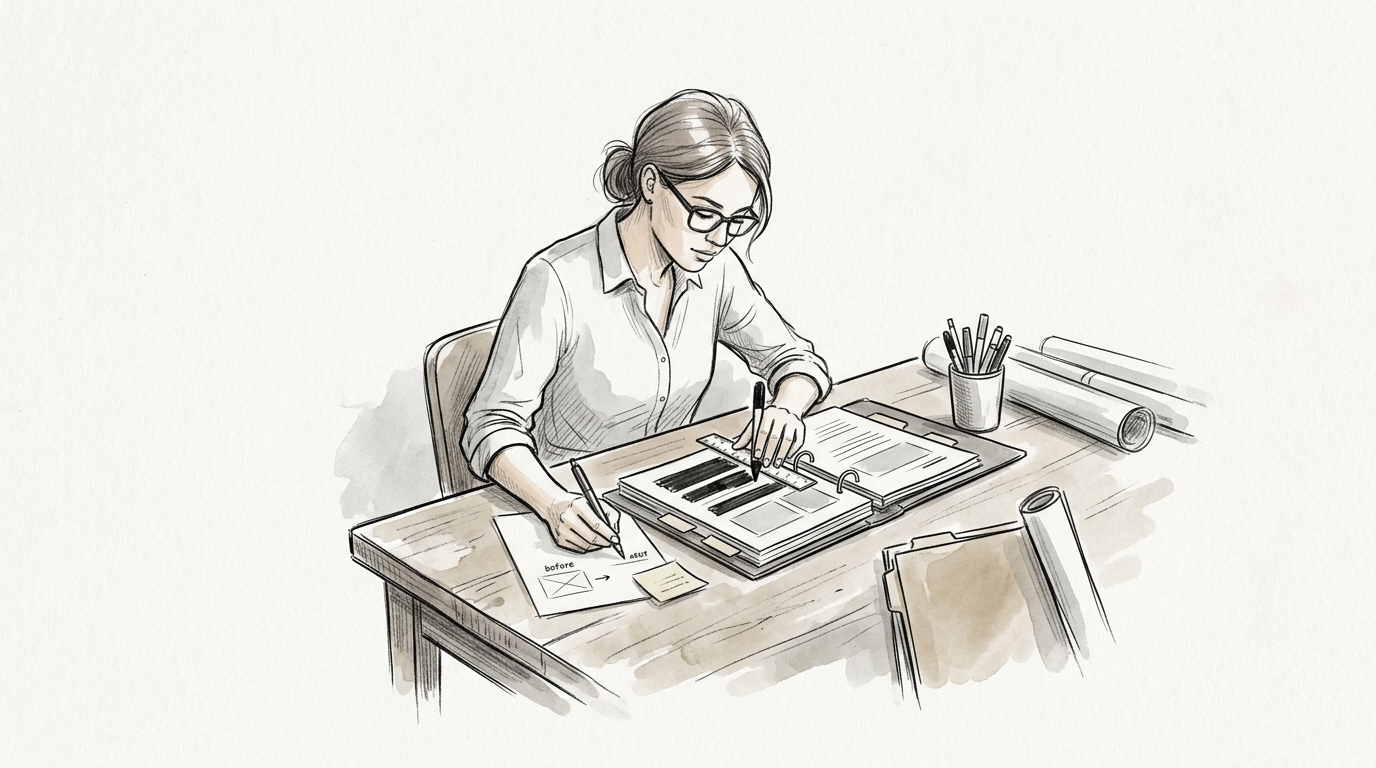
A strong portfolio should help other professionals understand how you think, what you contributed, and how you handle real work. It should not require you to expose a client’s competitive plans, a former employer’s internal processes, unpublished research, or materials you were never authorized to share. In advertising and marketing, that distinction matters more than many professionals realize.
Portfolios sit at an awkward intersection of career development and confidentiality. Hiring managers often want proof. Candidates want to show range, complexity, and results. Agencies, brands, publishers, research firms, and consultancies, meanwhile, have legitimate reasons to protect strategy, data, financial information, internal documents, and unreleased creative. Professionals who handle this tension well do more than avoid legal trouble. They demonstrate judgment, discretion, and an understanding of professional standards that many employers value as highly as polished work.
That is especially important in an industry where access is often a sign of trust. If a candidate appears careless with one employer’s confidential information, a prospective employer has little reason to assume their own information would be treated more carefully.
Confidentiality is a professional skill, not just a legal issue
Many portfolio questions get framed too narrowly: “Can I post this campaign?” or “Can I show this deck in an interview?” The better question is: “What am I authorized to share, with whom, under what conditions, and in what form?”
That is partly a legal matter. Non-disclosure agreements, employment contracts, work-for-hire arrangements, client confidentiality clauses, and internal policies may all limit what can be shared. The U.S. Small Business Administration’s guidance on non-disclosure agreements outlines the general role of NDAs in protecting confidential business information. The U.S. Patent and Trademark Office also distinguishes between patents, trademarks, copyrights, and trade secrets, with trade secrets often depending on organizations taking reasonable steps to keep information confidential, as explained by the USPTO.
But confidentiality is not only about formal restrictions. It is also about professional judgment. Many things may be technically accessible to you and still inappropriate to distribute. Examples include internal Slack screenshots, draft strategy frameworks, customer segmentation details, budget assumptions, targeting logic, test results, revenue data, and research transcripts. A candidate who shares them casually may be signaling poor boundary management, even if no one has yet objected.
Strong portfolio practice begins with the assumption that access does not equal permission.
What usually counts as confidential portfolio material
Confidentiality concerns vary by role, but several categories appear repeatedly across advertising, media, marketing, and research work.
These often include:
- Proprietary strategy, including positioning platforms, go-to-market plans, audience definitions, pricing logic, channel strategy, media allocation rationale, testing roadmaps, and competitive response planning.
- Client or company data, including customer data, campaign performance data, sales figures, attribution findings, conversion rates, budget levels, margin information, and forecasts.
- Internal documents, including briefs, planning decks, stakeholder memos, research summaries, meeting notes, operating documents, and internal workflows.
- Unreleased or abandoned work, including concepts not yet launched, campaigns that were killed, product naming explorations, packaging, scripts, and creative tied to confidential launches.
- Third-party protected material, including licensed assets, syndicated research, platform screenshots, publisher information, vendor pricing, and partner documents.
- Information covered by agreements or policy, including anything explicitly restricted by NDA, contract, employee handbook, client terms, legal review, or procurement rules.
Some of these risks are obvious. Others are more subtle. A single slide with percentages removed may still reveal market priorities, a testing approach, or a launch timetable. A creative case study with “anonymized” data may still be identifiable to anyone familiar with the category. Redaction is not effective if the surrounding context gives the answer away.
Why hiring managers care about how you handle this
Portfolio review is not just an evaluation of past work. It is also an assessment of professional behavior.
Hiring managers typically want to understand several things at once: the quality of the work, the candidate’s role, the sophistication of their thinking, and whether the person can be trusted with sensitive assignments. In client service, strategy, media, analytics, research, and executive-facing roles, discretion is part of the job.
That means an overexposed portfolio can create doubt even when the work is impressive. A candidate may think they are signaling depth by showing raw internal documents or live business data. The reviewer may instead see unnecessary risk. The issue is not simply “this person broke a rule.” It is often “this person does not seem to recognize where professional boundaries should be.”
The reverse is also true. A well-constructed case study that protects confidentiality while still demonstrating decision-making usually signals maturity. It shows that the candidate understands the difference between proving competence and distributing sensitive material.
Start with permission, not assumption
The safest and strongest standard is simple: if you do not clearly have permission to share something, do not include it in your portfolio in its original form.
That sounds straightforward, but in practice professionals often rely on weak assumptions:
- “I made it, so I can use it.”
- “It was public eventually, so I can show every step that led to it.”
- “I only share it in interviews.”
- “I took out the logo.”
- “Everyone in the industry does this.”
None of those assumptions reliably protects you.
If a work sample is important enough to your portfolio that you want to show it substantially intact, ask for permission. Depending on the situation, that may mean written approval from a former employer, a client contact, legal department, communications lead, or another authorized decision-maker. The point is not to create bureaucracy for its own sake. The point is to clarify what is approved, what audience is permitted, and whether any conditions apply.
Those conditions matter. Permission to show a piece privately in a final-stage interview is not the same as permission to post it publicly on a personal website. Permission to display finished creative is not the same as permission to reveal the strategy deck behind it. Permission from a former direct manager may not be sufficient if the material belongs to a client or another business unit.
When in doubt, ask more narrowly, not more broadly. It is often easier to secure approval for a reduced case study, selective screenshots, or a summarized description than for full original documents.
Redaction works only when it protects meaningfully
Redaction is one of the most common portfolio tactics, and one of the most poorly executed.
Weak redaction removes obvious labels while leaving the underlying information intact. Strong redaction removes or obscures anything that would allow a reviewer to reconstruct protected information or infer sensitive business details with reasonable confidence.
For example, weak redaction might black out a client name on a media plan while leaving category, market timing, budget scale, channel mix, and publisher names visible. In many industries, that is enough to identify the account.
Strong redaction is more deliberate. It asks:
- Can this company, brand, product, market, or campaign still be identified indirectly?
- Do the remaining numbers reveal scale, efficiency, financial performance, or strategy?
- Do comments, filenames, dates, version histories, or metadata expose anything sensitive?
- Does the document structure itself reveal proprietary process?
- Would a competitor, vendor, journalist, or former colleague learn something useful from this?
This is where candidates often need editorial discipline. A portfolio is not a forensic archive. If meaningful redaction leaves a document too incomplete to be useful, that is a sign you should not include the document itself. Use another method.
Abstraction is often more persuasive than disclosure
Many professionals assume that the more original detail they provide, the more credible they will seem. In practice, abstraction often does a better job.
Abstraction means explaining the business problem, your responsibilities, the decision-making process, the constraints, and the outcome without exposing the underlying confidential material. It translates specific work into a professionally understandable case study.
For example, instead of showing a full internal strategy deck, a strategist might describe:
- the category challenge
- the audience problem the team needed to solve
- the competing hypotheses considered
- the evidence used to make a recommendation
- the recommendation itself at a high level
- the cross-functional implications
- the eventual business or campaign outcome in approved terms
That is often enough for an experienced hiring manager to assess whether the work reflects real strategic thinking.
The same principle applies across functions. A media professional can explain how they balanced reach, efficiency, seasonality, and measurement constraints without revealing exact rates or budgets. A researcher can describe methodology, sampling logic, and how findings shaped decisions without disclosing participant-level data or proprietary instruments. A creative can show the final public campaign while explaining the brief challenge, review process, and revisions without uploading every round of confidential client feedback.
Abstraction is not vagueness. It still requires specificity about your contribution and reasoning. The goal is to remove protected detail while preserving professional meaning.
Use substitute evidence when the original cannot be shown
Sometimes the best portfolio decision is not to show the real artifact at all.
That does not mean abandoning the project. It means finding substitute evidence that demonstrates the same capability more safely. Depending on the role, substitute examples may include:
- A reconstructed case-study narrative created specifically for portfolio use, with confidential details removed and language rewritten.
- A public-facing version of the work, such as live creative, a landing page, earned coverage, or publicly released campaign materials.
- A sanitized mockup that reflects the type of problem solved without reproducing the exact client materials.
- An analogous self-initiated project that demonstrates the same skill, such as brief writing, audience framing, UX logic, messaging architecture, dashboard design, or presentation structure.
- A written explanation of process, tradeoffs, and outcomes supported by approved high-level results.
- A recommendation memo or one-page summary built from memory and cleared of confidential specifics.
Some professionals worry that substitute examples look weaker because they are not “the real thing.” In many cases, they are stronger because they force better explanation. Hiring managers do not need to inspect every original spreadsheet, testing document, or client markup file. They need enough evidence to understand the level of thinking and execution involved.
A substitute example is weak only when it becomes generic. If you remove all context, all constraints, all decision points, and all outcomes, reviewers cannot tell whether you did meaningful work. The challenge is to preserve the professional problem while changing the protected details.
Case studies should show contribution, not just access
Confidentiality problems often arise because professionals rely too heavily on original documents to prove they worked on something important. That is usually a sign that the case study itself is underdeveloped.
A good portfolio case study should be able to answer basic professional questions without requiring the reviewer to read sensitive materials:
- What was the problem?
- What was your role?
- What constraints shaped the work?
- What decisions had to be made?
- How did you make them?
- What did you create, recommend, analyze, or change?
- What happened afterward?
- What did you learn that would matter in a future role?
That structure protects confidentiality because it shifts attention from the document to the contribution. It also improves hiring quality. Many employers are less interested in whether you touched a recognizable brand than in whether you can explain your own work with clarity and precision.
This matters for early-career candidates in particular. Junior professionals sometimes worry that they need famous logos or complete original decks to be competitive. In reality, a clear explanation of your actual contribution to a complex assignment is usually more credible than a glamorous but overexposed artifact that makes your role impossible to verify.
Be especially careful with data, research, and internal performance metrics
Creative work often gets the most portfolio attention, but confidential risk is frequently higher in data-heavy and strategy-heavy roles.
Campaign metrics, customer segments, test results, attribution outputs, budget shifts, pricing data, funnel conversion rates, and research findings can all reveal commercially sensitive information. Even when names are removed, combinations of metrics may expose category performance, media economics, or a company’s decision logic.
The U.S. Federal Trade Commission emphasizes that companies should protect sensitive data through reasonable security practices, data minimization, retention limits, and access controls, as discussed in its guidance on data security. While that guidance is broader than portfolio use, the principle is relevant: possession of information does not justify wider distribution.
Research portfolios require similar care. The American Association for Public Opinion Research’s Code of Professional Ethics and Practices and the Insights Association’s Code of Standards and Ethics both emphasize confidentiality, appropriate disclosure, and responsible handling of research information. Even if a professional is not formally bound by those organizations’ membership rules, those standards reflect widely recognized norms in research practice.
For professionals in insights, analytics, CRM, performance marketing, and measurement roles, this means portfolio discipline should include at least three habits:
- Use approved ranges, directional descriptions, indexed results, or percentage change only when those forms have been cleared and cannot reasonably reveal protected baselines.
- Avoid participant-level information, raw respondent quotes that could identify individuals, audience files, customer records, or screenshots from internal systems.
- Explain what the data helped the organization decide, not just what the numbers were.
That last point is often the most useful professionally. Employers hire analysts and researchers to improve decisions, not merely to display dashboards.
Unreleased work requires stricter judgment
Professionals are often tempted to include unreleased campaigns, pitches, product concepts, naming systems, innovation pipelines, or work that “probably will never run.” That is one of the highest-risk areas in portfolio construction.
Unreleased work may still be commercially valuable. It may later be revived, adapted, licensed, litigated, or used to inform future strategy. A canceled project can still contain confidential business assumptions, new-product direction, partnership plans, audience testing results, or executive decisions that were never meant to leave the organization.
There is also a relationship issue. Clients and employers may be far more comfortable with professionals showing public work than with sharing material that never entered the market. Even when a piece seems harmless, distributing it can damage trust because it violates expectations about what remains internal.
If unreleased work is important to your development story, the safer options are usually to abstract it, substitute it, or omit it. “It never launched” is not a permission standard.
How to discuss confidential work in interviews
Not every portfolio conversation has to happen through a public website or downloadable PDF. Interviews allow more nuance, but they do not erase confidentiality obligations.
Strong interview practice sounds like this: “I can explain the challenge, the structure of the work, and my role, but I cannot share the original internal document or exact figures.” Most experienced interviewers will understand that immediately. In fact, many will respect it.
This is also where preparation matters. If you know a likely case study involves protected information, develop an interview-safe version in advance. That version should include:
- a neutral description of the organization or category if the name cannot be used
- the business problem in non-sensitive terms
- your remit and collaborators
- the approach you took
- the key decision points
- approved outcomes or directional impact
- what the experience demonstrates about your capabilities
A candidate who becomes evasive, defensive, or disorganized when asked for details may create confusion about whether the issue is confidentiality or lack of substance. A candidate who explains boundaries clearly and still communicates their thinking well usually comes across as more credible.
Hiring managers also have responsibilities here. It is poor practice to pressure candidates to reveal proprietary information from current or former employers. Asking for evidence of contribution is legitimate. Asking for confidential client lists, exact budgets, audience data, or internal strategy documents is not. Organizations that want ethical hiring should train interviewers accordingly.
Managers and mentors should teach portfolio judgment explicitly
Many confidentiality mistakes come from inexperience, not bad intent. Junior staff may not know what is considered proprietary, what belongs to the client versus the agency, or how to create a safe case study from sensitive work. In some organizations, no one explains the difference until a problem arises.
Managers can reduce that risk by treating portfolio judgment as part of professional development. Useful guidance includes:
- clarifying what categories of work are public, restricted, or prohibited from sharing
- explaining approval processes for awards, speaking, teaching, recruiting, and portfolios
- helping staff convert sensitive assignments into sanitized case studies
- teaching the difference between finished public work and internal planning materials
- reviewing examples of good anonymization and bad anonymization
Mentors can help in a different way. They can show less experienced professionals how to tell the story of their work without depending on confidential artifacts. That is a valuable career skill. Professionals who can explain difficult assignments clearly, ethically, and persuasively are often better prepared for interviews, promotions, client presentations, and cross-functional leadership.
What strong practice looks like
The most reliable portfolios are not the ones with the most exposed material. They are the ones that make informed tradeoffs.
Strong practice usually includes several characteristics. The professional knows which materials are public, which are restricted, and which are off-limits. They ask permission when needed and keep records of what was approved. They rewrite and sanitize case studies instead of casually reusing internal documents. They remove not only names, but also details that would allow others to infer protected information. They rely on explanation, context, and contribution rather than access alone. They prepare interview versions of sensitive projects that are specific enough to be credible and careful enough to be appropriate.
Weak practice tends to look different. The candidate uploads full decks to a personal site because they authored them. They assume that redacting logos solves the problem. They share exact performance figures without approval because the campaign is over. They include unreleased work because it shows better thinking than the public version. They cannot distinguish between publicly visible output and internal rationale. They treat confidentiality as a technicality rather than a professional obligation.
The difference is not only risk management. It is professional maturity.
When omission is the right decision
Not every important project belongs in a portfolio. Some assignments are simply too sensitive, too identifiable, too legally constrained, or too difficult to sanitize well. Omitting them is sometimes the strongest choice.
This can feel frustrating, especially if a confidential project was central to your growth. But portfolio quality is not measured by completeness. It is measured by whether the selected work gives a trustworthy picture of your capabilities. One compromised case study can cast doubt on the rest.
When omission is necessary, look for adjacent evidence. Perhaps the confidential assignment taught you stakeholder management, experimentation design, briefing discipline, executive communication, or category learning that can be demonstrated elsewhere. Career development depends on building capability, not merely displaying every artifact.
A portfolio should make employers more confident in your judgment. Protecting confidential work is part of that demonstration, not a barrier to it. Professionals who know how to use permission, redaction, abstraction, and substitute examples effectively show something important about how they work: they understand that trust is a business asset, and they know how to preserve it while still making their own contribution visible.
Leave a Reply