
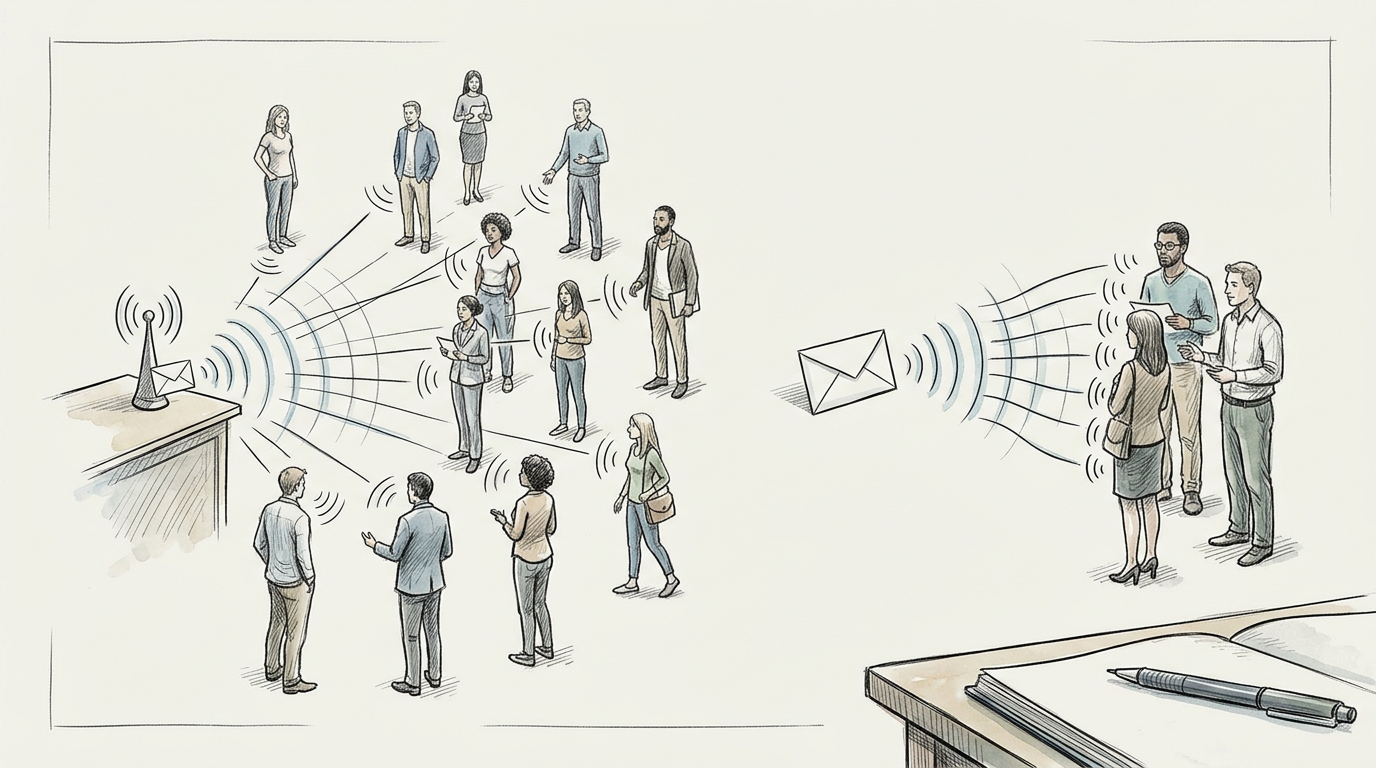
Reach and frequency are two of the most basic concepts in advertising media, and they remain two of the most important. Together, they describe a simple but consequential question: how many people did an ad campaign touch, and how many times did those people have a chance to see or hear it?
That question sits at the center of media planning because most campaigns do not have unlimited budgets. Marketers and agencies rarely have the resources to reach every possible buyer as often as they would like. As a result, planning media usually involves tradeoffs. A campaign can often be designed to reach more people at a lower number of exposures, or to reach fewer people more repeatedly. Neither choice is inherently correct. The right balance depends on the brand, the category, the message, the audience, the media environment, and the campaign objective.
Understanding reach and frequency helps professionals interpret media plans, evaluate campaign delivery, and make better strategic decisions across channels.
What reach and frequency mean
In professional media use, reach refers to the number or percentage of people in a defined target audience who are exposed to an advertisement at least once during a specified period.
If a campaign reaches 400,000 adults in a target market of 1 million, its reach is 400,000 people, or 40 percent of that target audience.
Frequency refers to how many times, on average, those reached individuals are exposed to the advertisement during the campaign period.
If those 400,000 people are exposed to the campaign an average of three times, the frequency is 3.0.
These definitions sound straightforward, but they depend on several conditions that professionals should always keep in mind:
- Reach and frequency are defined against a specific audience, not the entire population by default.
- They are measured over a specific time period, such as a week, a month, or a full campaign flight.
- They refer to exposure opportunity, not guaranteed attention, memory, or persuasion.
That last point matters. A delivered impression does not necessarily mean a person actively noticed the ad, processed it, or was influenced by it. Reach and frequency are media exposure metrics, not direct measures of effectiveness.
Why these metrics matter in media planning
Media planning is the discipline of deciding where, when, and how often advertising should appear in order to achieve a marketing objective. Reach and frequency are central to that work because they help planners translate strategy into distribution.
A brand launching a new product may need broad awareness quickly, which often increases the importance of reach. A brand trying to reinforce a specific message among likely buyers may need repeated exposures, which can make frequency more important. A retailer promoting a short-term sale might need intense repetition within a narrow time window. A mature consumer packaged goods brand may prioritize staying visible to a broad audience over time.
In other words, reach and frequency help answer practical planning questions such as:
- How broadly should the message be distributed?
- How often should the average person encounter it?
- What level of repetition is likely necessary for the campaign objective?
- How should a limited budget be allocated across channels, audiences, and time periods?
These are not merely reporting metrics. They shape the structure of campaigns before ads ever run.
The relationship between reach, frequency, and impressions
Reach and frequency are closely connected to a third media concept: impressions.
An impression is generally counted each time an ad is served, displayed, aired, or otherwise delivered. Depending on the medium, an impression may be based on a modeled audience estimate, a served ad, a viewable opportunity, or another platform-specific methodology. The definition varies somewhat by channel, which is one reason cross-media comparisons can be complicated.
At a conceptual level, the relationship is often expressed as:
Impressions = Reach × Average Frequency
For example, if a campaign reaches 100,000 people and each reached person is exposed an average of 4 times, the campaign generates 400,000 gross impressions.
This is a useful planning relationship, but it should not be treated too mechanically. Actual campaign delivery is rarely distributed evenly. Some people may see the ad once, some three times, some ten times, and many not at all. Frequency is an average, not a promise of identical exposure.
Reach is not the same as audience size
One common misunderstanding is to confuse reach with total audience size.
A television program may have a large audience. A social platform may have millions of users. A website may report substantial traffic. None of that automatically tells a planner how many unique people in the target audience a campaign will reach.
Reach is campaign-specific. It depends on factors such as:
- The target audience definition.
- The media vehicles selected.
- The campaign schedule.
- The number of insertions, spots, or served ads.
- The degree of audience duplication across placements.
That last factor is especially important. If the same people appear in the audience of multiple media placements, a campaign may accumulate impressions without increasing reach proportionally. A planner may think a media plan is expanding exposure, but in practice it may mostly be adding more exposures to people already reached.
Frequency is an average, not a uniform experience
Frequency is often discussed as if everyone sees the ad the same number of times. In reality, exposure distribution is uneven.
This matters because average frequency can hide very different delivery patterns. Consider two campaigns that both report an average frequency of 4:
- In one campaign, most reached people saw the ad between three and five times.
- In another, many people saw it only once, while a smaller segment saw it ten or more times.
Those campaigns may have very different effects and very different levels of media efficiency. The second pattern could indicate waste, especially if repeated exposures are concentrated among people unlikely to respond.
For this reason, experienced planners often look beyond simple average frequency and ask how frequency is distributed, whether frequency caps are in place in digital environments, and whether repetition is occurring among the right people at the right stage of the purchase process.
The strategic tradeoff: more people or more repetition
The central planning tension between reach and frequency is straightforward: with a fixed budget, increasing one often limits the other.
If a campaign spreads budget widely across many people, average frequency may stay low. If it concentrates budget on repeated exposure among a smaller group, reach may remain limited.
That tradeoff is not just mathematical. It is strategic.
A campaign may lean toward greater reach when the objective is to:
- Build awareness among a broad market.
- Support a major launch.
- Enter a new geography.
- Refresh salience across a large category audience.
- Ensure that more potential buyers have at least one chance to encounter the message.
A campaign may lean toward greater frequency when the objective is to:
- Reinforce a complex message.
- Drive action within a short time frame.
- Support a niche or highly defined audience.
- Increase recall in a cluttered media environment.
- Move consumers from awareness toward consideration or purchase.
In practice, most campaigns need both. A message no one sees often enough may fail to register. A message repeated too heavily among too few people may not generate enough market impact. Media planning is often an exercise in finding a workable balance rather than maximizing a single number.
How media planners use reach and frequency
Reach and frequency are used in both planning and evaluation.
During planning, media professionals estimate how different combinations of channels, publishers, dayparts, audience targets, and budgets are likely to deliver against a desired reach and frequency pattern. These estimates may rely on panel data, modeled audience data, platform reporting, historical campaign performance, or syndicated sources.
During campaign evaluation, professionals compare planned delivery with actual results. Did the campaign reach as many people as intended? Was frequency too low to be effective, or too high to be efficient? Did delivery skew toward heavy repeat exposure among a narrow subset of the audience?
Depending on the medium and organization, the people involved may include:
- Media planners and strategists, who shape the audience and channel approach.
- Media buyers, who secure placements and manage delivery.
- Analytics and measurement teams, who interpret campaign results.
- Account teams and brand marketers, who connect media choices to business objectives.
Reach and frequency are rarely decided in isolation. They are tied to creative strategy, campaign timing, budget levels, audience priorities, and expected business outcomes.
Gross rating points and the reach-frequency relationship
In many media environments, especially traditional media, reach and frequency are often discussed alongside gross rating points, or GRPs.
A GRP represents total gross impressions expressed as a percentage of the target population. In simplified terms:
GRPs = Reach (%) × Average Frequency
If a campaign reaches 60 percent of the audience at an average frequency of 3, it delivers 180 GRPs.
GRPs are useful because they summarize weight, or the overall amount of advertising pressure delivered against a target audience. But like impressions, GRPs do not reveal how that delivery is distributed across people. Two plans with the same GRPs can have very different reach and frequency balances.
That is one reason professionals typically do not rely on GRPs alone. A 100-GRP plan could represent broad but shallow reach, or narrower reach with heavier repetition.
The U.S. Media Rating Council offers standards and accreditation guidance relevant to audience measurement across media at https://mediaratingcouncil.org, and organizations such as Nielsen provide widely used audience measurement frameworks in television, radio, and cross-media planning at https://www.nielsen.com. Specific methods vary by market and platform, but the underlying planning logic remains consistent.
Effective reach and the question of “enough” frequency
One of the most debated ideas in media planning is effective reach. Broadly, the term refers to the proportion of the target audience reached often enough for the advertising to have a meaningful chance of producing the intended effect.
That concept sounds appealing, but it is more complex than it first appears. The difficult part is defining what “often enough” means.
Historically, planners have sometimes used threshold-based thinking, such as the idea that consumers need to be exposed a certain minimum number of times before advertising becomes effective. Variations of this logic have circulated in the industry for decades, but no single exposure threshold works universally across categories, audiences, creative quality, purchase cycles, and media environments.
The number of exposures that may be useful depends on factors such as:
- The simplicity or complexity of the message.
- The strength and memorability of the creative.
- The audience’s prior familiarity with the brand.
- The competitiveness of the category.
- The timing of the purchase decision.
- The channel or format delivering the message.
As a result, effective reach should be treated as a planning concept, not a universal rule. It helps remind professionals that both underexposure and overexposure can be problems.
How digital media complicates reach and frequency
Digital advertising has made reach and frequency both more measurable and, in some ways, more complicated.
In theory, digital platforms can provide detailed impression counts, audience segmentation, and exposure controls such as frequency caps. In practice, measurement can be fragmented across platforms, devices, identifiers, and walled gardens. A person may be counted differently on different systems. Unique reach estimates may rely on probabilistic or modeled methods. Cross-platform duplication can be difficult to see fully.
Additional complications include:
- Frequency capping: Advertisers may limit how many times a user can be served an ad within a given period. This can improve efficiency, but it does not guarantee true cross-platform control if campaigns run across multiple systems.
- Viewability: A served impression is not always viewable. The Media Rating Council and Interactive Advertising Bureau have established widely referenced viewability standards, but a viewable impression still does not guarantee attention.
- Identity resolution: Estimating how many unique people were reached can be difficult when users move across browsers, devices, apps, or privacy-controlled environments.
- Platform-specific reporting: Different platforms may define and report reach, impressions, and video exposure in different ways.
For reference, the Interactive Advertising Bureau provides standards and guidance relevant to digital advertising practices at https://www.iab.com.
These complexities do not make reach and frequency obsolete. They make careful interpretation more important.
Channel differences matter
Reach and frequency behave differently across media channels, and experienced planners account for those differences.
In mass-reach channels such as broadcast television, large digital video platforms, out-of-home, or broad social distribution, campaigns may build reach relatively quickly. In niche channels or tightly targeted B2B campaigns, building reach may be slower, and frequency may rise more quickly among a smaller qualified audience.
The same nominal frequency may also mean different things in different contexts. Three exposures to a six-second mobile video, three exposures to a full-page print ad, and three exposures to a thirty-second television spot are not equivalent experiences. Context, attention, creative format, and audience mindset all affect how repeated exposure works.
This is one reason sophisticated planning does not reduce media decisions to a universal target such as “reach 70 percent at frequency 3.” Those benchmarks may be useful in specific contexts, but they are not laws of advertising.
Common misunderstandings
Several misconceptions regularly create confusion around reach and frequency.
More frequency is not always better. Repetition can improve memory and response, but beyond a certain point it may become inefficient, irritating, or both. Excessive repetition can waste budget on people already saturated with the message.
More reach is not always better. Broad exposure may look impressive, but if frequency is too low, the campaign may fail to create enough memory or motivation to matter.
Reach does not equal attention. A person counted as reached may barely notice the ad.
Frequency does not equal persuasion. Repeated exposure can help, but weak creative, poor targeting, or low relevance can limit impact.
One platform’s reach metric is not automatically comparable to another’s. Methodologies differ, especially in digital media.
Average frequency can conceal waste. A campaign may appear balanced at the average level while overdelivering heavily to a subset of users.
Professionals who understand these limitations are less likely to overstate what campaign delivery data actually proves.
How reach and frequency connect to broader marketing goals
Reach and frequency are media metrics, but they only matter because they support larger marketing outcomes.
A campaign designed for brand awareness may require broad reach to put the brand into more consumers’ field of consideration. A campaign focused on conversion may need sufficient frequency among high-intent prospects to reinforce the offer and prompt action. A B2B marketer may prioritize concentrated reach among a small, high-value account list rather than broad market visibility. A local advertiser may care far more about efficient reach inside a geographic trade area than about national scale.
That is why media planning starts with objectives, not with arbitrary reach or frequency numbers. Professionals first ask what the campaign is trying to accomplish, who matters most, and what kind of exposure pattern is likely to support that objective. The metrics are then used to operationalize that strategy.
What professionals should look for in practice
When evaluating a media plan or campaign report, it is useful to ask several practical questions:
- What target audience is being used for the reach calculation?
- Over what time period is reach being measured?
- Is frequency an average, and what does the underlying distribution look like?
- Are repeated exposures occurring among the intended audience, or only among a narrow subset?
- How much duplication exists across channels or placements?
- Do the reported metrics reflect served impressions, viewable impressions, audience estimates, or modeled reach?
- Is the reach-frequency balance appropriate for the campaign objective?
These questions move the discussion beyond surface-level reporting and into real media judgment.
Why the distinction still matters
Advertising has changed dramatically across digital platforms, streaming environments, retail media networks, social ecosystems, and privacy-constrained measurement systems. Yet the distinction between reach and frequency remains foundational because it expresses a problem every advertiser still faces: whether to spread the message wider or repeat it more often.
Reach tells professionals how broadly a campaign extends across the intended audience. Frequency tells them how concentrated that exposure is among the people reached. The strategic challenge is not choosing one metric over the other. It is understanding how the two work together, what tradeoffs a budget creates, and what combination is most likely to serve the campaign’s purpose.
For students, marketers, agency teams, and media specialists alike, that is why reach and frequency remain core concepts rather than legacy terminology. They provide a common language for thinking about media pressure, audience coverage, and the practical limits of advertising distribution.
Leave a Reply