
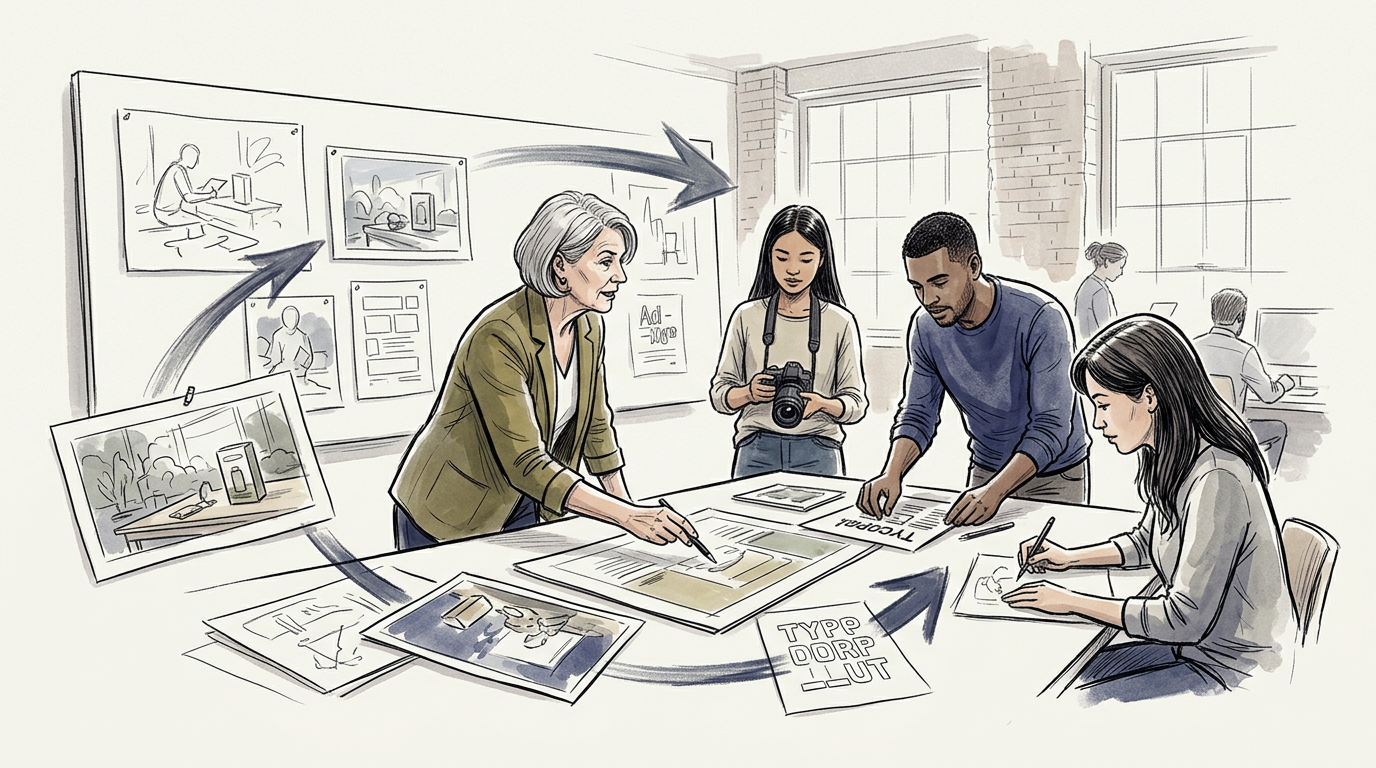
Art direction is the discipline responsible for shaping how an advertising idea looks and feels in market. In practical terms, an art director helps turn strategy and concept into visual communication. That can include decisions about imagery, composition, typography, color, casting, photography, illustration, motion, production design, and how all of those elements work together across formats.
The role matters because advertising is not communicated through words alone. Even when a campaign begins with a strategic insight or a strong line of copy, audiences encounter it as a designed experience. They see an image, scroll past a social post, watch a video, notice a billboard, open an email, or land on a page. Art direction helps determine whether that experience is clear, compelling, distinctive, and appropriate for the brand and the audience.
Although art direction is often associated with polished aesthetics, the job is not simply to make things look good. It is to make visual choices that support communication, persuasion, recognition, and brand meaning.
What art direction is
Art direction is the leadership and decision-making function behind a visual idea. In advertising and marketing, it typically sits within the creative process and works in close partnership with copywriting, design, strategy, production, and account teams.
An art director may help answer questions such as:
- What should this campaign look like?
- What visual metaphor or image system expresses the idea best?
- What type style, layout structure, or motion treatment fits the message and the brand?
- What kind of photography, illustration, set design, wardrobe, or casting will communicate the intended tone?
- How should the idea adapt across video, social, digital display, print, out-of-home, retail, or experiential environments?
- What needs to be created on set, in studio, through design, or in post-production to achieve that result?
In agencies, art directors are commonly part of the creative department. They often work as one half of a creative team with a copywriter, a partnership model that has long been central to agency creative development. The copywriter and art director may concept ideas together, present work together, and refine it together, even though each has areas of primary responsibility.
That division is useful, but it should not be understood too rigidly. Many art directors contribute to conceptual thinking, headlines, scripts, and brand storytelling. Many copywriters shape structure, pacing, and visual ideas. The best work is usually collaborative.
Art direction versus graphic design
One of the most common misunderstandings in advertising is treating art direction and graphic design as interchangeable. They are closely related, and in some organizations one person may do both, but they are not the same role.
Graphic design is the craft and practice of creating visual form. It typically involves arranging type, image, color, hierarchy, and layout into clear, functional, and aesthetically coherent communication. Designers often work deeply in execution, systems, files, formats, and production-ready assets.
Art direction is broader and more conceptual. It is concerned with the overall visual approach and how the idea should be expressed. That may include directing designers, photographers, illustrators, retouchers, editors, animators, set designers, stylists, or production partners.
A simple distinction is this:
- Graphic design often focuses on making the communication work in form.
- Art direction often focuses on deciding what the visual communication should be and guiding how it comes to life.
In practice, the line moves depending on the organization. In a small internal team, one person may concept, design, and produce everything. In a large agency production, the art director may establish the visual concept while a group of specialists handles execution. Neither role is inherently more strategic, more creative, or more valuable. They contribute differently.
That distinction matters because confusing the two can create poor staffing decisions, unclear expectations, and incomplete creative evaluation. A beautifully designed asset can still be weakly art directed if the visual concept does not support the brand or message. Likewise, a strong art direction concept can fail without excellent design execution.
Where art direction fits in the advertising process
Art direction usually enters the process after a business problem has been translated into a creative challenge, but visual thinking often starts earlier than many non-creative teams realize.
A common campaign workflow looks something like this:
- Business and marketing inputs: The client or brand team identifies a goal such as launching a product, increasing awareness, driving trial, or improving consideration.
- Strategy and briefing: Strategy, planning, research, and account teams help define the audience, the market context, the brand problem, the communications objective, and the desired response.
- Creative development: Copywriters and art directors develop campaign ideas, often exploring multiple routes that express the strategy in different ways.
- Concept selection and refinement: Creative leadership and client teams evaluate options, refine the strongest direction, and determine how it will work across channels.
- Design and production planning: The visual system becomes more specific. Layouts, storyboards, style frames, mood boards, shot lists, casting considerations, and production requirements are developed.
- Production: Assets are created through photography, filming, design, illustration, animation, editing, and post-production.
- Adaptation and rollout: The campaign is versioned across placements, formats, sizes, and audience contexts.
- Review and optimization: Teams assess whether the work is performing and whether the visual approach needs adjustment in later waves or channel executions.
Art direction can influence each stage differently. Early in development, it helps shape what the idea could become. Later, it protects the integrity of that idea as real-world constraints, budgets, timelines, technical specs, and stakeholder feedback enter the process.
What an art director actually does
The title can sound abstract, but the day-to-day work is concrete. Depending on seniority and organizational structure, an art director may be responsible for a wide mix of conceptual, visual, and production tasks.
Developing visual concepts
At the concept stage, an art director helps invent the visual expression of the campaign. That may involve creating routes based on different tones, settings, metaphors, image styles, or storytelling structures.
For example, if the strategy is to position a financial app as less intimidating for first-time investors, visual options might include:
- a clean, editorial look that signals clarity and trust
- a more human documentary style that emphasizes confidence-building
- a graphic, simplified illustration approach that reduces perceived complexity
Each route sends a different message before the audience reads a single line of copy.
Shaping layout and composition
Art directors guide how visual elements are arranged to create emphasis and comprehension. That includes hierarchy, focal point, pacing, balance, negative space, and the relationship between text and image.
In advertising, layout is not only a design concern. It affects whether the viewer notices the brand, understands the message quickly, and knows where to look next. A print ad, display unit, landing page, or social carousel each asks different questions of composition.
Working with typography
Typography carries both functional and expressive meaning. Art directors help determine whether type should feel authoritative, playful, premium, urgent, restrained, institutional, or disruptive. They may select or recommend type directions, establish hierarchy, and make sure type treatment supports both readability and tone.
In many settings, designers execute the typographic system in detail, but the art director is often responsible for the broader typographic point of view.
Selecting or directing imagery
Imagery can include photography, video, illustration, iconography, 3D elements, collage, animation, or mixed media. Art directors decide what kind of image world best supports the idea and the brand.
That might involve choices such as:
- studio photography versus documentary-style photography
- product hero shots versus lifestyle scenes
- literal visuals versus conceptual metaphor
- illustration versus live action
- high polish versus intentional rawness
These choices are strategic as well as aesthetic. They shape credibility, distinctiveness, emotional tone, and category fit.
Influencing casting, styling, and production design
When campaigns involve people, environments, or physical settings, art direction often extends into casting, wardrobe, hair and makeup, props, sets, and location selection. These decisions affect representation, realism, aspiration, and tone.
Casting is especially important because audiences infer a great deal from who appears in a campaign and how they are portrayed. Art direction helps ensure that people are chosen and presented in ways that fit the brief, serve the idea, and avoid defaulting to generic or inconsistent choices.
Directing shoots and production
Art directors are often involved in preparing for and overseeing production. Depending on the project, that can include reviewing directors’ treatments, helping select photographers or illustrators, approving locations, building shot lists, attending pre-production meetings, and being present on set or in studio.
A director in film production and an art director in advertising are not the same role, although they may work very closely together. In still photography, the art director may help guide composition, performance, set detail, and adherence to the approved concept. In motion work, they often collaborate with directors, producers, editors, and post-production teams to maintain the intended visual approach.
The Association of National Advertisers has published guidance on the advertising production process that illustrates how many stakeholders shape work from concept through execution, including creative, production, business, and legal participants: https://www.ana.net.
Adapting campaigns across channels
Campaigns rarely live in one format. A visual idea may begin as a film or key visual, then expand into paid social, retail signage, email, web, display, CRM, out-of-home, packaging support, or event materials.
Art direction helps maintain coherence while allowing for channel-specific adaptation. A visual system that works on a billboard may need substantial adjustment on a mobile screen. The challenge is not to make every asset identical. It is to make them recognizably part of the same campaign while respecting how each medium works.
Key skills and areas of judgment
Strong art direction depends on more than software proficiency or visual taste. It combines conceptual thinking, communication skills, and practical production knowledge.
Important areas of judgment include:
- Idea translation: turning strategy and message into visual form
- Brand sensitivity: understanding what is distinctive and appropriate for the brand
- Audience awareness: recognizing how visual choices affect perception, accessibility, relevance, and attention
- Craft literacy: understanding photography, typography, design systems, editing, motion, image-making, and production constraints
- Decision-making: selecting among visual options rather than generating endless possibilities
- Collaboration: working productively with copywriters, strategists, designers, clients, producers, and external partners
- Presentation: explaining why a visual choice serves the objective, not only why it looks appealing
Art direction also requires resilience. Visual work invites subjective reactions, and creative reviews often involve multiple stakeholders. A capable art director must be able to distinguish between personal preference, brand standards, strategic concerns, and legitimate execution issues.
How art directors collaborate with other disciplines
Art direction is not an isolated function. It gains value through interaction with adjacent roles.
With copywriters
This is one of the defining creative partnerships in advertising. The art director and copywriter often build concepts together. One may spark the central idea and the other may shape it, but the final work typically reflects both visual and verbal thinking.
This relationship is especially important because advertising concepts often depend on the tension or harmony between what is shown and what is said. A campaign can be weakened when image and copy are developed separately rather than as a unified idea.
With designers
Designers frequently turn art direction into finished systems and assets. They may develop grids, templates, responsive layouts, component libraries, typographic rules, and production-ready files that enable scale and consistency.
Where art direction defines the visual intent, design often operationalizes it. In many organizations, senior designers also contribute to concepting, and some art directors are highly skilled hands-on designers. The distinction is functional, not hierarchical.
With strategists and planners
Art direction is strongest when it is grounded in strategic understanding. Strategy clarifies the audience, objective, insight, category dynamics, and positioning challenge. The art director translates those inputs into visual choices that carry meaning.
A useful strategic question for an art director is not only “Does this look right?” but “What is this visual choice telling the audience about the brand, and is that what the strategy intends?”
With account and client teams
Account teams and client stakeholders often help define business constraints, timing, approvals, legal requirements, and market realities. Art directors need to understand these conditions without allowing them to collapse the idea prematurely.
Part of the role is advocating for visual quality and conceptual integrity while staying responsive to practical realities such as budget, production feasibility, market localization, and channel requirements.
With producers and production partners
Producers, photographers, directors, editors, animators, retouchers, stylists, illustrators, and developers all influence final output. Art direction frequently depends on these partnerships.
An art director does not need to perform every technical task, but should understand enough about process and craft to evaluate options, anticipate limitations, and make informed tradeoffs.
Art direction across different types of marketing work
The role changes depending on the assignment.
Brand campaigns
In broad brand work, art direction often focuses on creating a distinctive campaign world and expressing brand positioning through repeated visual patterns. Consistency matters, but so does freshness. The art director may think in terms of campaign systems rather than isolated assets.
Performance and direct response work
In performance-oriented environments, art direction must still build brand clarity, but it often works under tighter speed, testing, and conversion constraints. The visual question is not only “Is this on-brand?” but also “Does this clarify the offer and help the user act?”
That does not mean performance work is less creative. It means visual decisions are often evaluated in closer relation to user behavior, interface friction, and measurable response.
Social and content programs
For social content, art direction often needs to balance speed with coherence. Teams may produce a large volume of assets, work with creators or community managers, and adapt visual language continuously. The challenge is maintaining standards without making every asset feel over-processed or out of touch with the platform.
Retail and shopper marketing
In retail contexts, art direction must account for product visibility, pricing, hierarchy, promotional clarity, and physical or digital shelf competition. The visual solution may be less atmospheric and more transactional, but it still requires strong judgment.
Experiential and environmental work
When a brand idea extends into physical space, art direction can involve signage, spatial storytelling, installations, materials, lighting, wayfinding, and user flow. The viewer is no longer only looking at a communication piece but moving through an environment.
Common deliverables in art direction
The exact documents vary by team, but art directors frequently contribute to or create materials such as:
- concept boards
- mood boards
- reference decks
- layouts and mockups
- storyboards
- style frames
- shot lists
- casting references
- design direction presentations
- on-set feedback and markup
- post-production review notes
These are not merely presentation artifacts. They help align stakeholders, communicate intent to production partners, reduce ambiguity, and protect quality as work moves from idea to execution.
How art direction is evaluated
There is no single metric for art direction. Its impact is usually assessed through a mix of qualitative and quantitative signals.
Professionals often evaluate art direction by asking:
- Does the visual approach express the strategy clearly?
- Is the work recognizable as belonging to the brand?
- Does it attract attention appropriately for the medium?
- Does it support comprehension rather than distract from it?
- Is the craft level strong enough to build confidence and credibility?
- Can the system scale across channels and formats?
- Does it create distinctiveness relative to competitors?
Quantitative campaign results may provide indirect evidence. Measures such as brand recall, attention, click-through rate, video completion, engagement, conversion, or sales lift can all be influenced in part by creative quality. But they cannot isolate art direction on their own.
That limitation matters. Strong art direction can improve communication and distinctiveness, but outcomes also depend on targeting, media placement, offer strength, pricing, distribution, frequency, timing, and competitive context. Creative teams should avoid claiming sole credit for business results, just as organizations should avoid treating visual work as irrelevant because performance is shaped by many variables.
Industry bodies such as the World Federation of Advertisers and the Institute of Practitioners in Advertising have published work on creative effectiveness and the role of distinctive brand assets, both of which help explain why visual decisions matter over time: https://wfanet.org and https://ipa.co.uk.
Common misunderstandings about the role
Several misconceptions recur in agency and brand environments.
“Art directors just pick images or make things pretty”
This is probably the most persistent misunderstanding. Visual polish is part of the job, but the role is fundamentally about communication. An art director is making decisions about meaning, hierarchy, tone, salience, and brand expression.
“Art direction begins after the idea is finished”
In strong creative development, visual thinking helps form the idea from the beginning. If art direction is treated as decoration added at the end, the work often feels generic or disconnected from the concept.
“Graphic design and art direction are the same thing”
They overlap, but they are distinct functions. Both are essential. Organizations that collapse them into a single undefined expectation often create confusion around staffing, timelines, and quality control.
“A good art director must personally execute every visual detail”
Hands-on craft is valuable, and many art directors are excellent makers. But the core role is direction, judgment, and leadership of the visual idea. Depending on scale, the work may rely on many specialists.
“Art direction is purely subjective”
Taste and cultural awareness matter, but professional art direction is not random preference. It can and should be discussed in relation to audience, strategy, medium, brand codes, production realities, and communication goals.
Important limitations and tradeoffs
Art direction is powerful, but it is not unlimited.
A visually distinctive campaign cannot solve a weak product, an unclear strategy, or a poor media plan on its own. Likewise, a strong visual concept may need to compromise when budgets, rights issues, localization needs, accessibility requirements, or platform constraints make the original approach impractical.
There are also tradeoffs between novelty and consistency. A brand may need fresh creative expression without discarding the visual assets that make it recognizable. Art direction often operates inside that tension.
Another tradeoff involves craft versus speed. In fast-moving content environments, teams may not have the time or resources to produce highly refined visuals for every execution. Good art direction in those contexts means knowing where precision matters most and where looser approaches are acceptable or even advantageous.
Accessibility should also be part of the discussion. Typography, contrast, motion, color choices, captioning, and layout all influence whether communication is usable by a broad audience. Guidance from the World Wide Web Consortium’s Web Content Accessibility Guidelines is particularly relevant in digital environments: https://www.w3.org/WAI/standards-guidelines/wcag/.
Why the role matters
Art direction helps bridge the space between strategy and audience experience. It takes an intended message and gives it visual form in a way people can notice, understand, remember, and associate with a brand.
That makes the role important well beyond traditional agency creative departments. Brand teams, in-house studios, digital product marketing groups, social content teams, retail marketing organizations, publishers, and production companies all rely on some version of art direction, whether or not the title is used consistently.
For professionals outside the creative department, understanding art direction improves collaboration. It clarifies why visual decisions take time, why reference materials and production planning matter, why not every image can be swapped without consequence, and why creative quality is not separate from strategic effectiveness.
For professionals inside creative teams, the role remains a reminder that visual excellence is not only decoration or taste. It is a disciplined way of shaping communication.
At its best, art direction gives advertising a visual point of view. It helps brands say something clearly, and look like themselves while doing it.
Leave a Reply