
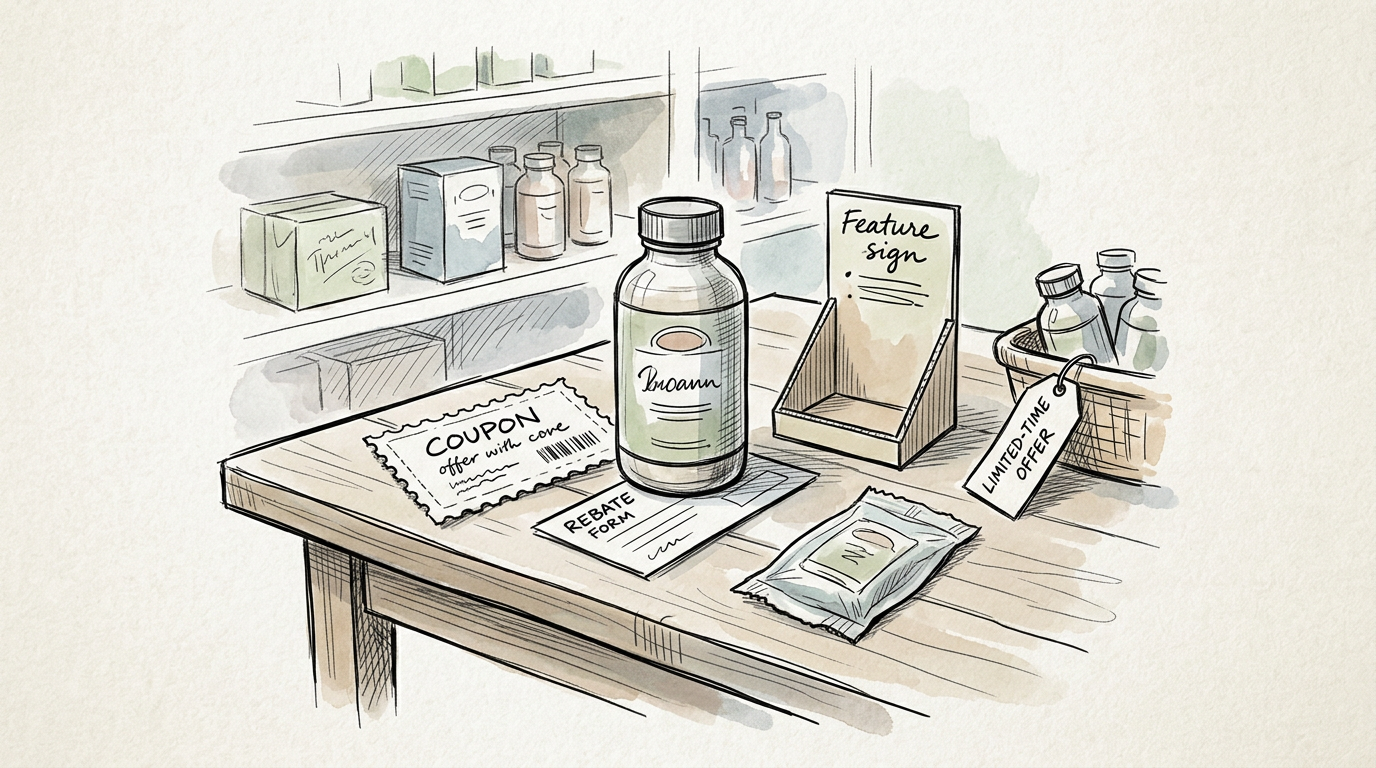
Sales promotion is one of the most familiar tools in marketing, but it is also one of the most commonly oversimplified. In professional practice, sales promotion refers to short-term incentives or activities designed to stimulate a specific response in the market. That response might be a consumer purchase, a product trial, a retailer order, additional shelf support, a distributor commitment, or a sales team action. Unlike broad brand-building efforts, sales promotion is usually intended to create movement now or within a defined window of time.
That practical focus is what makes sales promotion both useful and easy to misuse. A well-designed promotion can help introduce a new product, encourage trial, increase distribution, support a seasonal sales period, or prompt switching from a competitor. A poorly designed promotion can reduce margins, train customers to wait for deals, create channel conflict, or generate a temporary spike with little lasting value. For marketers, agencies, and sales organizations, understanding sales promotion means understanding not just the tactic itself, but also when it fits and what job it is actually being asked to do.
## What sales promotion is
Sales promotion consists of temporary offers, incentives, or merchandising activities that encourage action beyond what advertising alone may produce. That action can happen at different points in the market system:
– Consumers may be encouraged to buy, buy sooner, buy more, or try a product for the first time.
– Retailers or distributors may be encouraged to stock the product, feature it, display it, or support it more actively.
– Sales teams may be motivated to prioritize a product, account, or selling period.
In that sense, sales promotion sits at the intersection of marketing, sales, distribution, retail execution, and customer behavior. It is not limited to one channel or one audience.
Common examples include:
– Coupons
– Temporary price reductions or discounts
– Rebates
– Samples
– Premiums or gift-with-purchase offers
– Contests and sweepstakes
– In-store displays
– End-cap features
– Trade allowances
– Co-op promotional support
– Dealer incentives
– Slotting or display support in some retail contexts
Although many people use “promotion” as a catchall term for all marketing communications, sales promotion is more specific. In professional use, it refers to incentive-based activity intended to produce a measurable near-term response.
## Sales promotion is not the same as advertising
One of the most important distinctions in marketing is the difference between advertising and sales promotion.
Advertising typically communicates a message to build awareness, shape perception, establish positioning, or persuade over time. It may support immediate sales, but its primary role often includes creating memory, meaning, and brand preference. Sales promotion, by contrast, adds an immediate reason to act. It gives the audience a concrete prompt such as a discount, a limited-time offer, a sample, or a retailer incentive.
A simple way to think about the difference is this:
– Advertising says why the brand matters.
– Sales promotion says why act now.
In practice, the two often work together. A campaign may use advertising to introduce a new product and sales promotion to encourage first purchase. A digital video ad may drive interest, while a coupon, rebate, or retail offer lowers the barrier to trial. A trade campaign may explain the product opportunity to retailers, while a trade allowance or display program encourages distribution and in-store support.
This distinction matters because a promotion cannot do the entire job of marketing. Incentives can stimulate action, but they do not automatically create durable brand value. Brands that rely too heavily on promotion without supporting brand strategy can become associated primarily with price rather than with differentiated meaning.
## The major types of sales promotion
Sales promotion is often divided into consumer promotion, trade promotion, and sales force promotion. Different organizations may use slightly different categories, but the distinction is useful because the audience and objective change the design of the program.
### Consumer promotion
Consumer promotion is directed at end users or shoppers. Its purpose is usually to encourage purchase, trial, repeat purchase, switching, or increased usage.
Common consumer promotion tools include:
– **Coupons:** Certificates or digital offers that reduce the purchase price. Coupons may be distributed through apps, retailer loyalty programs, direct mail, packaging, paid media, or brand-owned channels.
– **Discounts or temporary price reductions:** A product is offered at a lower price for a limited period. In retail settings this may appear as a sale price, markdown, or shelf-level promotional pricing.
– **Rebates:** The buyer pays full or near-full price initially and receives money back after completing a redemption process. Rebates are often used for higher-priced goods because they preserve the list price while still offering an incentive.
– **Samples:** Free trial quantities distributed in-store, by mail, at events, through subscription boxes, or via digital request programs. Sampling is especially useful when product experience is central to adoption.
– **Premiums:** A free or discounted item offered with purchase, such as a branded gift or bonus pack.
– **Contests and sweepstakes:** Promotional programs that encourage participation, attention, or engagement. In the United States, contests and sweepstakes have distinct legal meanings, and marketers need to structure them carefully.
– **Point-of-purchase displays:** In-store materials that highlight the product and encourage impulse or planned purchase near the decision point.
Consumer promotions can be delivered through physical retail, ecommerce, mobile wallets, loyalty platforms, email, social media, connected TV commerce tie-ins, and other channels. The format has evolved, but the underlying function remains the same: reduce friction, increase perceived value, or create urgency.
### Trade promotion
Trade promotion targets intermediaries such as wholesalers, distributors, retailers, dealers, or franchisees. The goal is to secure or improve channel participation. A manufacturer may use trade promotion to persuade retailers to carry a product, allocate shelf space, run features, build displays, or support launch activity.
Common trade promotion tools include:
– **Trade allowances:** Financial incentives given to channel partners for stocking, promoting, or featuring products.
– **Display allowances:** Payments or discounts tied to agreed in-store displays or merchandising placement.
– **Off-invoice discounts:** Immediate price reductions offered to trade buyers.
– **Buy-in incentives:** Temporary terms that encourage retailers or distributors to order additional volume during a certain period.
– **Cooperative advertising or co-op support:** A manufacturer shares the cost of local advertising run by a retailer or dealer, usually under defined brand guidelines.
– **Dealer contests or incentives:** Programs that reward sellers, locations, or channel partners for meeting specified performance targets.
– **Slotting-related support:** In some retail categories, manufacturers may provide payments or support tied to shelf placement or item introduction, subject to retailer policy and applicable rules.
Trade promotion is especially important in industries where distribution, shelf presence, reseller recommendation, or dealer support strongly influence sales. Consumer demand matters, but channel cooperation often determines whether the product is available, visible, and actively sold.
### Sales force promotion
Some organizations distinguish promotions aimed at the internal or external sales force. These are intended to encourage salespeople, field representatives, or dealer personnel to prioritize a product, push a launch, or support a campaign period.
Examples include:
– Sales contests
– Performance bonuses
– SPIFFs, meaning special incentives paid for selling specific items
– Sales materials and demonstration kits tied to a promotional push
This category overlaps with sales management as much as with marketing, but it can be a critical part of getting a promotion executed in market.
## What problem sales promotion solves
Sales promotion is used when marketers need a stronger or more immediate behavior shift than messaging alone is likely to produce. Common business problems it helps address include:
– Encouraging trial for a new product
– Increasing volume during a seasonal or promotional window
– Supporting a product launch
– Moving inventory
– Defending share against competitor activity
– Stimulating retailer orders or improved placement
– Rewarding loyal customers
– Reactivating lapsed buyers
– Encouraging larger basket size or multiple-unit purchase
– Reducing perceived risk for a first-time user
For example, a new snack brand may use sampling and introductory coupons to encourage first purchase. A consumer electronics manufacturer may use rebates around a holiday period to increase unit sales without permanently changing the product’s list price. A consumer packaged goods brand may fund end-cap displays and feature pricing with retail partners to improve in-store visibility and volume during a category peak.
In each case, the promotion is not the whole strategy. It is a mechanism for overcoming a specific barrier to action.
## How sales promotion works in practice
Although details vary by company and category, most promotional programs move through a recognizable planning process.
### 1. Define the business objective
The first question is not “What promotion should we run?” It is “What behavior are we trying to change?” A promotion designed to increase household trial will look different from one designed to reward repeat buyers or secure better retail distribution.
Objectives may include:
– Increase trial by a defined audience
– Lift unit sales during a specific period
– Increase retailer participation
– Improve display compliance
– Drive repeat purchase among recent buyers
– Encourage channel sell-in before a launch
– Support a product bundle or cross-sell
Clarity here matters because promotions are often judged by activity rather than by whether they solved the original problem.
### 2. Identify the target audience and buying context
Professionals then consider who must act and under what conditions. Is the audience a price-sensitive shopper, a retailer category manager, a distributor, a dealer network, or an internal sales team? Is the buying decision impulsive, planned, infrequent, seasonal, or high-risk? Is the product sold online, in mass retail, through field sales, or through multiple channels?
The answers shape the type of promotion that makes sense. Sampling may be effective for experiential categories. Dealer incentives may matter more for durable goods. Coupons may work in a repeat-purchase category but not in a highly infrequent purchase category.
### 3. Select the promotional mechanism
At this stage, marketers choose the form the incentive will take. The selection depends on the objective, economics, distribution realities, and consumer behavior.
For example:
– A **coupon** lowers price and may encourage trial or switching.
– A **rebate** preserves shelf price visibility while providing post-purchase savings.
– A **sample** lets consumers experience the product before committing to a full purchase.
– A **display allowance** may improve visibility at retail.
– A **contest** may increase engagement or retailer participation if structured appropriately.
The tactic should match the barrier. If the core problem is lack of awareness, a price promotion alone may not solve it. If the problem is hesitation to try an unfamiliar product, sampling may work better than a deep discount.
### 4. Set the offer economics and operational terms
This is where promotion design becomes financially and operationally real. Teams determine:
– Incentive value
– Timing and duration
– Redemption conditions
– Eligible products or SKUs
– Channel availability
– Retailer participation terms
– Funding source and budget treatment
– Forecasted lift
– Margin impact
– Fulfillment and reimbursement processes
A promotion that looks attractive in creative form can fail if reimbursement is unclear, retail execution is inconsistent, fraud controls are weak, or margin effects are not understood.
### 5. Coordinate execution across functions
Sales promotion often requires more cross-functional coordination than people expect. Depending on the organization, participants may include:
– Brand marketing
– Shopper marketing
– Trade marketing
– Sales
– Channel or account teams
– Finance
– Legal and compliance
– Operations and supply chain
– Agency partners
– Retail media or merchandising teams
– Analytics or marketing science
For example, if a manufacturer offers a trade allowance tied to an in-store display and a consumer coupon, the company may need retailer agreement, creative assets, inventory planning, legal review, field merchandising support, reimbursement systems, and post-campaign analysis.
### 6. Measure results and learn
Promotions are usually measured more directly than broad brand campaigns, but that does not mean measurement is simple. Sales lift during a promotional period may reflect the incentive, seasonality, retailer support, competitive activity, or stock-up behavior rather than true incremental growth. Professionals need to look beyond the initial spike.
## Common sales promotion terminology
Several terms frequently appear in promotional planning and evaluation.
### Trial
Trial refers to first-time use or purchase. Many launch promotions are built primarily to reduce barriers to trial.
### Redemption rate
For coupons, rebates, or similar offers, redemption rate measures the percentage of distributed or activated offers that are actually used. A high redemption rate may indicate a compelling offer, but it may also increase cost significantly.
### Lift
Lift refers to the increase in sales or another target behavior during or after the promotion relative to a baseline. The baseline may be a historical average, a control group, or a modeled expectation.
### Incremental sales
Incremental sales are the additional sales attributable to the promotion beyond what would likely have happened anyway. This is one of the most important and most difficult concepts in promotion analysis.
### Cannibalization
Cannibalization occurs when a promotion shifts purchases among a company’s own products rather than creating net growth. For example, a discount on one package size may pull demand away from another size in the same brand portfolio.
### Forward buying
In trade promotion, forward buying happens when retailers purchase larger quantities during a deal period to take advantage of temporary discounts, then sell the product later at regular terms. This can distort demand signals.
### Pass-through
Pass-through refers to the extent to which a trade incentive is actually reflected in the consumer offer or retail support rather than retained entirely by the intermediary.
### Merchandising compliance
This concerns whether agreed displays, signage, placement, or feature activity were actually executed in market. A strong promotion on paper may underperform because it was not implemented consistently.
## Measuring sales promotion performance
The appeal of sales promotion is that results often seem visible and immediate. A retailer order increases. Unit sales spike. Coupons get redeemed. Traffic rises. But professionals have to distinguish visible activity from real effectiveness.
Useful metrics may include:
– Unit sales and revenue during the promotion period
– Incremental sales
– Redemption rate
– Trial rate
– Repeat purchase rate after trial
– Average order value or basket size
– Distribution gains
– Display execution and compliance
– Retail feature participation
– Return on promotional spending
– Margin impact
– Customer acquisition cost in digitally delivered offers
– Sell-in versus sell-through
A few cautions are especially important.
First, not all promoted sales are incremental. Some buyers would have purchased anyway. Some simply buy earlier than they otherwise would have. Some stock up during the deal and buy less later.
Second, sales promotion can pull volume from future periods. A very strong discount in one week may create an apparent win followed by softer demand the next week or month.
Third, trade promotion can improve shipments into the channel without improving sales out of the channel. Sell-in is what the manufacturer sells to retailers or distributors. Sell-through is what consumers actually buy from those outlets. Both matter, but they are not the same.
Fourth, promotion should be evaluated against profit as well as volume. An offer that drives a large sales increase while sharply reducing margin may not improve the business.
Organizations often use scanner data, retailer data, loyalty data, ecommerce analytics, field audits, and econometric or marketing mix analysis to understand promotional impact more accurately. In digital commerce settings, controlled experiments and holdout groups may also help estimate incrementality.
## Sales promotion and brand strategy
One reason sales promotion requires careful management is that it affects both immediate behavior and longer-term brand perception. Incentives can be highly effective when they reduce friction, encourage trial, or support distribution. But if used too frequently or too deeply, they can reshape how customers value the brand.
Common risks include:
– Conditioning customers to wait for discounts
– Weakening perceived quality or prestige
– Compressing margins
– Increasing competitive deal pressure
– Shifting focus from brand difference to price alone
– Creating internal dependence on promotions to hit short-term targets
This does not mean promotions are bad for brands. It means the promotion must fit the brand strategy and market context. A prestige brand, a grocery staple, a seasonal product, a new technology device, and a business-to-business dealer network will all approach promotion differently.
In some categories, frequent promotion is structurally normal. In others, overpromotion can damage the brand quickly. The right question is not whether a brand should ever promote, but how promotional activity supports the broader value proposition and growth model.
## Legal and regulatory considerations
Because sales promotion often involves incentives, prizes, pricing claims, and conditions of participation, legal review can be essential. Rules vary by market and by promotional format.
In the United States, marketers often need to pay special attention to requirements related to:
– Truthful and non-deceptive advertising, overseen broadly by the Federal Trade Commission
– Sweepstakes and contest rules, including disclosures and prohibited structures
– Pricing representations and savings claims
– Rebate terms and fulfillment practices
– Data collection and privacy requirements for digital promotions
– State-level promotional and prize regulations
– Retailer policies and platform rules
For example, a contest generally requires skill-based judging, while a sweepstakes is typically chance-based and cannot be structured as an illegal lottery. The distinctions can be consequential. Similarly, a rebate with unclear or burdensome redemption terms may create compliance and consumer trust problems.
Trade promotion can also involve contractual and channel issues that require careful documentation, especially in heavily distributed categories.
## Where sales promotion fits in the marketing organization
Sales promotion rarely belongs to only one department. Its organizational home depends on the company and channel structure.
It may sit within:
– Brand marketing
– Shopper marketing
– Trade marketing
– Sales
– Channel marketing
– Customer marketing
– Revenue management
– Growth or performance marketing in digital businesses
Agency involvement also varies. Creative agencies may develop consumer-facing promotional campaigns and assets. Shopper marketing agencies may focus on retail activation. Media agencies may support the communication plan around the offer. Promotional marketing specialists may handle sweepstakes, sampling, or experiential execution. In trade-heavy sectors, sales and account teams may play a central role in designing and negotiating promotional programs.
This is one reason sales promotion can be misunderstood. It is not merely a “coupon function” or an “in-store function.” It is a cross-functional commercial tool.
## Common misunderstandings about sales promotion
Several misconceptions regularly create confusion.
### “Promotion” means any form of marketing
In everyday speech, people may use “promotion” to mean publicity, advertising, content, or general exposure. In industry practice, sales promotion is narrower and refers to incentive-based activity intended to stimulate response.
### A promotion that increases sales is automatically successful
A short-term sales increase may come at the cost of margin, future demand, or brand value. The key question is whether the promotion created profitable incremental value aligned with the objective.
### Promotions are only for consumer goods
Consumer packaged goods make heavy use of promotion, but sales promotion is also common in automotive, retail, electronics, hospitality, pharmaceuticals under relevant rules, software, industrial goods, and business-to-business channels.
### Trade promotion is the same as consumer promotion
They are related but distinct. Trade promotion aims to influence channel partners. Consumer promotion aims to influence end buyers or users. One may support the other, but they are not interchangeable.
### Discounts are the only real form of promotion
Price reduction is important, but promotion also includes non-price incentives and merchandising support such as samples, displays, contests, premiums, and dealer programs. In many cases, the strongest promotion is not the deepest discount but the tactic that best addresses the actual barrier to action.
## Why professionals should understand sales promotion clearly
Sales promotion often looks simple from the outside because the visible part is familiar: a coupon, a rebate, a contest, a temporary price cut. Behind that visible offer, however, is a set of strategic choices about audience, incentive design, channel economics, execution, legal structure, measurement, and brand impact.
For advertisers and marketers, the core value of sales promotion is its ability to create immediate motivation. It can accelerate trial, improve retail support, unlock distribution, and convert interest into action. Its limitation is equally important: it does not replace the need for clear positioning, effective advertising, sound pricing strategy, or strong products.
Used well, sales promotion is a disciplined short-term tool within a longer-term marketing system. Professionals who understand that balance are better equipped to design promotions that do more than generate a temporary bump. They can use promotion to solve the right problem, with the right audience, in a way that supports both current performance and future brand health.
Leave a Reply