
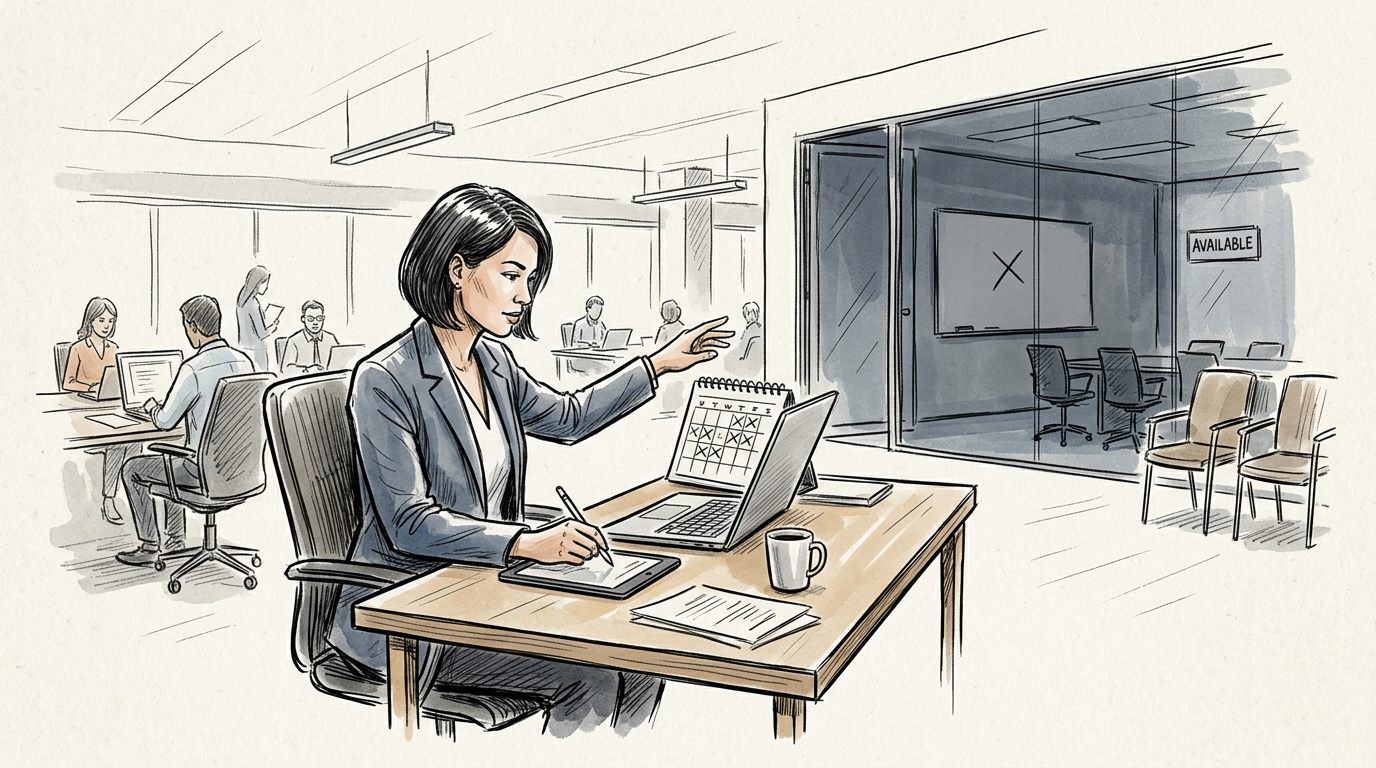
In advertising and marketing organizations, meetings are often treated as evidence of movement. A calendar fills up, stakeholders gather, and the project appears to be advancing because people are talking about it. But conversation is not the same as progress. In many teams, especially those coordinating creative, media, strategy, analytics, research, account, and client-facing work, too many meetings create a predictable professional problem: less time for thinking, less time for execution, and less clarity about what actually needs a group decision.
The question is not whether meetings are good or bad. Complex work often does require live discussion. Campaign strategy, creative review, scope negotiation, crisis response, research interpretation, and cross-functional decision-making cannot always be reduced to a status note. The professional skill is knowing when real-time conversation is necessary and when it is not.
That distinction matters more than many organizations admit. Microsoft’s Work Trend Index has documented the expanding burden of digital communication and meeting load in knowledge work, while broader workplace research from sources such as the Harvard Business Review has repeatedly examined how excessive meetings reduce focus and crowd out time for substantive work. Advertising and marketing teams feel that strain acutely because their work depends not only on responsiveness, but also on judgment, concentration, and synthesis. A strategist cannot develop a useful point of view between back-to-back status calls. A creative director cannot give thoughtful feedback while triaging calendar invites all day. A media lead cannot do careful planning if every update becomes a meeting.
Reducing unnecessary meetings is not an argument for less communication. It is an argument for better communication design.
What a meeting is actually for
A useful meeting has a clear reason to exist. In professional terms, that usually means one of five things: a decision must be made, tradeoffs must be debated, expertise must be combined in real time, a sensitive issue requires dialogue, or the group needs to solve a problem together.
Those are different purposes, and professionals often create weak meetings because they fail to distinguish among them. A status update gets scheduled as if it were a workshop. A workshop gets run as if it were an approval meeting. A decision meeting turns into a vague discussion because no one established decision rights in advance.
Before calling a meeting, it is worth asking a more disciplined set of questions:
- Does this require interaction, or only transmission of information?
- Do participants need to react to one another in real time?
- Is the issue ambiguous enough that discussion will improve the outcome?
- Is there an actual decision to make, and is the decision-maker present?
- Would written context produce better thinking before anyone talks?
If the answer to those questions is no, the meeting may not be necessary.
In many advertising and marketing environments, the most common meeting failure is using synchronous time for matters that could have been communicated asynchronously with more clarity and less disruption. A campaign timeline change, an updated client delivery date, a revised media budget assumption, a list of open creative feedback items, or a recap of what happened in yesterday’s client call rarely needs a live group conversation unless it creates conflict, risk, or a substantive decision.
Strong professionals learn to separate “people should know this” from “people need to discuss this.”
When an email, memo, or shared update is the better tool
Asynchronous communication is usually better when the objective is to inform, document, confirm, or prepare. That is especially true when people need time to absorb detail, check facts, or respond according to their part of the workflow.
In practice, that means a meeting should often become an email, shared document, project update, or recorded walkthrough when the purpose is any of the following:
- Providing status updates that do not require immediate discussion.
- Sharing background material before a decision meeting.
- Documenting a decision that has already been made.
- Assigning tasks, owners, and deadlines clearly.
- Summarizing feedback from a smaller review group.
- Collecting input that participants can provide independently.
- Distributing data, research findings, or reporting dashboards for review.
- Clarifying process steps, logistics, or handoffs.
This is not simply a question of efficiency. Written communication can be better communication. It creates a reference point, reduces the risk that people hear different versions of the same instruction, and gives recipients a chance to engage with substance rather than react on the spot.
In creative and marketing organizations, asynchronous updates are particularly useful when work spans specialties with different cadences. A research team may need time to inspect methodology questions. A legal or compliance stakeholder may need time to review claims. A media team may need to confirm inventory implications before responding. A brand team may want to consult internal leadership before agreeing to a recommendation. Pulling everyone into a meeting too early can create noise without producing better judgment.
Strong asynchronous communication is not a vague note that says, “Just wanted to circle back” or “Let’s all align.” It is structured and usable. It states what happened, what changed, what matters, what action is required, by whom, and by when.
When a meeting is worth the interruption
Meetings earn their place when they solve a problem that asynchronous tools cannot handle well.
That often includes situations where competing priorities must be reconciled across functions. For example, a strategy lead may want more time to refine positioning, a media team may need assets by a fixed trafficking deadline, and an account lead may be managing client expectations tied to a product launch date. An email chain may document those tensions, but it may not resolve them. A meeting can help the group surface the tradeoffs, identify what is fixed versus flexible, and decide what will happen.
Meetings are also useful when professionals need to evaluate ambiguous work together. A strong creative review, for instance, is not just a series of isolated comments. It may require live conversation about whether the work answers the brief, whether the idea is distinct enough, what audience assumption is driving disagreement, and whether concerns are strategic, legal, tonal, or executional. That kind of discussion is hard to conduct well through fragmented written responses.
Other situations that often justify live meetings include:
- Decision-making when options carry material tradeoffs.
- Problem-solving under deadline pressure.
- Conflict resolution where misunderstanding or tension is affecting work.
- Client conversations involving risk, expectations, budget, or scope.
- Project kickoffs where ownership, dependencies, and success criteria must be clarified across functions.
- Retrospectives or postmortems intended to improve future practice.
The common feature is not importance alone. Many important things can be communicated in writing. The common feature is interdependence. When the quality of the outcome depends on people responding to one another, challenging assumptions, or making choices together, a meeting may be the right tool.
Why unnecessary meetings persist
If unnecessary meetings are so widely recognized as a problem, why do they continue?
Part of the answer is risk management. Many professionals schedule meetings because they are trying to avoid blame. A meeting feels safer than sending a clear recommendation. If everyone was invited, no one can later claim they were excluded. If the issue was discussed live, the organizer feels protected even if the discussion produced little.
Part of the answer is cultural habit. In some organizations, managers equate visibility with participation. People prove they are engaged by showing up. This is especially common in client service functions, where responsiveness is essential and teams can slide from being available to being overassembled.
Part of the answer is communication weakness. Writing a concise, useful, decision-oriented email is harder than sending an invite. So is building a clear agenda, circulating pre-read material, and defining the objective of a live discussion. Poor meetings are often symptoms of poor thinking upstream.
There is also a status dynamic. Junior professionals may feel they lack permission to decline or question meetings. Mid-level managers may over-convene because they are coordinating across stakeholders with different expectations. Senior leaders may unintentionally create meeting-heavy cultures by demanding constant updates rather than designing better reporting rhythms.
In that sense, reducing unnecessary meetings is not just a personal productivity tactic. It is a management and leadership issue.
What strong professional judgment looks like
Professionals who handle meetings well do not simply attend fewer of them. They become more precise about communication mode, participation, and desired outcome.
That precision shows up in several ways.
First, they define the purpose before they choose the format. If the purpose is information-sharing, they write. If the purpose is interpretation or decision, they convene the right people and explain why.
Second, they respect other people’s concentration as a professional resource. In advertising and marketing, knowledge work depends on stretches of uninterrupted attention. Writing strategy, editing a deck, reviewing research, modeling scenarios, producing concepts, and refining recommendations all require time that meetings can easily fragment.
Third, they know that not everyone needs to attend everything. Invite lists often grow because people confuse being informed with being present. A strong operator separates core decision-makers, contributors, and people who simply need the recap.
Fourth, they understand documentation. A meeting without a useful written record often creates another meeting because no one is sure what was decided.
Finally, they know that speed and thoughtfulness are not always the same thing. Pulling people into an urgent call can create the appearance of momentum while weakening the eventual decision. In some cases, sending a written summary and giving participants two hours to review before a shorter discussion produces a much better result.
What weak practice looks like
Weak practice is easy to recognize because the same patterns repeat across organizations.
A status meeting is held because it always exists, even when the update could be read in two minutes.
A project review includes twelve participants, but only three of them have a role in the discussion.
A meeting is scheduled with no agenda, no pre-read, and no stated decision required.
People attend because the organizer included them, then multitask because their presence is unnecessary.
An issue that could have been resolved through a clear written recommendation becomes a 45-minute conversation ending with, “Let’s regroup.”
None of this is harmless. It slows work, blurs ownership, and teaches teams that calendar activity is a substitute for professional clarity.
It also creates unequal burdens. Senior people may have more control over their calendars, while junior staff absorb the fragmented schedule and then complete their actual work after hours. In that respect, meeting discipline is also a workload and management issue, not merely a personal preference.
How managers can reduce meetings without reducing alignment
Managers often say they want fewer meetings while continuing to create the conditions that generate them. If teams are unclear about priorities, approval paths, timelines, or authority, meetings multiply because people are trying to get certainty in real time.
The better approach is operational, not rhetorical.
Managers can reduce unnecessary meetings by establishing predictable communication systems. These may include a weekly written status update, a shared project tracker, a standard template for decision memos, or clear escalation rules for issues that truly require discussion. The point is not bureaucracy. The point is reducing ambiguity.
A few management practices are especially effective:
- Use written updates for routine status reporting.
- Define which decisions require live review and which do not.
- Require agendas for recurring meetings and cancel those that no longer serve a clear purpose.
- Set expectations about who is accountable, who must be consulted, and who only needs visibility.
- Ask teams to circulate materials in advance so meeting time is used for judgment, not reading slides aloud.
- End meetings with explicit next steps, owners, and deadlines documented in writing.
These are not minor administrative habits. They are management disciplines that improve execution and reduce rework.
For creative leaders, this may mean separating exploratory reviews from approval meetings. For account and client-service leaders, it may mean distinguishing between a client update, a negotiation, and an internal prep call. For research and analytics leaders, it may mean sending findings ahead of time so the meeting can focus on implications and business decisions rather than reading charts.
How early-career professionals can handle meeting-heavy cultures
Junior professionals are often told to be available, responsive, and collaborative. That advice is not wrong, but without judgment it can produce passive meeting behavior: accept every invite, say little, and hope attendance signals engagement.
A better professional standard is to learn how meetings work and how communication choices affect the work itself.
Early-career professionals can build credibility by asking useful operational questions. What is the purpose of this meeting? What decision needs to be made? Should I prepare anything in advance? Am I attending to contribute, to learn, or to stay informed? Those questions are not signs of resistance. Asked professionally, they signal seriousness about time and output.
They can also get better at written follow-up. One of the simplest ways to become useful on a team is to convert discussion into clarity. A concise recap that documents decisions, open questions, and next steps saves time and reduces confusion. It also helps early-career professionals develop a reputation for organization and judgment.
This matters for advancement because seniority is not only about having opinions. It is about helping teams work better.
When email is not enough
There is a counter-risk here: some professionals overcorrect and treat asynchronous communication as inherently superior. It is not.
Email can distribute information efficiently, but it can also conceal disagreement, delay difficult conversations, and produce long threads where no one takes responsibility for resolving the issue. Tone can be misread. Feedback can become fragmented. Important stakeholders may respond at different times with conflicting perspectives that would have surfaced more quickly in a well-run meeting.
This is especially true in moments involving trust, conflict, or ambiguity. If a client relationship is under strain, if two departments disagree about priorities, or if a piece of work is conceptually stuck, replacing conversation with written updates can preserve politeness while allowing the underlying issue to persist.
The professional question is not, “Could this technically be sent by email?” The better question is, “What communication method gives this issue the best chance of being understood and resolved?”
Sometimes that answer is a written note. Sometimes it is a 20-minute call with the right three people. Sometimes it is a pre-read followed by a focused decision meeting. Good judgment lies in choosing deliberately rather than defaulting to habit.
Better meetings start before the meeting
One reason meetings become bloated is that participants arrive unprepared, lacking context or uncertain about the objective. As a result, live time gets consumed by background explanation, repeated updates, and circular discussion.
Much of that can be fixed before the meeting begins.
A useful invitation should state the purpose, the expected outcome, the participants’ role, and any material they need to review in advance. If the meeting exists to make a decision, the organizer should identify the decision clearly. If the meeting exists to solve a problem, the organizer should frame the problem precisely enough that people know what they are being asked to help solve.
This is where written communication and meetings work together rather than compete. A short pre-read can make a meeting far more efficient. Participants arrive with the same baseline information, and the conversation can move quickly to questions, implications, and choices.
In advertising and marketing settings, this is especially valuable for cross-functional work. A strategy team may circulate the key audience insight and brief tension before a creative review. A media team may send scenarios and cost implications before a budget discussion. An analytics lead may summarize findings and methodological caveats before a recommendation meeting. The live discussion then focuses on judgment, not transmission.
Reducing meetings is partly a cultural signal
How an organization uses meetings reflects how it values time, thought, and accountability.
In a healthy culture, not every issue becomes a group forum. People are expected to read, think, prepare, and communicate clearly in writing. Meetings are used where they add value, not where they relieve discomfort about making a recommendation or setting direction.
That culture also depends on leaders modeling the right behavior. If leaders ignore pre-reads, ask for meetings instead of reading concise updates, or invite large groups to discussions with no clear purpose, others will follow. If leaders instead reward clear writing, respect focused work time, and insist that meetings produce decisions or movement, teams become more disciplined.
This matters in client-service businesses and internal brand organizations alike. Every unnecessary meeting carries an opportunity cost. It may delay the deck, weaken the analysis, reduce review quality, or exhaust the people responsible for the work. Over time, that affects professional standards.
Choosing the right mode is part of professional maturity
Knowing when a meeting should be an email is not a minor productivity preference. It is part of professional communication, management discipline, and organizational judgment.
Strong professionals understand that meetings are expensive, not only in hours but in attention. They use them when live interaction improves the outcome: to decide, debate, solve, calibrate, or address difficult issues directly. They use asynchronous communication when the work calls for clarity, documentation, preparation, or distributed response. They do not confuse visibility with effectiveness, or activity with progress.
In advertising and marketing work, where collaboration is essential but uninterrupted thinking is equally valuable, that distinction can materially improve both execution and working conditions. Fewer unnecessary meetings do not mean less alignment. When handled well, they produce the opposite: clearer information, better use of expertise, stronger decisions, and more time to do the work that meetings are supposed to support.
Leave a Reply