
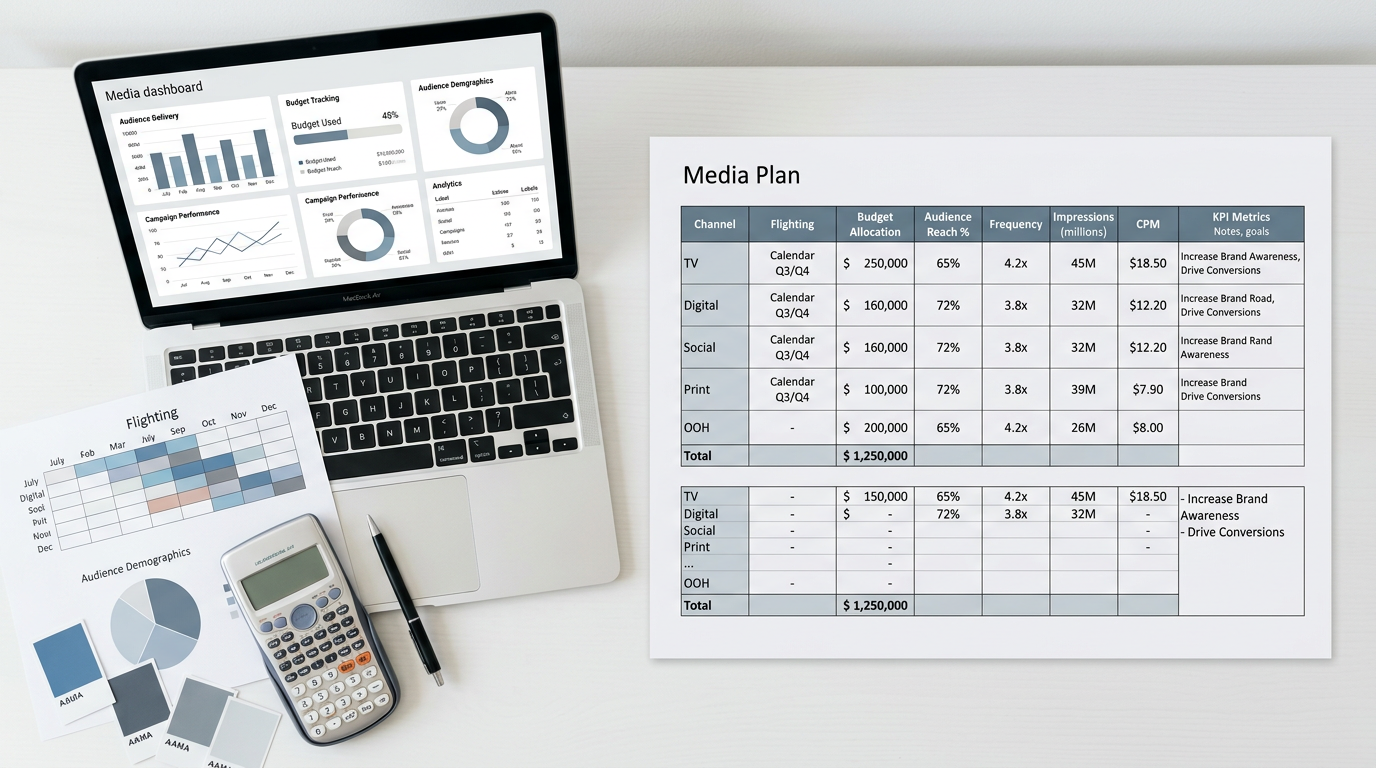
Build a structured media strategy, channel plan, budget, flighting schedule, and measurement framework with the AAMA Media Plan Template. This editable Excel workbook helps marketers, agencies, organizations, consultants, students, and academic teams translate campaign objectives into practical media decisions while documenting the assumptions behind budget, audience delivery, reach, frequency, traffic, conversion, and performance projections.
A useful media plan should explain more than where advertising will run. It should show why each channel has been selected, what role it plays in the communication strategy, which audience it is expected to reach, how much investment it receives, what delivery is expected, how performance will be measured, and what conditions would justify changing the plan after launch.
Download the Media Plan Template
The AAMA Media Plan Template is provided as an editable Microsoft Excel workbook with formulas, dropdown controls, planning tables, budget calculations, audience-delivery tools, flighting, and a visual summary already built in. Enter campaign assumptions and channel plans, then use the workbook to evaluate allocation, expected delivery, efficiency, and measurement before the campaign launches.
The workbook uses a neutral professional design so it can be adapted to an organization, agency, client, course, campaign, or media-planning assignment. Bracketed instructional text should be replaced or removed before the completed plan is distributed.
What the Template Helps You Plan
The workbook is designed to connect media decisions with the larger campaign strategy. It provides working areas for defining the audience and objective, allocating budget, comparing channels, estimating reach and frequency, scheduling investment over time, documenting assumptions, establishing KPIs, and creating a concise summary for review or approval.
The template can support paid search, paid social, display, online video, connected television, traditional television, radio, streaming audio, out-of-home, print, direct mail, email, influencer or creator activity, sponsorships, events, affiliate programs, retail media, and other channels.
What’s Included
The workbook contains seven working sheets:
- Instructions
- Plan Overview
- Media Plan
- Flighting
- Reach & Frequency
- KPI & Measurement
- Media Plan Summary
Together, these sheets create a working media-planning system rather than a static list of placements.
Begin With the Media Objective
The Plan Overview establishes the campaign, audience, media objective, primary KPI, geography, approved budget, reserve, planning period, attribution methodology, and important assumptions.
Media choices should follow from the objective rather than from a predetermined list of channels. A campaign designed to maximize broad awareness may require a different mix from one designed primarily to produce qualified leads, ecommerce revenue, event registrations, or customer retention.
Define the Audience
Media planning depends on understanding who the campaign is trying to reach and how those people can realistically be accessed.
The Plan Overview includes a primary-audience field, while the detailed Media Plan allows each channel or placement to have its own audience or targeting definition. This is useful when different parts of the campaign serve different segments or stages of the customer journey.
Audience definitions should remain specific enough to guide media decisions without becoming so restrictive that scale, cost, or delivery becomes impractical.
Establish the Media Strategy
The Media Strategy Summary asks planners to explain how the channel mix is expected to support the campaign objective. This may include the role of broad-reach media, high-intent media, retargeting, direct communication, sponsorships, customer media, or other forms of distribution.
The strategy should also acknowledge important tradeoffs. Increasing precision can reduce audience scale, increasing reach can reduce available frequency, and concentrating budget in a small audience can increase repetition without materially expanding coverage.
Document Planning Assumptions
Media plans rely on estimates.
Rates, audience sizes, reach, frequency, inventory availability, response rates, conversion rates, attribution, and other assumptions may change before or during the campaign. The workbook therefore includes a dedicated assumptions table with space for the rationale, evidence, and owner associated with each major planning input.
Documenting assumptions makes later performance analysis more useful because the organization can compare what actually happened with what the plan originally expected.
Build the Detailed Media Plan
The Media Plan sheet is the primary working area for individual channels, partners, publishers, placements, or tactics.
Each row includes fields for:
- Channel
- Partner or publisher
- Placement or tactic
- Format
- Audience or target
- Pricing basis
- Rate
- Planned budget
- Planned impressions
- Planned reach
- Average frequency
- Planned clicks
- Planned conversions
- Planned revenue
- CPM
- CPC
- CTR
- CPA
- Conversion rate
- ROAS
- Owner
- Notes
This structure allows planners to compare both delivery and business-response assumptions within the same media plan.
Use the Appropriate Pricing Basis
Different media may be purchased using different commercial structures.
The workbook includes common pricing bases such as:
- CPM
- CPC
- CPA
- Flat fee
- Sponsorship
- Other
The stated pricing basis should describe how the inventory or activity is actually being purchased. Performance metrics such as effective CPM or effective CPC can still be calculated afterward even when the commercial agreement uses another pricing model.
Calculate CPM
CPM measures the cost associated with 1,000 impressions:
CPM = Media Cost ÷ Impressions × 1,000
The workbook calculates projected CPM when planned budget and impressions are entered.
CPM can be useful for comparing impression-based media costs, but the cheapest CPM does not automatically represent the strongest media opportunity. Audience relevance, placement quality, attention, viewability, geography, context, and campaign objectives also matter.
Calculate CPC
Cost per click measures the average media cost associated with each planned click:
CPC = Media Cost ÷ Clicks
The workbook calculates projected CPC when planned budget and clicks are available.
CPC should be interpreted with traffic quality and conversion performance. A channel that generates inexpensive but poorly qualified clicks may create less value than one producing more expensive traffic that converts at a higher rate.
Calculate CTR
Click-through rate measures the percentage of impressions that generate clicks:
CTR = Clicks ÷ Impressions × 100
CTR can provide useful information about response to creative, targeting, placement, message, and offer. It should not be treated as the primary measure of every media channel because many advertising environments are intended to create awareness, memory, consideration, or other outcomes that do not require an immediate click.
Calculate CPA
Cost per acquisition measures average media spending per defined acquisition or conversion:
CPA = Media Cost ÷ Acquisitions
The workbook calculates projected CPA when budget and planned conversions are entered.
The acquisition definition should be documented. A lead, purchase, registration, membership, appointment, qualified opportunity, and new customer may represent very different levels of business value.
Calculate Conversion Rate
Conversion rate compares completed conversions with the eligible traffic or interaction base:
Conversion Rate = Conversions ÷ Clicks × 100
The Media Plan uses clicks as the planning denominator for channel-level conversion rate. Organizations using another definition should document that methodology and adjust the workbook where necessary.
Calculate ROAS
Return on ad spend compares projected attributed revenue with planned media spending:
ROAS = Attributed Revenue ÷ Media Cost
ROAS can help evaluate revenue efficiency, but it is not a complete measure of profitability. Margin, fulfillment, overhead, refunds, retention, customer acquisition cost, and other business factors may materially change the financial interpretation.
Plan Reach
Reach represents the number of unique audience units expected to receive the advertising at least once during the specified period.
Depending on the medium, that audience may represent people, households, accounts, devices, listeners, viewers, readers, or another defined unit.
The Reach & Frequency sheet allows teams to document both the target population and planned reach so reach percentage can be calculated consistently.
Calculate Reach Percentage
Reach percentage compares the unique audience reached with the defined target population:
Reach % = Planned Reach ÷ Target Population × 100
This helps planners understand coverage within the relevant market rather than looking only at the absolute number of people reached.
A reach figure should always be interpreted using the audience definition and reporting period associated with it.
Plan Frequency
Average frequency represents the average number of advertising exposures received by the reached audience:
Average Frequency = Gross Impressions ÷ Reach
Frequency is an average rather than a statement that every person receives exactly the same number of exposures.
The appropriate frequency depends on the objective, message complexity, audience familiarity, campaign duration, creative rotation, media environment, purchase cycle, and other strategic factors.
Calculate Gross Impressions
Gross impressions can be estimated from reach and average frequency:
Gross Impressions = Reach × Average Frequency
The Reach & Frequency sheet calculates gross impressions automatically from those planning inputs.
This relationship helps planners understand whether additional media investment is expected to expand audience coverage or increase repetition among people who have already been reached.
Calculate GRPs
Gross Rating Points combine reach percentage and frequency:
GRPs = Reach % × Average Frequency
For example, a campaign reaching 50% of a defined audience at an average frequency of 4 produces approximately 200 GRPs.
GRPs are particularly familiar in traditional broadcast planning but can also help illustrate the relationship between audience coverage and repetition more broadly.
Do Not Add Reach Across Channels Without Deduplication
A person may encounter the same campaign through television, streaming video, social media, audio, display, out-of-home, or other channels.
Because those audiences overlap, adding the reported reach of each channel can substantially overstate the number of unique people reached by the overall campaign.
Cross-channel reach should be treated as unduplicated only when the measurement methodology actually supports deduplication.
The Media Plan Summary includes a reminder that channel-level reach totals are planning inputs rather than proof of unique cross-channel campaign reach.
Plan Media Flighting
The Flighting sheet allows media spending to be allocated across January through December, or adapted to another set of planning periods.
Flighting helps teams understand when investment will occur rather than looking only at the total budget. This is important because campaigns may use:
- Continuous schedules
- Pulsing schedules
- Concentrated launch periods
- Seasonal campaigns
- Promotional windows
- Event-driven bursts
The right timing should follow audience behavior, campaign objectives, market conditions, creative availability, inventory, and operational readiness.
Compare Flighting With the Media Budget
The Flighting sheet compares scheduled spending with matching channels or tactics in the detailed Media Plan.
Differences can reveal that a channel has been budgeted but not fully scheduled, or that the monthly allocation exceeds the amount currently planned.
This creates a useful timing control before launch.
Establish Channel Roles
A media plan becomes stronger when every channel has a defined job.
One channel may create broad awareness, another may capture active demand, another may retarget interested prospects, and another may support existing customers.
Judging every channel against the same KPI can produce poor decisions when those channels occupy different positions in the customer journey.
The planning notes should explain what each channel is expected to contribute.
Balance Reach & Frequency
Media planners frequently face a tradeoff between reaching more people and reaching the same people more often.
A very broad schedule with insufficient repetition may fail to create memory or understanding. A highly concentrated schedule may generate substantial frequency while leaving much of the priority audience untouched.
There is no universal balance that applies to every campaign. The appropriate relationship depends on the communication problem the media plan is intended to solve.
Consider Audience Saturation
As a campaign delivers more impressions into a limited audience, the share of impressions reaching previously exposed people usually increases.
This can create rising frequency with relatively little incremental reach.
Audience saturation may be intentional in some campaigns, particularly retargeting or narrow professional markets, but it should be recognized and monitored rather than treated as automatic evidence of successful scale.
Plan Creative Rotation
Frequency should also be considered at the creative level.
A person receiving eight campaign impressions may see one advertisement eight times or four different advertisements twice each. Those experiences can produce different levels of reinforcement and fatigue.
Media planning and creative planning should therefore be coordinated when campaigns rely on meaningful repetition.
Evaluate Cross-Channel Roles
Integrated media does not require every channel to perform the same task.
Television or online video may introduce the campaign, search may capture active demand, social media may reinforce the message, email may communicate directly with known audiences, and retargeting may support people who have already shown interest.
The media strategy should describe these relationships rather than evaluating channels only as isolated performance lines.
Plan Measurement Before Launch
The KPI & Measurement sheet documents:
- Objective
- KPI
- Definition or formula
- Baseline
- Target
- Data source
- Reporting cadence
- Owner
- Decision threshold
- Notes or limitations
Defining these standards before launch creates a more disciplined measurement process.
It also reduces the risk that teams will change the definition of success after campaign results become known.
Establish Decision Thresholds
A measurement plan should help teams decide when to act.
A decision threshold may identify the conditions under which a channel should receive more investment, be optimized, be paused, require additional testing, or be reviewed by another stakeholder.
For example, a team might decide before launch that a placement will be reconsidered if CPA remains above a specified level after enough conversions have accumulated to support a useful comparison.
Predefined rules do not eliminate judgment, but they can reduce impulsive reactions to normal short-term variation.
Review the Media Plan Summary
The Media Plan Summary automatically consolidates major planning measures, including:
- Approved media budget
- Working media budget
- Planned media budget
- Remaining budget
- Planned impressions
- Planned reach
- Average frequency
- Planned clicks
- Planned conversions
- Projected CPM
- Projected CPC
- Projected CTR
- Projected CPA
- Projected conversion rate
- Projected ROAS
A channel-allocation chart provides a visual view of planned media investment.
The summary also includes space for an executive planning interpretation so the numbers can be connected with the strategic reasoning behind the plan.
Treat Forecasts as Planning Assumptions
Projected clicks, conversions, reach, revenue, CPM, CPA, and other metrics are estimates rather than promises.
Planners should document the basis for important projections, particularly when they influence large budget decisions.
Useful evidence may include historical performance, publisher estimates, research, benchmarks, controlled tests, prior campaigns, market data, or other relevant sources.
Avoid False Precision
Media planning often contains uncertainty that cannot be eliminated simply by adding more decimal places.
A reach estimate of 684,217 people may appear highly precise while being based on modeled audience data with meaningful uncertainty.
Use enough precision to support the decision while remaining clear about the nature and limitations of the underlying measurement.
Review the Plan After Launch
The approved media plan should become a reference point for campaign management rather than disappearing after launch.
Actual results can be compared with the original assumptions to identify where delivery, pricing, traffic, conversion, reach, frequency, or revenue differed from expectations.
Those differences can inform optimization during the campaign and improve planning for future campaigns.
Customize the Workbook
The workbook is intentionally flexible. Channels, placements, pricing methods, planning periods, audience fields, KPIs, formulas, reporting cadence, and assumptions can be expanded or adapted to match the organization and campaign.
Bracketed instructional text should be replaced or removed before the completed media plan is distributed. Organizations should also document any metric definitions that differ from the standard formulas used in the template.
Use It With the AAMA Media & Planning Resources
Use the template alongside Media Planning Fundamentals, Campaign Planning Framework, AAMA Campaign Planning Workbook, Marketing Metrics & KPI Reference, Common Marketing Formulas, Marketing Channels Reference Guide, the AAMA Marketing Budget Template, and the AAMA Marketing & Advertising Calculator Hub.
Together, these resources provide a practical system for connecting campaign strategy with audience planning, channel selection, media budgeting, reach and frequency, measurement, optimization, and final performance analysis.