
Published November 9, 2026 | Industry review: November 2–8, 2026 | Forward calendar: November 9–December 9
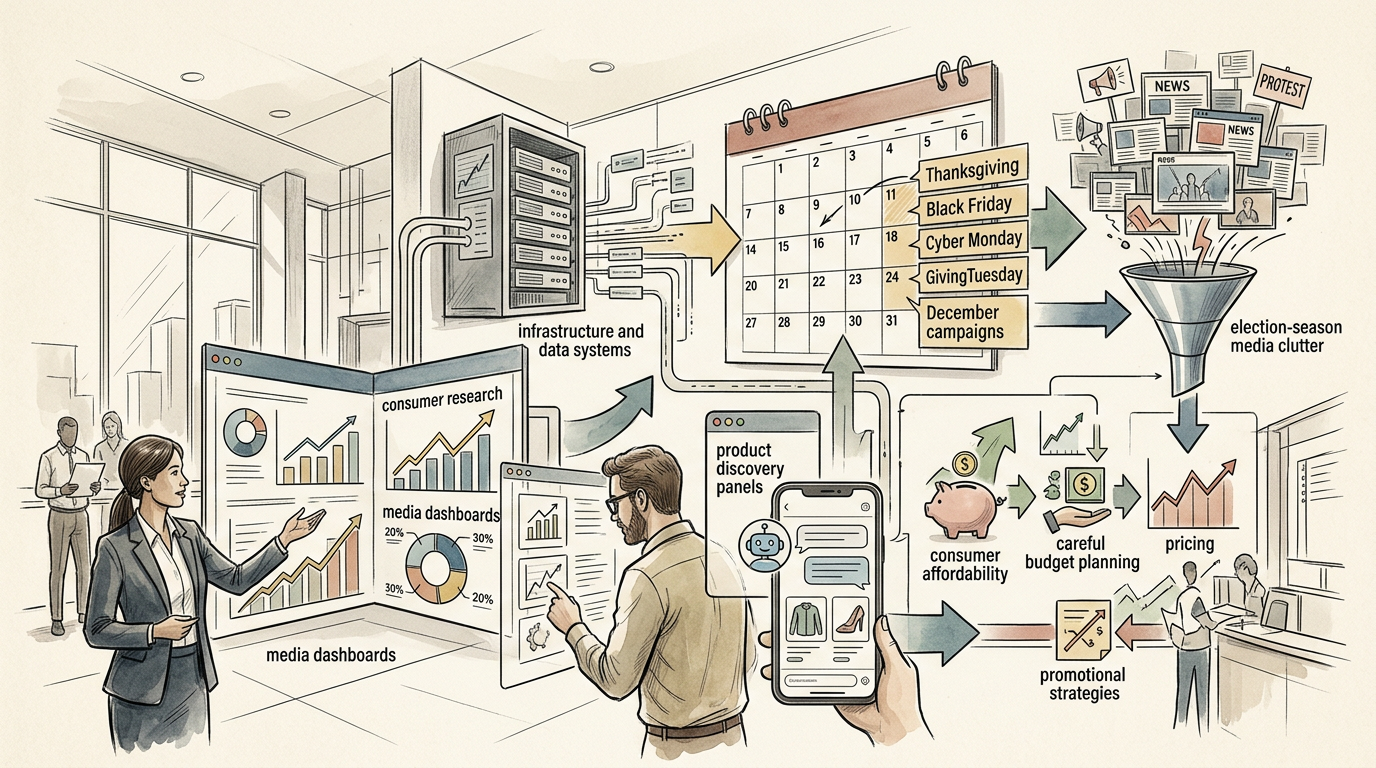
The advertising business entered November with a revealing contradiction. Retailers are developing AI assistants that can help customers shop without browsing conventional storefronts, yet those same storefronts support one of digital advertising’s most valuable businesses. Meanwhile, the midterm elections exposed the scale and changing composition of political media spending, and new consumer research suggested that Americans remain acutely sensitive to prices even as sentiment improved. For marketers entering the holiday peak, these developments have immediate consequences for media allocation, product discoverability, measurement and promotional strategy.
The Week in Review
Shopping agents confront the retail media business model
A Reuters examination published November 4 explored a potential collision between AI shopping agents and retail media. Amazon and Walmart together account for an estimated 88% of the $74.4 billion U.S. retail media market, according to figures cited in the report. If consumers delegate product searches and transactions to assistants, they may spend less time viewing sponsored placements on retail sites and apps. Morgan Stanley estimates that agents could handle 10%–20% of U.S. e-commerce spending by 2030, a forecast rather than an observed market share.
Amazon and Walmart are taking different approaches to outside agents. Amazon has resisted some third-party automated shopping access, while Walmart is enabling controlled agent connections. The distinction matters because retailers have competing incentives: make shopping easier while preserving advertising revenue, customer relationships and transaction data. Reuters also notes that retail media continues to grow and that Amazon has not yet seen a material advertising effect from shopping agents. A future disruption should not be mistaken for a present collapse.
Why it matters: Commerce teams should improve structured product information, availability, delivery promises, reviews and other attributes that automated assistants may use to compare offers. Media planners should establish a baseline for retail media performance now, before shopping interfaces and attribution paths change. This deserves testing, not a sudden wholesale budget transfer.
Amazon brings sponsored products into shopping-by-text conversations
On November 6, Digiday reported that Amazon introduced an invite-only U.S. shopping-by-text experience. Customers can message an Alexa Shopping contact to research, reorder and purchase products. Sponsored Products placements are expected to appear in some conversational replies, initially without additional charges to participating advertisers, while purchases completed autonomously by the agent remain ad-free.
The format makes an important distinction visible: advertising may be inserted when a shopper is considering options, but may have fewer opportunities to appear when an assistant acts on an established instruction. A conversational recommendation is also a different creative surface from a search-results grid. Product relevance, trust and the clarity of the answer could matter more than conventional display design.
Why it matters: Brands should monitor eligibility, placement reporting, disclosure and conversion measurement as access expands. Product feeds and retail search campaigns need to be evaluated for how they translate into conversational recommendations. Because the initial rollout is limited, the sensible immediate action is preparation and observation rather than forecasting large incremental sales.
The midterms reveal how heavily political campaigns depend on broadcast and connected television
The November 3 elections concluded an enormous political advertising cycle. AdImpact’s election-day dashboard, using data through November 2, put total spending at approximately $11.87 billion. Broadcast accounted for about $5.84 billion, connected television $2.61 billion, digital $1.78 billion and cable $1.27 billion. These figures reflect the vendor’s tracking methodology and should not be conflated with platform-specific totals or all political expenditures.
A Washington Post analysis of political creative in competitive races found that economic concerns dominated campaign messages, with different emphases on living costs, health care, immigration, public safety and corruption. Political advertising offers a large, imperfect natural experiment in message repetition, geographic targeting, channel concentration and audience fatigue. Its spending totals alone do not establish which messages persuaded voters.
Why it matters: Commercial advertisers in contested markets should review Q4 media delivery for displacement, inflated rates and frequency anomalies during the election period. Agencies can now compare actual post-election inventory conditions against the pricing assumptions built into holiday plans. Researchers should separate creative prevalence, paid reach and persuasion outcomes rather than treating them as interchangeable.
Consumer sentiment improves, but affordability still shapes purchase decisions
The University of Michigan’s preliminary November survey, reported by Reuters on November 6, showed sentiment rising to 51.0 from 48.0 in October. One-year inflation expectations eased from 4.7% to 4.3%, while longer-term expectations moved from 3.5% to 3.4%. The improvement was uneven: consumers with larger stock portfolios reported a decline in sentiment, and many respondents continued to identify high living costs as a serious concern.
This is a reminder that a better monthly confidence reading does not automatically translate into more discretionary spending. Holiday shoppers may remain responsive to price comparisons, installment options, delivery certainty and visible value even if their outlook becomes marginally less pessimistic. The survey is a measure of attitudes, not a direct count of transactions.
Why it matters: Holiday marketers should test value propositions and pricing claims against actual conversion and basket data. Avoid using a single sentiment headline to justify either aggressive discounting or optimistic demand assumptions. The final November sentiment release later this month will help establish whether the improvement persists.
Meta’s acquisition signals continuing investment in agent infrastructure
On November 4, TechCrunch reported Meta’s acquisition of Conductor, a startup focused on parallel AI coding agents. The acquisition is relevant to the broader marketing technology environment because platforms are investing in systems that can execute multi-step work rather than simply generate individual responses. It does not, by itself, constitute an announced new advertising product or demonstrate that agent-based campaign management is ready for general deployment.
Why it matters: Marketing leaders should distinguish between infrastructure investments, product demonstrations and tools that have passed operational tests. Before delegating campaign changes to agents, organizations need clear permissions, audit trails, human review rules and error-recovery procedures. The relevant question is whether a system reliably completes an accountable workflow, not how many agents appear in a demo.
Action-Worthy Developments Versus Background Noise
The immediate priorities are practical: audit product data for agent-mediated shopping; document the measurement questions raised by conversational sponsored placements; reconcile political-season media delivery; and recalibrate holiday messaging against evidence of continued affordability pressure. These tasks can affect campaigns already running or entering their final production stages.
Long-range projections about the percentage of commerce that AI agents might control are useful scenarios, but they remain projections. Corporate acquisitions involving AI infrastructure may indicate direction without producing a usable marketing capability today. Treat both as inputs to planning, not as reasons to abandon established channels before evidence warrants it.
What to Watch: November 9–15
The ANA Multicultural and Inclusive Marketing Conference runs November 9–11 in Los Angeles. Watch for concrete case studies demonstrating how cultural knowledge translates into creative effectiveness, audience understanding and business results, rather than generic declarations about authenticity. The ANA’s events calendar also lists analytics and data science programming and additional practitioner sessions this week.
The holiday retail calendar is entering its last major preparation stretch before Thanksgiving. Watch whether retailers bring Black Friday offers forward, how they explain price guarantees and returns, and whether AI-assisted discovery becomes visible in shopping journeys. Election-related inventory should also begin normalizing, though local pricing and demand will vary.
The Next 30 Days: November 9–December 9
| Date | Event or planning milestone | Marketing implication |
|---|---|---|
| Nov. 9–11 | ANA Multicultural and Inclusive Marketing Conference, Los Angeles | Cultural research, inclusive creative and professional development. |
| Nov. 10–12 | Adobe MAX 2026, Miami Beach | Review creative-production and AI workflow announcements against real team needs. |
| Nov. 11 | Veterans Day (U.S.) | Consider tone and appropriateness of commemorative messaging; some services and institutions operate differently. |
| Nov. 12 | ANA/AEF Silicon Signals: The Future of Intelligent Marketing, San Francisco | Practical AI marketing education. |
| Nov. 17 | ANA/AEF From Metrics to Momentum measurement summit, Minneapolis | Measurement practices and professional learning. |
| Nov. 20 | Final November University of Michigan consumer sentiment reading | Check whether holiday confidence and inflation expectations confirm the preliminary improvement. |
| Nov. 26 | U.S. Thanksgiving | Service messaging, brand sensitivity, fulfillment schedules and promotional handoff. |
| Nov. 27 | Black Friday | Conversion, inventory, pricing integrity and real-time creative optimization. |
| Nov. 30 | Cyber Monday | E-commerce capacity, retail media performance, paid search and retention capture. |
| Dec. 1–3 | Digiday Programmatic Marketing Summit, Nashville | Programmatic buying, measurement and platform strategy. Confirm details with organizer. |
| Dec. 2 | GivingTuesday | Nonprofit fundraising, cause partnerships and donation-flow readiness. |
| Dec. 4 | Preliminary December consumer sentiment reading | Early indication of post-Black Friday consumer mood. |
| Dec. 4 evening–12 evening | Hanukkah | Relevant community outreach, retail fulfillment and culturally appropriate creative. |
| Dec. 9 | 30-day outlook endpoint | Review campaign pacing, remaining shipping cutoffs and December media commitments. |
Event dates and programs can change; consult organizer pages before travel or registration.
Seasonal and Holiday Outlook
Thanksgiving, Black Friday and Cyber Monday
With Thanksgiving on November 26, Black Friday on November 27 and Cyber Monday on November 30, marketers have little room left for structural campaign changes. Focus on verifying promotional rules, product availability, landing-page performance, checkout reliability, customer support capacity and return policies. Price-sensitive shoppers need transparent savings claims and dependable delivery information. Brands should distinguish genuine discounts from inflated reference prices and make offer terms easy to understand.
GivingTuesday and December holidays
GivingTuesday on December 2 gives nonprofits and mission-aligned organizations an important fundraising moment immediately after the retail promotion peak. Donation pages, matching-gift claims, receipts and email journeys should be tested in advance. Hanukkah begins the evening of December 4 this year, making early December especially relevant for brands with established relationships to Jewish communities. Cultural relevance should arise from real audience understanding and appropriate products or services, rather than generic holiday imagery.
Across the Americas
Holiday planning across the Americas requires local calendars and purchasing behavior, even when platforms and creative systems are shared. U.S. Thanksgiving and Cyber Monday influence cross-border commerce, but promotions, shipping windows, currencies and local observances differ across Canada, Mexico, Brazil and other markets. Regional teams should validate localized offers, consumer protections, translation, tax treatment and fulfillment capacity before reusing a U.S. campaign unchanged.
Looking beyond the promotion peak
December marketing should not end at conversion. Build post-purchase communication, service recovery, returns, loyalty and customer feedback into the plan now. Retailers and brands should also document what happened during agent-assisted discovery and conversational shopping tests, since these findings may shape 2027 product information, search and retail media strategies.
What It Means for the Industry
The most consequential shift this week is the possibility that shopping, recommendation and advertising will increasingly happen within the same AI-mediated conversation. That future is still emerging, but Amazon’s early texting experiment makes it tangible. At the same time, the election demonstrated the continued scale of conventional media, and consumer research showed why persuasive value communication remains central to commerce.
For advertising and marketing professionals, the next step is disciplined adaptation. Improve the data that describes products, scrutinize where paid messages appear, protect measurement quality and keep consumer economics at the center of holiday planning. The industry has plenty of predictions about what AI will eventually replace. The more useful work is determining what can be measured, improved and responsibly deployed today.
Sources and Further Reading
- Reuters: AI shopping agents and retail media, November 4
- Digiday: Amazon shopping by text, November 6
- AdImpact: 2026 election-day advertising data
- The Washington Post: 2026 campaign advertising analysis
- Reuters: November consumer sentiment, November 6
- TechCrunch: Meta acquires Conductor, November 4
- ANA: Upcoming events
- ANA: Multicultural and Inclusive Marketing Conference
- ANA Educational Foundation: Practitioner events
- Adobe MAX
Leave a Reply